Monday, May 10, 2010

near Kimberton, Pennsylvania

In the farmland near Kimberton, Pennsylvania, (beyond Valley Forge) there is mostly open farmland, with patches of trees lining pastures and agricultural fields - a very different habitat from my home in southeastern Vermont but with many similar birds ... a few samples of the birds near my daughter's home ...

Eastern Bluebird ...


Baltimore Oriole ...


On the edge of an old farm pond, Solitary Sandpiper ...


... and in the narrow band of woods next to her home, several Wood Thrush singing in the morning and evening - such a delight to hear the flute notes of this wonderful songster ...


Also, a grandparents day with our grandson, and a soccer game, Mother's Day brunch with the mothers of my grandchildren and their mother. Next up ... a few days of birding in Cape May. It's just one thing afgter another -life can be tough!

Good birding!

Saturday, May 08, 2010

Birding in Vermont - the Challenge

Several years ago, I did a big day in late May with a couple of friends. Our goal was to find as many birds as possible within the boundaries of Windham County. We camped at Grout Pond and began the day about 5am, though in the earlier hours of the morning two of us heard the Barred Owl calling. We ended the day at 9pm in downtown Brattleboro listening to the Common Nighthawk hunting overhead. In the intervening hours, we traveled 125 miles. We roamed from the highlands of Somerset to the farm land of Vernon to the wetlands of Herrick’s Cove. We had a few small spots on the edge of boreal forest. We had plenty of temperate forest, both mature and young, brushland in transition, beaver ponds, marshes and mudflats, grassland and farmland, parking lots and neighborhoods. In other words, we visited many different habitats.

We knew we would miss some species. We did not get to the mountain tops, so we had no chance to count Bicknell’s Thrush or Blackpoll Warbler. We also missed some common species like Rose-breasted Grosbeak (seen the next day in my back yard) and Wild Turkey. There were at least twenty-five species that are present in the county during the breeding season that we had missed.

Even so, our total at the end of the day was 111 species, including 21 warblers, the jewels of summer birding in the east. It was a day of really good birding. But, we had worked at it.

We live in an area that has a wonderful variety of bird life from mid-May through August. There is always the potential for really good discoveries. But, before you invite a friend from a bird impoverished city to come to Vermont for good birding, you need to make it clear to that friend that Vermont is a destination for birds, not necessarily a birding destination.

There are a number of places in the East that are birding destinations - place where birders can go and almost be assured of seeing a good variety, often without a great deal of efforts. A few of those places are “migrant traps.” One of the best known is in northwestern Ohio along the southern shore of Lake Erie (Magee Marsh Wildlife Area, Ottawa NWR, and nearby areas). Northward moving birds pile up, waiting for favorable tail winds to help them across the water. Bird photographers line the boardwalks and trails because this is the best place for multiple opportunities to photograph multiple song bird species - especially warblers. Some May soon, I hope to be one of those pilgrim bird watchers who visit this birding destination.

The Cape May peninsula, bounded by the Atlantic Ocean and Delaware Bay and pointing south, and with large expanses of many different habitats, collects migrating species needing to rest and refuel on their journeys. It is a premier birding destination, attracting birders from around the world.

As migrating birds move toward their breeding grounds, they tend to concentrate along flyways - typically broad river valleys. The Connecticut River Valley is our flyway. If you are lucky, you may occasionally experience a “fall-out” where you have many migrants and perhaps considerable variety. A fall-out is when a migrating flock comes down in the morning to feed after their night flight. I remember one late April day when my timing was just right; in every direction there were Yellow-rumped Warblers resplendent in their breeding plumage. Mixed among the Yellow-rumps were Palm Warblers, Ruby-crowned Kinglets, and Blue-gray Gnatcatchers.

Along the Connecticut River, you may also see birds that don’t really “belong” in this river valley habitat, such as the Magnolia Warbler reported last weekend; it prefers low dense shrubbery and nests in areas of short young spruce. Or the White-eyed Vireo also reported last weekend; it was a hundred miles north of the northern edge of its breeding range.

By the time the birds reach us, they are beginning to disperse across the countryside. Their flyways are dissolving and they are heading toward their favored breeding habitats, looking for their old territories or exploring new territories to claim as their own. And that means, for most species, that the bird watcher has to go to the appropriate habitat in order to see particular birds, and then patiently look for them.

There are some exceptions. Our bird feeders are a specially created habitats, and may provide the opportunity to observe closely some species. For many birders, the Evening Grosbeak is a coveted species, and they will target this species whenever they venture into the northern woods. I am fortunate to live at enough elevation and with plenty of nearby woodlands that are favored by these birds. I have a flock of twenty that feed daily at my feeders. My photographic file for the handsome and beautiful  Evening Grosbeak contains dozens of excellent photographs. However, my neighbor who lives less than a quarter mile from me and in almost identical habitat, came to my yard to listen to these birds sing.

Changing focus, another target species for many birders is the Least Bittern, a shy and elusive wetland wader.  I have had mere glimpses of this bird in the north. But the artificially created park-like wetlands of several Florida waste-water treatment facilities almost guarantee superior opportunities to observe the bittern. These wetlands are to the marsh-bird equivalent what my backyard feeders are to the finches.

Unfortunately, the best places for marsh birds in the north are the National Wildlife Refuges, where meager visitor trails and observation points seem designed to frustrate engagement with any wildlife much less provide opportunity to see birds.

Vermont is not a migrant trap. Our state is near the northern limits for the flyways. As the birds move northward for the breeding season, they are scattering across the countryside. You can see a lot of different birds just within the confines of Windham County. But you may have to work at it. That is why local birders call May the month for “warbler neck” - the painful condition which result from looking upward while holding binoculars. You search the tree tops for extended periods of time, trying to find the tiny little bird flitting among the emerging leaves on the thin branches. It pauses on a branch. The sunlight strikes it. Its breast flames with fire-like brilliance as he lifts his head and trills his song. Blackburnian Warbler!

... and the birding is good!

Thursday, May 06, 2010

Good Birding!

Purple Finches in the backyard are at the peak of their wine red plumage ...


Rose-breasted Grosbeak returned to the backyard on Tuesday ...


Along the Connecticut River flyway, on Wednesday morning I happened on a fall-out of American Redstart ...


In the surrounding trees, Warbling Vireos were playing hard to find, but singing so they would not be hard to find to the right companion ...


Likewise the Yellow Warblers were busy singing when not chasing other males ...


A redundancy to add - Good Birding!

Monday, May 03, 2010

Herrick's Cove Wildlife Festival

Herrick's Cove Wildlife Festival was on Sunday, Began with intrepid Don Clark leading a large group on a bird walk. Many migrants are returning, including Baltimore Oriole, Field Sparrow, Eastern Kingbird, Warbling Vireo - and plenty of very enthusiastic Yellow Warblers, looking resplendent in their spring attire. The boys were not much interested in my attempts to phish them closer; they were too busy with the early efforts to keep other males away from their territory, wherever that may eventually be - singing with enthusiasm and chasing one another.


The festival has many types of wildlife activities and displays for the family. Kent McFarland from Vermont Center for Ecostudies set up mist nets and did bird banding, although few birds cooperated by flying into the nets. The few that did provided visual aid to Kent's engaging explanations of the process of banding, as for example, this very handsome Gray Catbird ...


... although he/she appears to have some different opinions about the whole affair.


At Allen's Marsh, a pair of Virginia Rails were calling back and forth. One provided a brief view.


 Note: the Wildlife Festival has been held on the first Sunday in May for the last eleven years.

Good birding!

Saturday, May 01, 2010

Eurasian Teal

Note on Photos: The photo of the Eurasian Teal in flight was given to me by Hilke Breder who saw the bird at Herrick's Cove on one of those rare occasions when it was close (relatively) to viewers. It is used with her permission. I digiscoped the 2 photos of the Eurasian Teal swimming in 2007. The Green-winged Teal photos were taken in Cape May and Texas last fall using my new equipment

Two weeks ago I was at Herrick’s Cove, the designated “Important Bird Area” north of Bellows Falls where the Williams River joins the Connecticut River. I walked all the way through the picnic area to the small sandy spit which points south. There were six birders crowded along the narrow path. The crowding was increased by the tripods and scopes set along the path, and bodies hunched over, staring through the eyepieces.

A flock of Green-winged Teal had been present for the previous couple of week. Off and on, a Eurasian Teal had been seen among the flock of Green-winged Teal. Herrick’s Cove always has the potential for good birding, so this was the third times in recent days that I had been there. I had missed the Eurasian Teal on my earlier trips.

First, some background on the Green-winged Teal: This teal is our smallest dabbling duck. Dabbling ducks feed by turning themselves upside-down as they feed on plant life beneath the water’s surface. Mallards, American Black Ducks, and Northern Pintails are among the most familiar “dabblers.” Canada Geese, though not ducks, are dabblers. The Green-winged Teal has a length of 14 inches and weighs about 12 ounces. Only the Bufflehead, a diving duck, is smaller (L. 13.5 inches). The teal is slightly larger than the Rock Pigeon (L. 12.5 inches, W. 9 ounces), and significantly smaller than the American Crow (L. 17.5 inches, W. 1 pound), although comparing a duck with a song bird is like comparing apples and broccoli.

Green-winged Teal are common and widespread. Like most waterfowl, they are most often observed swimming on water, usually with other ducks, usually at a distance, and usually through binoculars or a scope. All of these conditions make it difficult to wrap the mind around its small size. Several years ago in southern Texas during the winter, I walked along a boardwalk in a marshy refuge. Green-winged Teal were feeding in the water below us, not fifteen feet away. I still remember clearly our reaction: “They’re so tiny!”

The drake Green-winged Teal is a handsome bird; he has a chestnut head with a broad green ear patch. When swimming, you can see a prominent, vertical white stripe near his shoulder. The Eurasian Teal looks identical, except that the drake does not have the vertical stripe. Instead he has a horizontal white stripe along the wing. The stripe is also apparent when he flies, if you are close enough and quick enough to notice. The two birds are subspecies of one another, though there is considerable discussion about whether they should in fact be separate species.

Serious birders pay attention to presence of subspecies, so that they are prepared to add a new tick to their life lists when the taxonomists finally recognize what they (the birders) have suspected - that many distinctive subspecies should have species status.

In Europe, this bird has been known as the Common Teal, and more recently has been renamed the Eurasian Teal. If I were a visiting birder from Great Britain or the Netherlands and had gone looking for the teals in Herrick’s cove last week, I would have been looking for two birds for my North American list. I would have been looking for the Eurasian Teal (Anas crecca) and the Green-winged Teal (Anas carolinensis). Under the prodding of the Association of European Rarities Committee, all of Europe recognizes these ducks as two distinct species.

Not so on our side of the pond. The American Ornithological Union (AOU), which determines taxonomy, has refused to take up the split of this (or these) teal(s). The American Birding Association (ABA), which determines the official bird list for North American birders, follows the AOU, which makes for North American consistency if not world consistency.

Regardless of the species status of these teal, tracking vagrant species and/or subspecies assists in tracking the movement and breeding ranges of many birds. The Eurasian Teal is a case in point. The first record of this duck in Vermont was at Herrick’s Cove in 2007. This year’s drake Eurasian Teal was the third or fourth time it has been recorded. Some questions: Is this year’s visiting teal the same bird traveling with the same flock of Green-winged Teal, or a different bird? Are we documenting a change in movement and range, or the same stray and lost bird? Or have different birds gotten lost and joined their North American cousins in their travels? And does this say something about breeding range? I don’t think anyone has any answers ... yet. Science begins by asking questions and then looks for the answers, hoping that one or two answers may appear among the many new questions that keep arising.

Occasionally the waterfowl at Herrick’s Cove are close. Most of time, binoculars and a scope are needed to get any kind of a decent look. As I was walking toward the spit where the birders had gathered, a power boat came speeding into the cove, sending all of the waterfowl into the air. When they settled down, they hid themselves in the interwoven channels and along the distant shore of the Cove below the railroad bed. Tthey could just barely be seen swimming in and out of view.

These were serious birders, and they studied the distant waterfowl intently until they found a flock of some thirty teal. Then they strained to watch the swimming drakes, most of whom seemed paired with a hen. A few times a drake could be seen displaying, whipping his head up and backward. The viewers paused on each drake, saw the vertical white stripe, then moved their attention to the next drake ... until someone announced, “Got him!”

And sure enough, there was the drake Eurasian Teal, displaying with whiplash enthusiasm for any interested hens. Few details of his plumage were visible - just a hint of the chestnut head and green eye patch - but the horizontal white stripe along his wing was clearly visible.

The sighting on that day was what birders describe as a BVD - better view desired. We don’t always get the great look at a bird that we want, so we keep looking. Birders are sometimes a strange and obsessive bunch. But they live in anticipation, and function on hope, and rejoice in those moments of fulfillment. From what I have seen of life in general, it is a good way to live.

Good birding!

Thursday, April 29, 2010

Today

Few new arrivals today, but old friends are always welcomed. At Bennett Meadows in Bernardston, MA, there were 8 Wood Ducks, and at least two Hooded Merganser hens. Here's one of those hens ...


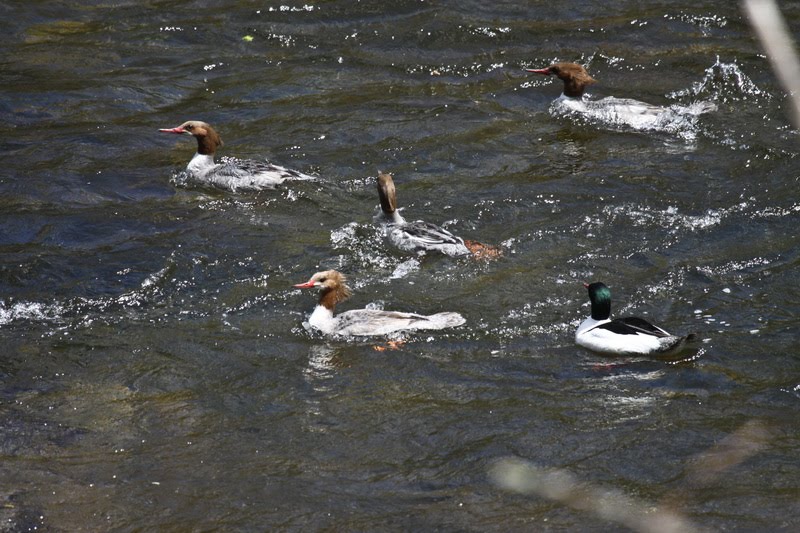
Along the West River, a single Common Merganser drake was guarding his harem of eight hens, though I only got four of the hens in this picture. Some appeared a bit reticent toward him ...


Then they all got spooked by the long thing that I was pointing at them ...


But the highlight of the morning birding had no feathers. Along the railroad tracks near the boat launch on the Connecticut River, this mink came up the bank and started to cross the trestle ...


... then it became aware of some odd creature on the other side. Curiosity did not get the better; the mink retreated ...


The sighting of the mink sent me to resources about this mammal. Kaufman's Mammal Guide says that it is fairly common in marshes, rivers, & lakes. It sometimes appropriates the use of a muskrat lodge for its den, "often after killing and eating the previous owners."  So, behind that sweet face is the soul of a foreclosure banker.

Good birding!

Wednesday, April 28, 2010

Wednesday

From the West River in Brattleboro - Common Merganser ...


... and from the backyard, a House Finch, usually expected in the town neighborhoods along the Connecticut, but an uncommon visitor in my village.


Good birding!

Saturday, April 24, 2010

Evening Grosbeak

When I lived in eastern Pennsylvania, I saw Evening Grosbeaks almost every year. Two or three times each winter, a flock of ten to fifteen grosbeaks appeared at the feeders. They gorged on my seeds, emptied the feeders, then hurried on to another yard with a full feeder. A few weeks later, they reappeared with the same results.


A couple of Evening Grosbeaks visited my South Newfane home during this past winter, but their visit was passing and brief. Then about three weeks ago a dozen birds appeared, coming and going to the feeders throughout the day, with much the same result that I experienced when I lived further south. But they did not move on. Most of them are here to stay for the summer. If the pattern of the last few summers continues this year, two to four pair will be nesting somewhere in the mature trees nearby. They will be feeding on my sunflower seeds, emptying the bulk feeders every few days. Young will be fed on the branches of the surrounding maple trees, and taught how to feed themselves on the platform feeder.

I have no complaint. Friends in Brattleboro consider themselves fortunate when they have one or two visits by the Evening Grosbeak during a year. To the south, their presence is hit or miss. They may irrupt during the winter ... or not.

The late nineteenth century ornithologist, Elliott Coues wrote a flowery description of the Evening Grosbeak: “ a bird of the most distinguished appearance, whose very name of the ‘Vesper-voiced’ suggests at once the far-away land of the dipping sun, and the tuneful romance which the wild bird throws around the dimming light of day; clothed in striking color-contrasts of black, white and gold, he seems to represent the allegory of diurnal transmutation; for his sable pinions close around the brightness of his vesture, as night encompasses the golden hues of sunset, while the clear white space enfolded in these tints foretells the dawn of the morrow.”

The florid prose is the result of the Evening Grosbeak having been discovered for science in the far Northwest, the land of the setting sun. In the 1830s when it was first studied, it was abundant in the Columbia River basin. At that time, it was almost exclusively a western bird.


The Evening Grosbeak has been extending its range eastward since the late 1800s. A comprehensive study published in 1940 found the eastern range of the Evening Grosbeak distributed along the U.S.-Canadian border, mainly in the area of the Great Lakes, but with some suggestion that it may have been breeding in New England. The first confirmed breeding in Vermont was in Woodstock in 1926, the second record was 1953 in Londonderry. Since then, it has become increasingly regular during the summer breeding season.

The Evening Grosbeak’s scientific name used to Hesperiphona vespertina. The name derived from the Greek, referring to the Hesperides, “Daughters of the Night,” who dwelt on the western edge of the world, the place of the setting sun. Both parts of the scientific name, as well as the common name, suggest that this bird sings in the evening. As the light is fading away, the Evening Grosbeak acknowledges the vesper hour with his song.

This sounds wonderful, even poetic, but it is wrong. The Evening Grosbeak will sing at any hour of the day, particularly during this season when pairing and mating is foremost in the hormonal dictated life cycle. I hear them singing in the trees when I go out for the paper at first light. They are singing in the top branches when I get the mail in the late morning. They are singing at lunch time, tea time, and supper time.

So, in spite of its name, the Evening Grosbeak will sing at any time of the day ... if you are willing to concede that the sound he is making is actually a song.

John James Audubon quotes another early naturalist’s description of the Evening Grosbeak’s song: “they are remarkably noisy during the whole of the day, from sunrise to sunset. They then retire quietly to their roosts in the summits of the tall pines .... Their ordinary voice, when they are engaged in procuring food, consists of a single rather screaming note, which from its tone I at first supposed to be one of alarm, but soon discovered my error. At other times, particularly about mid-day, the male sometimes selects a lofty pine branch, and there attempts a song; but it is a miserable failure, and he seems conscious of it, for he frequently pauses and looks discontented, then remains silent sometimes for some minutes, and tries it again, but with no better success ... The song, if it may be so called, is to me a most wearisome one: I am constantly listening to hear the stave continued, and am as constantly disappointed.”

I cannot argue with this critical appraisal of the Evening Grosbeak’s song. It does not amount to much.


The common name, “grosbeak,” refers to its large beak, from the French for “big.” While eating breakfast, I watched a female on the feeder hanging by the kitchen window; deftly she opened one sunflower seed after another with her big (“grosse”) beak.

In spite of the grosbeak’s common name, the Evening Grosbeak is not closely related to the Rose-breasted Grosbeak. The Rose-breasted is in the cardinal family. The Evening Grosbeak is in the finch family which includes the Purple and House Finches, goldfinches, crossbills).

The Evening Grosbeak is now in the Genus, Coccothrautes, meaning “shatter kernels.” The Genus also includes the European Hawfinch (which sometimes strays to western Alaska) and the Central American Hooded Grosbeak. The wide distribution of the three Coccothrautes species raises intriguing questions about how three close relatives became so geographically separated, and why, given the separation, there are only three close relatives. It’s a mystery to me, and probably to science as well.

The Evening Grosbeak is a strikingly handsome bird, and I am delighted that they spend the spring and summer with me - all the more so since research suggests that the population is in serious decline. The decline may be over 75% in the last 40 years. Based on data from Project Feeder Watch, they are completely missing from many areas where they were
common as recently as the early 1990s.


The cause of the Evening Grosbeak’s decline is unknown. One possibility is that they are not moving as far south during the winter due to warmer winter temperatures. The decline might also be related to food availability. Hardwood tree seeds, a favorite natural source of food of Evening Grosbeaks, may be less common due to in forestry practices in Canada. Finally, Evening Grosbeak numbers in the East may simply be stabilizing after their colonization of the north woods east of the Great Lakes.

Gotta go replenish the sunflower feeders and put them out for the day - Good Birding!

Friday, April 23, 2010

On Time Arrivals

Spring came early to Vermont, which caused everyone to feel as though the migrants should be returning also. Not so ... but they are right on time. Here are three of the favorite early arrivals which I tracked down this morning.

Blue-gray Gnatcatcher ...


Palm Warbler ...


Ruby-crowned Kinglet ...


... also, three reasons why the next three months provide the best birding of the year!

Good birding!

Saturday, April 17, 2010

The Sexiest Time of the Year

Throughout the winter months, I had four Downy Woodpeckers which visited my suet feeder every day: two males and two females. I assumed they were from the two pairs which had nested in the neighborhood last summer. One pair nested somewhere upstream, the other somewhere downstream. When they fledged young, the parents came to the feeders, chased by the fledglings. The young were fed, and eventually learned to feed themselves. Each pair of Downy Woodpeckers raised two broods. They were busy parents.

I don’t know if Downy Woodpeckers maintain a pair bond through the winter. Probably not, since mortality is high among small birds, and survival of oneself is more important than a mate. Sometimes during the cold months I would see two males, or two females, or a mixture of three birds, and sometimes all four. It was foraging behavior I observed; if there was any pair bond which remained, it was incidental.

Whatever the winter relationships may have been, they are different now. A few days ago I watched three of these small woodpeckers making a racket in the trees behind my home. On one occasion I clearly saw two males and one female. (The male has a red spot on the back of his head; the female does not.) The males were chasing the female, while simultaneously trying to chase off the other male. It was noisy and chaotic.

Given the two pairs I had last summer, and their presence through the winter, there were several possible scenarios. Perhaps there was an interloping male trying to mate steal from one of the wintering males. Perhaps one of the wintering males had been widowed and coveted his neighbor’s wife. Perhaps there was an attempt at involuntary wife swapping. Whatever precisely was going on, it was marvelous entertainment.

Now on to another of my common backyard birds, the Black-capped Chickadee. I never figured out the numbers or dynamics of the wintering chickadees. They moved through the feeders in loose flocks, but feeding as individuals. They are still feeding as individuals, but there are new dynamics at work. Last weekend I watched a half dozen or more chickadees as they hurried through the tree branches and bushes, made quick trips to the bird feeder, and pounded open the sunflower seeds for the tasty meat inside. As one of these tiny birds sated its appetite, it flew off, but not alone. A second chickadee flew after the first, followed by a third. They all swirled as a fourth joined the chase, and then a fifth. The boys were in hot pursuit of the girls.

When not chasing one of the girls, or one another, the chickadee boys are boasting their prowess. “Feee-beee” or “peee-weee” go back and forth from the trees as the male chickadees sing their genetic virtues.

All the birds are doing it.

Blackbirds for example: until the orioles (which are blackbirds - Icterids) finally arrive, there is nothing musical in blackbird songs, but the blackbirds sing anyway, stretch and strut, spreading tails and wings, all in an effort to impress the females.

The phoebe is doing it, with his maddeningly monotonous “song” which he repeats from dawn to dusk, with a wag of his tail accompanying each so-called song. “Phoe - bee” (tail wag) ... “phoe  - Bee” (tail wag).

Older generations of writers called it the family season, or if they were being bold, the love season. They said it was the time for domestic duties, for solicitousness to one’s mate, followed by parental devotion to one’s offspring.

Today we are less circumspect. What is going on is about sex. Getting it and getting as much as possible. Many  birds form a social bond during the breeding season. They pair monogamously to nest build and raise young. DNA studies are showing that social monogamy is different from sexual monogamy. Few birds are sexually  “faithful” to the mate. The eggs in the nest of a chickadee pair may have been fertilized by the male of the pair, or not. One or more other males may have had a fling with the female. The eggs may not have come from the female of the pair. Another female may have dropped an egg in her nest. Cowbirds consistently parasitize nests with their eggs. But sometimes even a chickadee female will drop one of her eggs in someone else’s nest. Perhaps she gets confused in the heat of the moment.

There are a lot species that don’t even make a pretense of forming any kind of a pair bond. The Red-winged Blackbird gathers as many females into his harem as he can, but I am sure the females sneak through the marshy reeds gathering as much genetic diversity for their young as they can. The Wild Turkey tom gathers a harem for a brief time, then the hens head off to incubate and raise the young without any further assistance from the strutting tom.

As Bob Engel explains in his article in the April newsletter of Southeastern Audubon, it is all triggered by sunlight. As the days start to get longer, physical changes are switched on. As the number of daylight hours increase, the internal evolutionary manual carried by the birds tells them they will likely survive winter and now it is time to insure the survival of the genes. In the male bird, his testes swell. Testosterone is released. He begins to sing. More testosterone is released. He becomes aggressive, defends his territory, and pursues females.

Physiological changes are also triggered in the female, because as the days continue to lengthen, she welcomes the pursuit. In many species, she selects a social mate who demonstrates good foraging ability and domestic skills to help with the young. She also gathers DNA for her young from as many sources as she can.

It is wild and raucous ... and all of the birds in our neighborhoods are doing it. More will be arriving soon to join the festivities.

It is as though the whole bird population has roared into puberty at the same time. Their hormones are raging. Can you imagine what downtown Brattleboro would be like if every, single person you saw was on the make. Not just some, but every one - the entire population - looking for assignations? The entire population strung out on new hormones? That is what is happening with our birds. It happens every year.

For the birds, Spring is the sexiest time of the year. For a bird watcher, it is the most entertaining time of the year.

Good birding!

LinkWithin

Related Posts with Thumbnails