Wednesday, June 12, 2013

Alcids & Tern - Machias Seal Island

Last week we traveled to the northernmost coast of Maine, known as “Down East” (see note at end of post). The purpose was a trip to Machias Seal Island, a fifteen acre patch of land located about ten miles southeast of Cutler, Maine, at the boundary between the Gulf of Maine and the Bay of Fundy.

The island is a bird sanctuary which hosts the major regional breeding colony of Atlantic Puffins and Razorbills. There are also smaller breeding populations of Common Murre, Arctic Tern, Leach’s Storm Petrel and Savannah Sparrow.

Machias Seal Island is a spot of land which every birder should visit at least once. This was my third trip, but my first trip with a good camera. It was a photographer’s dream! This is the first of several posts.

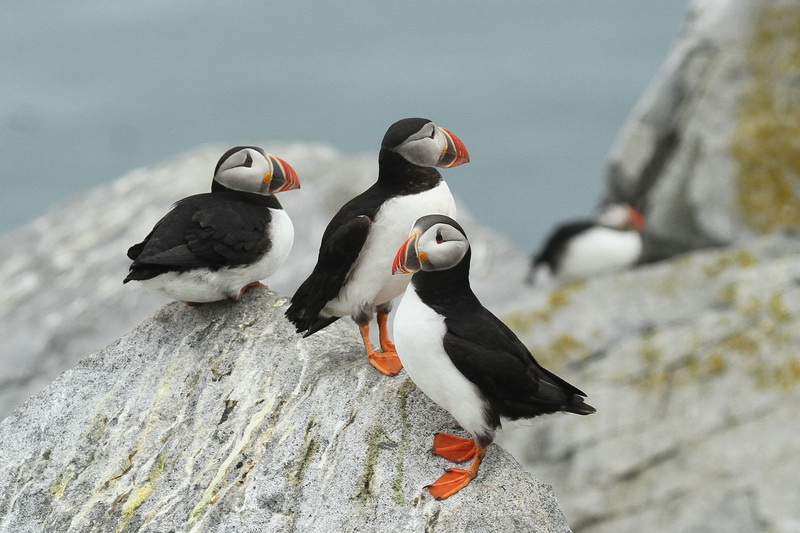
Alcids are a family of oceanic species which come to land only to nest. In the North Atlantic, the Atlantic Puffin is the icon of the Alcid family, a 12" package of charisma and charm ...

Atlantic Puffin
Atlantic Puffin
Atlantic Puffin (Razorbills in foreground)

The Razorbill is larger (17"), chunky, and thick-billed. If the bill were a nose, you would describe it as possessing Jimmy Durante proportions (older readers should remember him), or if you have a literary bent, of Cyrano de Bergerac proportions ...

Razorbill
Razorbills

Razorbills

Common Murres are less common on the island; these are sleek and handsome birds ...

Common Murre (aka Thin-billed Murre)
Common Murre
 Arctic Terns in recent years have had very limited nesting success on the island. Their nest is on the surface and in the open (we saw one egg in the grass close to our boardwalk). This tern nests in the far northern latitudes, and “winters” in the summer of the southern latitudes, making an annual round trip flight of some 24,000 miles. A champion traveler and graceful flyer barely does it credit ...

Arctic Tern
Arctic Terns

Note: Down East, The Magazine of Maine explains the origin of the term, "Down East" in New England: "When ships sailed from Boston to ports in Maine (which were to the east of Boston), the wind was at their backs, so they were sailing downwind, hence the term 'Down East.' And it follows that when they returned to Boston they were sailing upwind; many Mainers still speak of going 'up to Boston,' despite the fact that the city lies approximately 50 miles to the south of Maine’s southern border."

IF YOU GO - Machias Seal Island

Bold Coast Charter Company, Cutler, Maine - www.boldcoast.com - Captain Andrew Patterson is the only operator currently taking visitors to the island from Maine. He exceeded my best expectation: knowledgeable, personable, equally concerned for the safety and well-being of his passengers and the birds. (Link on website to accommodations in area)

Riverside Inn & Restaurant (East Machias - 20 minutes from Cutler) - www.riversideinn-maine.com comfortable B&B on the East Machias River. The restaurant was as good as any restaurant anywhere.

Good Birding!!

Monday, June 10, 2013

Flies - Butter, Dragon, Damsel

There are lots of winged creatures which attract the attention of the fraternity/sorority of binocular toters and camera pointers.

Here are a some in the "FLY" category, beginning with a few in my backyard ...

Viceroy
Viceroy

Pearl Crescent
Tawny-edged Skipper (note extended probosis

Tawny-edged Skipper (note the "curled" probosis)
A new area of exploration and learning for me are dragonflies and damselflies. Please consider these IDs to be tentative. If you can confirm or correct the IDs, your input will be much appreciated.

Blue Corporal
Northern Bluet

Blue Corporal - female (but very tentative ID)
An editorial comment: Butterfly guides are beginning to approach the usefulness and quality of bird guides. Not so the guides to dragonflies and damselflies. I have several, and they are exercises in frustration. Somewhere I hope there is a Peterson/Sibley/Kaufman for these fascinating creatures.

Good Birding ... or butterflying, dragonflying, or whatever!!


Friday, June 07, 2013

A Few Warblers

A few warblers have presented themselves for my camera in recent days. Here is a sampling - most are familiar, but never let it be said of the warblers that familiarity breeds ennui. They are exciting to a bird ...

The male Blackburnian Warbler defines warbler-neck while his mate is seldom seen. But this female was working the bushes along a woodland lane in Somerset ...

Blackburnian Warbler - female
 Chestnut-sided Warblers were actively engaged in pair forming last week, with jealously and coyness present in the males and females respectively ...

Chestnut-sided Warbler - male
Chestnut-sided Warbler - female
Two familiar, common, but always entertaining warblers. First, the Black-masked Rogue, officially (though boringly) known as the Common Yellowthroat ...

Common Yellowthroat - male
... and the Yellow Warbler.

Yellow Warbler - Male
Good Birding!

Tuesday, June 04, 2013

Winter Wren and others

One of the most difficult forest song birds to get a good sighting of is the Winter Wren, at least until last week when this gentleman, in the throes of his surging testosterone, proclaimed his immense qualities as a mate ...

Winter Wren
 I was mightily impressed with his ability to spill forth an almost endless stream of notes. It left me breathless, but was merely what is expected by the discriminatingh ladies of his species.

Winter Wren

A late, but always welcome, arrival in the alder swamps is the Alder Flycatcher. I've never quite understood some of the guidebooks as they offer confusing mnemonics of his call/song. Quite clearly I hear him saying - "Free beer!" - an offer which brings the girls rushing, and maybe a few old frat boys ...

Alder Flycatcher
Alder Flycatcher

The Blue-headed Vireo has given me any number of photo opportunities over the years, but few have yielded satisfying result ... until this gentleman hurried over to investigate by "phish" and posed as nicely as any photographer could wish.

Blue-headed Vireo
Blue-headed Vireo

And finally, the Eastern Phoebe is incessant with his "phoe-be" in my neighborhood, but it was also gratifying to see him check me out in an edge thicket somewhere in Dover ...

Eastern Phoebe
Good Birding!

Saturday, June 01, 2013

Rose-breasted Grosbeak - A Welcome Summer Resident

John James Audubon began his account of the Rose-breasted Grosbeak with these unusually poetic words describing his night encounter:

“One year, in the month of August, I was trudging along the shores of the Mohawk river, when night overtook me. Being little acquainted with that part of the country, I resolved to camp where I was; the evening was calm and beautiful, the sky sparkled with stars, which were reflected by the smooth waters, and the deep shade of the rocks and trees of the opposite shore fell on the bosom of the stream, while gently from afar came on the ear the muttering sound of the cataract. My little fire was soon lighted under a rock, and, spreading out my scanty stock of provisions, I reclined on my grassy couch. As I looked around on the fading features of the beautiful landscape, my heart turned towards my distant home, where my friends were doubtless wishing me, as I wished them, a happy night and peaceful slumbers. Then were heard the barkings of the watch-dog, and I tapped my faithful companion to prevent his answering them. The thoughts of my worldly mission then came over my mind, and having thanked the Creator of all for his never-failing mercy, I closed my eyes, and was passing away into the world of dreaming existence, when suddenly there burst on my soul the serenade of the Rose-breasted bird, so rich, so mellow, so loud in the stillness of the night, that sleep fled from my eyelids. Never did I enjoy music more: it thrilled through my heart, and surrounded me with an atmosphere of bliss. One might easily have imagined that even the Owl, charmed by such delightful music, remained reverently silent. Long after the sounds ceased did I enjoy them, and when all had again become still, I stretched out my wearied limbs, and gave myself up to the luxury of repose. In the morning I awoke vigorous as ever, and prepared to continue my journey.” (Birds of America, octavo edition, 1871.)


Audubon was enamored with the beauty of the Rose-breasted Grosbeak - both its song and its plumage. I can hardly disagreed. Of the two dozen or so species which regularly visit my feeders during the summer, the two summer grosbeaks, Rose-breasted (Cardinal family)  and Evening (Finch family), are the ones which arrest my attention every time they appear.

The plumage of both is stunning, though very different.  But if you add the respective songs into the mix, then I have to tip the balance in favor of the Rose-breasted Grosbeak.  The Evening Grosbeak hardly has a song worthy of the term. The Rose-breasted, by contrast, sings like a robin who has taken voice lessons. When you hear a robin singing with fewer pauses and with particularly clear, liquid phrases, check the tree tops for the Rose-breasted Grosbeak.


The male Rose-breasted Grosbeak is a handsome specimen. On his wings, back, and tail he presents a contrast of black and white. When I startle birds from my feeders with my sudden appearance, and see only a bold black and white pattern disappearing into the trees, I know that I have just scared him away.

But the breast is what catches the breathe. Beneath the dark, black hood covering the head, his breast is rose-red - a rose-red that often evokes the poetic, and even the tragic. The lower tip of the triangular rose-red often runs down toward the white belly, leading some to liken him to a jilted lover whose heart has been broken. His heart has been pierced by a cruel arrow, and he bleeds out his love.

From a harsher and more violent era, his folk name has sometimes been Throat-cut.

I prefer to imagine him a groom dressed for his wedding - tuxedo clad with a brilliant cummerbund to balance formality with gaiety.

All such imaginings are, of course, nonsense, although the nonsense prevails in the scientific name. The Rose-breasted Grosbeak is Pheucticus ludovicianus. Pheucticus, from the Greek, means “painted with cosmetics,” suggesting that his breast has been rouged; ludovicianus means “of Louisiana,” the area where the first specimen came from. The Rose-breasted shares its Genus with the western Black-headed Grosbeak.


In contrast to the male, the female Rose-breasted is a plain Jane. She looks like a big sparrow, or an oversized female Purple Finch.

Usually when a male is brilliantly attired and the female is plain, the male spends most of his time singing, continuing to boast his virtues and defend his territory. Domestic duties, particularly incubation, are left to the inconspicuous female. He may perhaps join in the feeding after the eggs hatch, but not necessarily.

The male Rose-breasted Grosbeak is unusual. He provides some help in building a flimsy nest and then shares in the incubation.  When sitting on the nest, he continues to sing. Protection of a nest typically depends upon keeping its location as secret as possible from predators; singing on the nest seems counterintuitive. Edward Forbush watched a male sing while on the nest: “When a hawk flew overhead he continued to sing, but so reduced the volume of the song that it seemed to come from far away, raising his voice again when the hawk had passed on. Singing on the nest and ventriloquizing are common habits of the male.”


“Grosbeak” means big beak, an adaptation designed to open large seeds. Watch the grosbeaks, finches, cardinals and other large beaked birds as they feed on your sunflower seeds. Adeptly they crack open the hard shell, extract the nutritious meat and drop the casings. Chickadees, titmice, and even Blue Jays, by contrast, take the sunflower seed to a branch, hold it between the feed, and hammer it open with their bills.

However, the adept use of this “big beak” adaptation apparently has to be learned. Bent, in his life history of the Rose-breasted Grosbeak, reports this observation of the male with his adult sized offspring: “The father then started to show it how to break open sunflower seeds. Perching beside his offspring on a branch, he cracked a seed, broke the kernel into pieces, and fed it to the young bird. He then gave it a whole kernel. Next, he pretended to give the fledgling an uncracked whole seed, but held on to it and in due time cracked the seed and fed the young bird. [After a week of this], irritability on the part of the parent, which had been increasing, resulted in his jamming food into the mouth of the young bird, pecking its bill, and driving it away.”


The natural habitat of the Rose-breasted Grosbeak is second-growth woodlands, the borders of swamp and streams, along wood edges, and in neglected pastures. In more recent years it has also adapted to human habitation and is not unusual in towns, villages, and suburbs where there is enough suitable trees and bushes for its nesting.

Like so many other birds, the Rose-breasted Grosbeak is not really “one of ours.” It is a tropical species. It arrives in our neighborhood in May. By mid-October, it will be back home in Central America. But during these summer months, it is a welcome resident, delighting the eye and the ear. The Rose-breasted Grosbeak is one of those birds which defines - Good Birding!

Wednesday, May 29, 2013

South Jersey Shorebirds

A miscellany of shorebirds along the Delaware Bay:

Least Sandpiper ...

Least Sandpiper
Semipalmated Plover ...
Semipalmated Plover

Short-billed Dowitcher ...

Short-billed Dowitcher
Willet ...

Willet
Horseshoe Crabs mating ...

Horseshoe Crabs mating
Dunlin ...

Dunlin
Red Knot ...

Red Knot
Short-billed Dowitcher ...

Short-billed Dowitcher
Good Birding!!

Sunday, May 26, 2013

Turning Stones and Forster"s courting

My recent trip to southern New Jersey was a little early for shorebirds, but most species were present in modest numbers.

At Forsyth NWR, Ruddy Turnstones were actively "turning stones" ...

Ruddy Turnstone
Ruddy Turnstone
The bird with the turnstone in the preceding photos was capitalizing on the sand being churned to forage. When it finally presented its profile, it gave itself away as a Sanderling in glorious breeding plumage. I am accustomed to seeing the Sanderling as the wave-chasing white sandpiper ...

Sanderling (foreground)
One more Ruddy Turnstone, just because I like the pose ...

Ruddy Turnstone
Forster's Terns were in hyper-active courtship mode, with the ladies calling for food ...

Forster's Turn

... and the gentlemen doing their best to accommodate, though coming up from a dive empty was not unusual, as seen here ...

Forster's Tern

On his way with a gift for his lady ...

Forster's Tern
Good Birding!!

LinkWithin

Related Posts with Thumbnails