Showing posts with label Black-throated Green Warbler. Show all posts

Wednesday, May 14, 2014

The Joy of S*x

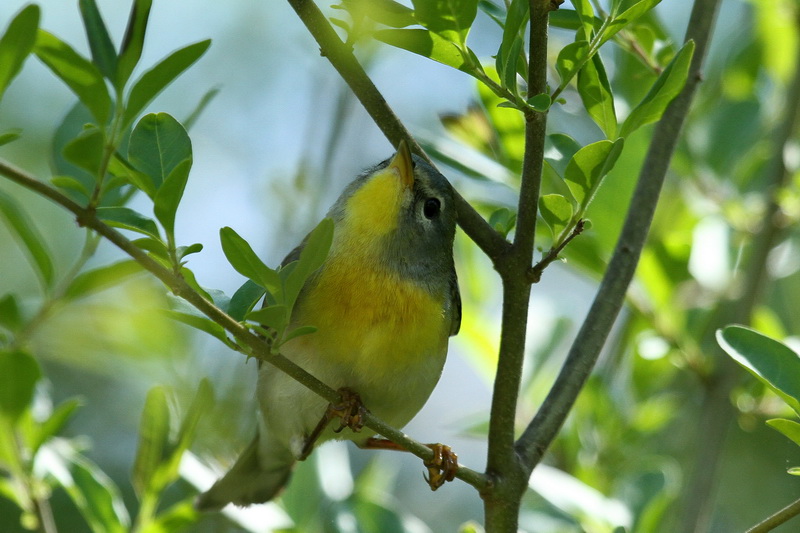
Ah yes ... the joy of the Spring activity. A couple of bird walks this weekend yielded many warblers hurrying toward their breeding grounds, feeding frenzily, and singing lustily. Most were high in the canopy, but this Black-throated Green Warbler was closer to lens ...

Black-throated Green Warbler
The walks in the woods are marvelous, but for theatrical entertainment, sitting quietly on the back porch provides front row seats to drama, intrigue, and rivalry.

Five Evening Grosbeak males (perhaps six) are vying for the attention of four (best count) females, so there is sorting, accommodating, and liaisons to figure out. The guys are getting serious, with raised crest, raised tail, and flared wings becoming prevalent and insistent ...

Evening Grosbeak
 Rose-breasted Grosbeaks (we have had five males and a lesser number of females) are gentlemen toward one another, but they have their moments ...

Rose-breasted Grosbeak
For shear truculence, there is nothing that can match the 1 gram package of the Ruby-throated Hummingbird. This guy perched 15 feet in front of us, until an intruder came along. He did his rapid "U" shaped display and totally cowed the poor rival who sped off - tried again - and again - and was driven off each time ...

Ruby-throated Hummingbird
By contrast, the dispute between Northern Cardinal males was almost gentlemanly, but no less serious ...

Northern Cardinals
Two transients made brief stops in the yard - welcome visitors not seen in the yard every year ...

Brown Thrasher ...

Brown Thrasher

Indigo Bunting

Indigo Bunting
Not to be overlooked in the profusion of life bursting forth as the tiny gems at our feet, like the trout lily ...

Trout Lily
... or in the garden, the Crown Imperial ...

Crown Imperial
Listen to the birds ... visually consume the flowers ... celebrate Spring!!

Saturday, May 11, 2013

Warblers on the Way

Spring migration has been slow in Vermont, but the warblers are on the way.

I spent yesterday in Cape May for the first full day of birding/photography which I have had in many months. Yesterday was the day when the migrants arrived in Cape May, and it was a great day for the many birders flocking to Cape May for the World Series of Birding and the Cape May Spring Bird Festival.

Warblers - those coveted little bundles of color and energy - were everywhere, and my camera was busy. The breath-taking male Magnolia Warbler continued to play hard to get, and others like the Chestnut-sided, Blackburnian, Blackpoll, and Prairie were also elusive. But many others were at least semi-cooperative. Choosing photos has been tough ... here are a few:

Northern Waterthrush (along Wissahickon Creek, Philadelphia)
American Redstart - first year male

Common Yellowthroat - male
Yellow-breasted Chat - male
Yellow Warbler - female
Yellow-rumped Warbler - female
Northern Parula - female
Black-and-White Warbler - male
Black-throated Green Warbler - female
Black-throated Blue Warbler - male
Good Birding!

Friday, November 09, 2012

Black-throated Green, Rusty, et al - Heinz NWR today

Today was a beautiful, crisp Fall day at John Heinz National Wildlife Refuge at Tinicum in Philadelphia.

It began with a Black-throated Green Warbler, a bird which should be in Belize by now - and if it does not get a move on soon will become a genetic cul-de-sac. Nevertheless, a feast for the eyes, and a cooperative poser for the cameras of several birders.

Black-throated Green Warbler
 Photographic highlights included the elusive elf of the tree trunk - Brown Creeper.

Brown Creeper
Brown Creeper
Waterfowl are still abundant on the impoundment, including the Ruddy Duck ...

Ruddy Duck
 At home in the southeastern corner of Vermont, the Rusty Blackbird has been a hit or miss bird from year to year. But at Heinz NWR has been likely tick on my year list in the Fall and Spring, as it was today ...

Rusty Blackbird
Rusty Blackbird
Good Birding!!

Sunday, October 02, 2011

Being Normal and Human

(Note: This column appeared in "The Commons," Wednesday, September 28. It was written on September 19.)

Bridge - Augur Hole Rd nr Alcan Power Equip.
Hurricane Irene ripped apart the tiny village of South Newfane where I live. I was in Philadelphia when she struck. The village was physically isolated, with every road washed out in multiple places and many bridges reduced to rubble. Communication was severed. It was three days before I could make contact with any neighbor.

When I was finally able to return to South Newfane, I found my home safe, but the leach field for my septic system was gone along with 40-50 feet of property. The carefully developed bird and butterfly garden was severed, and many of the protective trees around the bird feeders had disappeared. Those that remain will be removed when a new leach field is squeezed into the remaining space.

the lower lawn
Compared to some neighbors, our damage was not severe. But I quickly recognized that every neighbor was affected. Hurricane Irene ravaged the mental and psychological state of everyone, just as she tore out homes, trees, roads, and bridges. Four weeks after the storm, the daze created by the storm and fatigue is still apparent as one talks with people. Ordinary tasks are difficult and everything seems to take too long.

A week ago I went to the flood sale for my neighbor, artist-photographer Christine Triebert. I paused before a mystical, mysterious scene with a small stream bubbling through a forest canopy. In the distance the water was spanned by a delicate, spider-like, bridge. The title read, “Rock River;” the bridge was the Parish Hill Bridge. Tears welled up in my eyes as I viewed the spiritually rich image - but an image of what was, and a contrast to the Hieronymous Bosch scene left in the wake of Irene. It will be a long time before I can view the image of Chris’ “Rock River” and draw from it the spiritual peace which the artist conveyed.

In the midst of all this, one grasps for the normal activity. One afternoon, I made myself cut the grass. It did not take as long as in the past, so I did the neighbor’s grass and a nearby field.

Black-throated Green Warbler
Two weeks ago after church, friends on Newfane Hill invited me to lunch. We ate our sandwiches and watched the birds coming to the feeders on the deck. I pulled myself out of the daze when an olive-drab and yellow bird landed on the deck. It took a while before the mental computer booted up. When it did, I watched the young Black-throated Green Warbler with a sense that my “normal” expectations for a mid-September day were still around. That sense continued as a young Blackburnian Warbler also gleaned food in one old apple tree while a young Common Yellowthroat gleaned food in another apple tree.

Last Sunday, I wandered along the Dover Road to again try to wrap my mind around the damage. Between the Covered Bridge and the Parish Hill Bridge there were four washouts. Road construction crew had brought these back to grade and had made them passable. Beyond my home on the Dover Road, another washout was nearly back to grade. Each of these required major road reconstruction. The tireless efforts of the construction workers was heroic, but in a way, unexceptional. The number and variety of people who have made heroic and tireless contributions is legion - volunteer firemen, cleaning crews, community dinner organizers, communicators, town officials, emergency workers, and neighbors handing out supplies ... and hugs.

Wild Turkeys

When I drove out the Augur Hole Road last Sunday, a flock of turkeys crossed the road. I tried to creep close to them in my truck, but the wary birds scurried off and gave me only a third rate photo opportunity. Even so, it was a moment of normalcy.

But that moment paled when I reached Tom Fusco’s home. The bridge just past his shop, Alcan Power Equipment, like all the others on the Augur Hole Road, had been washed out by the Marlboro Branch. Four culverts had been placed along side the broken bridge and a one car lane reconnected the isolated residents with roads to Route 30. At one end of the basic river crossing, a hand lettered sign announced “The Thomas Fusco Memorial Bypass.”

Tom Fusco Memorial Bypass
I laughed, as I am sure I was meant to. In the midst of so much somberness, for a moment the burden was lighter. As we slog through the debris and labor through the destruction, those moments when we cry, and those moments when we laugh, are moments that keep us human and connect our humanity.
The Bypass reconnected residents of the Augur Hole
Common Yellowthroat

Tuesday, June 07, 2011

Warblers

Last year in a remote area of Somerset in the Green Mountains, I photographed the Canada Warbler. The bird was not cooperative and I was not satisfied with my results. So I returned to the same spot this year to try again.

Two to four males were singing on territory, but they were even less cooperative this year. During the 1 1/2 hours I spent there, I had mere glimpses of the Canada Warbler through thick foliage.

However, other wood warblers in the same spot posed quite nicely and provided a morning of good photography and good birding.

Magnolia Warbler
Black-throated Blue Warbler
Black-throated Green Warbler
Blackburnian Warbler
Common Yellowthroat

Sunday, April 10, 2011

Vacationing Birds

Just like humans, when birds go on vacation they often behave very differently from when they are engaged in domestic duties. Two weeks ago I wrote about the Wood Thrush on its wintering grounds in Belize where its behavior is positively robin like. The thrush’s behavior is a sharp contrast to its behavior on its breeding grounds in Vermont where it is shy, secretive, and elusive.

Here are a few more examples of bird behavior on wintering grounds that is different from behavior on breeding grounds.

Northern Waterthrush (Belize)
When I was surveying for the Vermont Breeding Bird Atlas, I found a Northern Waterthrush in a beaver pond in Stratton. It was singing, and I listed it as a probable breeding bird. I have returned to the beaver pond during June every year since. I have circled through the forest to the back end of the pond where the water is shallow and still, the favored habitat for the Northern Waterthrush. By contrast, it cousin, the Louisiana Waterthrush, likes fast moving mountain streams. Both waterthrushes are are warblers which look like thrushes (Wood, or Hermit) - brown birds with spotted white breasts. They bob their tails, like a Spotted Sandpiper, as they walk along the ground.

One June, I saw the Northern Waterthrush in the beaver pond for an extended time. At the the shallow end of the pond, I sat on a log and fed the mosquitos. While the male sang somewhere in the swampy pond, the female bobbed along the muddy edges a couple dozen feet from me, feeding. Then I suppose she gathered nesting material, because she flew off with something in her beak.

Every quest I have made for this warbler during June has required patience and luck. In our  swampy forest neighborhoods, the Northern Waterthrush is shy, secretive, and elusive, like the Wood Thrush. It carefully balances the need to advertise its presence in order to attract a mate and warn off rivals against the need to protect its nest, eggs, and young from dangers.

Along the shallow edges of a small pond in Belize, I watched a pair of Northern Waterthrushes as they foraged through leaf debris. It was the dry season, and many trees dropped their leaves. Large brown leaves covered the forest floor and the muddy pond edge. The waterthrushes walked along, tails bobbing. Systematically they flipped over the large leaves looking for food. Walk, bob, flip, feed ... walk, bob, flip, feed. They were cautious about any movement in their direction on my part. After all, I was a huge intrusive presence. But they were not the shy and elusive birds I knew in Vermont.

Hooded Warbler (male - Belize)

For many years I lived in Delaware Water Gap, Pennsylvania. The sides of the mountain ridges were covered with rhododendron, prime nesting habitat for the Hooded Warbler. On many occasions, I sat along the trail for long periods trying to get a good look at the male. He is a bright yellow bird with a bold and striking black hood. A good look is worth the wait. He often chose a mid-level branch as his singing perch. Picking that tiny spot of yellow out of filtered sunlight in a forest always included a dollop of luck. If a second male sang nearby, fast flights in defense of territory might provide a glimpse.

The first day we were in Belize, I caught my breath and said, “Oh my, a Hooded Warbler.” Then it happened again ... and again ... and again. The Hooded Warbler’s frequent appearance never became humdrum, but it was not the breath-catching experience that I had been accustomed to.

Botanical gardens adjoined our jungle lodge in Belize. One morning in an open orchard section, I watched a male Hooded Warbler feeding. He went from tree to tree, working the branches and gleaning the leaves. While he never allowed me to get too close, he did not hide in thick foliage where he was a mere flitting and fleeting presence. Back and forth he went, pausing from time to time to pose and allow me to marvel at the black cowl framing his yellow face.

The Hooded Warblers I saw were all males. The females, which lack the prominent black hood, were absent. That typified the experience with the “northern” birds which I saw on their wintering grounds.

Black-throated Green Warbler (female - Belize)
Magnolia Warbler (female - Belize)

Where we were staying in Belize, I saw lots of Black-throated Green Warblers - all female. In a much different location, I saw males. The Black-and-White Warblers were male. The Magnolia Warblers were female.

Parenthetically, last year I struggled to get reasonable pictures of the Magnolia Warbler. They were high in tree branches, moved rapidly, and rarely presented a good photo opportunity. I had several good opportunities to photograph the female Magnolia Warbler in Belize and the male in Tikal, Guatemala.

Continuing. I saw lots of American Redstarts with the black and orange plumage of the male and the gray and yellow plumage of the female. But, one year old male redstarts look like the female; they do not acquire the adult male’s black and orange plumage until they are two years old. I suspect that the American Redstarts were all male.

You see the pattern. In addition to very different behavior from what we see when these birds are in our neighborhoods during their breeding season, the sexes also vacation separately. With many species, males and females occupy different habitats during the winter.

Another striking behavioral difference in these wintering birds was the lack of song. They did not sing. Bird song is such a key component to knowing what birds are present, but singing is an activity largely confined to the breeding season. Local guides relied on voice for identification, but that voice was not song, it was call - the chip notes that birds use to communicate with one another.

On the wintering grounds, there is no singing, no displaying, and no rivalry among the males. There is no need for such behavior until the birds begin their journey northward when they are driven by hormonal changes and the urgency of species propagation.

Gray Catbird (Belize)

The Gray Catbird presented something of an exception. I heard some catbird mimicry, though not nearly as much as I hear during the summer in my yard. Otherwise, the catbird on vacation behaved like the catbird I see in Vermont. It came to the feeder on the veranda for fruit. It picked berries from the ground and off branches. It hoped about with friendly curiosity, cocking its head when listening to my silly sounds or when some other movement caught its attention.

In summary, it was fun seeing old friends on vacation.

Friday, February 25, 2011

Still Nostalgic

Yes, still remembering the colorful wonder from Spring, 2010.

But be alert ... new images with cure-for-winter will be coming!!

Blackburnian Warbler
Black-throated Green Warbler
Northern Parula
Prothonotary Warbler
Good birding!

Monday, September 20, 2010

A Few Fall Warblers

Warblers, the jewels of breeding birds in the Northeast, are on the move, heading back home to the tropics for winter.

Blackpoll Warblers make one of the most impressive migratory journeys. They gather along the New England coast, then fly 3000 kilometers nonstop across the western Atlantic Ocean to northeastern South America.

Blackpoll Warbler - juvenile
Black-throated Green Warbler
Black-throated Blue Warbler - female
Yellow-rumped Warbler
Chestnut-sided Warbler - juvenile
Good birding!

LinkWithin

Related Posts with Thumbnails