Showing posts with label Mourning Dove. Show all posts

Wednesday, July 01, 2015

A Busy Day in the Yard


This afternoon alternated between heavy showers and golden sunshine, and the yard was as busy as ever. At least two dozen species (maybe three dozen) nest in our immediate neighborhood, and most of those make regular visits to our bird feeders. I sat on the back porch and watched the show! Hardly a pause in the activity ... a captivating way to spend an afternoon.

Here is just a sample ...

Rose-breasted Grosbeak
Rose-breasted Grosbeak - immature male

Mourning Dove
Red-bellied Woodpecker

Evening Grosbeak
Northern Cardinal

Purple Finch
 
American Goldfinch
Gray Catbird
White-breasted Nuthatch waits its turn - Evening Grosbeak (female)
It is a BIRD Feeder!! What do you not understand about BIRD FEEDER?


Good Birding !!

Friday, January 03, 2014

Snowed In

Mourning Doves during the snow storm
I have been unable to get free to pursue any of the Snowy Owls which have irrupted into the Northeast this winter. In fact, yesterday's winter nor'easter with its foot of snow precluded almost all venturing beyond the warm walls of the house.

That's okay, because there has been plenty to do just watching the birds in the back yard. There has been no winter finch presence this winter, but the variety of sparrows has been notable. Juncos are always present in numbers, but this year several American Tree Sparrows have been regular, as have White-throated Sparrows. The White-crowned Sparrow first seen in early December continues.

Best of all has been the Fox Sparrow. Probably my favorite sparrow, it generally makes brief stops during Spring and Fall migration. For the first few days, it kept to the brushy edge of the yard, but as the snow has continue to accumulate it has moved into the open ...

Fox Sparrow - Red (Taiga)

... and yesterday, it became a true "feeder" bird, scratching seeds on the platform feeder, and as the photo shows, un-intimitated by the much larger Mourning Doves which crowd the platform, and often chasing off juncos, goldfinches, white-throats, and even Blue Jays ...

Fox Sparrow on the platform feeder with Mourning Dove and junco

A few additional images ...

White-throated Sparrow

Dark-eyed Junco

American Tree Sparrow
Chickadees are unfazed by all the visiting "snow birds," always finding a free feeder somewhere to grab a seed, then head to a branch to pound it open ...

Black-capped Chicadee
Good birding in the year ahead!

Wednesday, April 04, 2012

Grosbeaks Return!!

Last August, Hurricane Irene ripped apart my little village. In my yard, 14 years of developing bird friendly habitat disappeared - and just as quickly, the birds all but disappeared.

Our bank has been rebuilt, our septic system installed, and bird feeders put up. Soon we will begin replanting.

Over the winter, I have wondered what would occur with our birds. When I returned to Vermont last week, I was delighted to see that the birds had also returned - perhaps not in quite the numbers of the past, but they are here: red-wings, grackles, cowbirds, goldfinches - an occasional siskin or two - sparrows, and all of the other regulars.

Most gratifying was the return of the Evening Grosbeaks. For the last several years they have been present every month of the year and seldom absent for more than a few days. After the hurricane, they were gone. One made a visit in late October.

The Evening Grosbeaks are back! - not 10-15 as in the past, but 5-7. This photo was taken through the back door & storm door, so it lacks the quality I would like. But the quality is offset, for me, just by his presence ...

Evening Grosbeak
American Goldfinches are common at the feeders and around the year, their song a cheerful reminder of new life ... and they are quickly changing from their olive drab winter wear to the bright yellow summer wear ...

American Goldfinch (through the kitchen window)
The squirrels and chipmunks are out of hiding and gleaning the seed scattered by the jays ... or in the case of this enterprising individual, discovering that a few remaining rose branches can get him/her closer to the source ...

Red Squirrel
Red Squirrel on the "inaccessible-to-squirrels" feeder
And finally, a few more friends at the feeders. Maybe there is nothing unusual about these birds, but after the experience of last year, so very welcome!

Blue Jay
Mourning Dove

Song Sparrow
Good Birding!

Monday, October 17, 2011

Birding Again!

For the first time in over 2 months, I mounted the big lens on my camera and photographed birds in the backyard. Hurricane Irene took out much of the backyard and washed away the trees, shrubs, and plants which we have cultivated for a decade to benefit birds and butterflies.

Installation of the new leach field required removing an old apple tree and several other large bushes which provided cover for the birds.

Even so, we preserved what we could, and some of the resident birds came daily to feed, in spite of the heavy equipment working nearby.

The residents included at least two pair of Downy Woodpeckers. This one is trying to reorient himself to the new feeder locations on a high bush rose which we saved ...

Downy Woodpecker

A small island of thick cover remained untouched behind the stone wall, providing Song Sparrows a close haven of safety. I wish there were someway to identify individual birds. As the changes took place in the yard, it often seemed that the Song Sparrows went first to where the feeders had been. With the leach field completed, grass seed spread, and feeders placed in new locations, they are beginning to get themselves reoriented. But are they the ones which came all summer, or did they stop on the way north and are now stopping on the way south, scratching first in the spot where they scratched in the Spring? I have no idea.

Song Sparrow

Mourning Doves have been present throughout, although their numbers do not seem as great as in previous Falls. But they come to the platform and forage on the ground several times a day.

Mourning Dove

Hairy Woodpeckers have also made daily visits, managing to find the suet feeder in its various locations.

Hairy Woodpecker
Installation of the leach field required digging up most of what remained of the lawn, yard, and flower beds behind the house.

Installing the leach field for the septic system

Taken just minutes before publishing this post, the leach field is completed, feeders are in and as close to cover as possible. Additional clean-up and grading will be completed this morning.

Completed leach field is seeded and finish work is being done
Good birding!

Saturday, August 27, 2011

More on the Mourning Dove

A few years ago I was at a friends home on Timson Hill. He led me into a bedroom and pointed through the window to a spruce tree just on the other side of the glass. On the flat branch of the needle covered branch was the nest of a Mourning Dove. She was on her eggs and seemed unconcerned about the oglers peering through the window.

It was not much of a nest. It looked like a disorderly jumble of small sticks and twigs hastily placed on the branch - like an indigent’s camp beneath a bridge, designed with impermanence in mind. But the nest served its purpose. As the season progressed, my friend reported that two young doves fledged, and when they were gone, the nest was used a second time.

To the degree that a Mourning Dove has any place in folklore, it is as a “love bird.” To anthropomorphizing eyes, the mated pair appears very affectionate, and in fact, a mated pair seem to remain together during the entire breeding year.

With his flowery prose, Audubon described his painting of the Mourning Dove (which he knew as the Carolina Turtle-Dove): “I have tried, kind reader, to give you a faithful representation of two as gentle pairs of Turtles as ever cooed their love in the green woods ... Look at the female, as she assiduously sits on her eggs, embosomed among the thick foliage, receiving food from the bill of her mate, and listening with delight to his assurances of devoted affection. Nothing is wanting to render the moment as happy as could be desired by any couple on a similar occasion.

“On the branch above, a love scene is just commencing. The female, still coy and undetermined, seems doubtful of the truth of her lover, and virgin-like resolves to put his sincerity to the test, by delaying the gratification of his wishes. She has reached the extremity of the branch, her wings and tail are already opening, and she will fly off to some more sequestered spot, where, if her lover should follow her with the same assiduous devotion, they will doubtless become as blessed as the pair beneath them.”

Audubon has perhaps gone too far in his anthropomorphizing of the Mourning Dove, but he does capture the sense of devotion and peace which the doves evoke within us. A hundred years later, Massachusetts ornithologist Edward Forbush was still writing about the doves with a romantic flourish, though toned down from Audubon:

 “The male does not cease his attentions to the female when the eggs are deposited, but often brings sticks and straws for the nest and takes his share of the duties of incubation, feeding and brooding. As a rule, after incubation commences until the young are hatched, one or the other of the parents is continually on the nest. When the adult bird is frightened from the nest by an intruder, it may drop to the ground and imitate so well a wing-broken bird as to lead the enemy away, or it may alight on the ground and flap its wings to draw attention. This is most likely to happen after the young are hatched, and in some cases both parent join in the ruse.” (Forbush)

What can be said with a bit more straightforward sobriety is that the Mourning Doves pair early in the Spring and nest early. Sometimes they begin to nest in late March or early April. The male brings the nest material; the female builds the nest. It takes one to three days. Typically, two eggs are laid. Incubation takes about two weeks; both male and female incubate. The young are fed by both parents. From altricial hatchlings (naked and helpless) to leaving the nest as fledglings takes about two weeks.

When the young have left the nest, the parents do it again ... and again ... and again. Sometimes Mourning Doves will nest as many as six times during a breeding season.

Mourning Doves, like other members of their family Columbidae, feed their young with “pigeon milk.” “This substance is produced in the crop, an enlarged pocket of the upper esophagus. During the nesting season, the walls of the crop secrete a milky fluid that is rich in fat and protein. For the first dew days after hatching, the young are fed a pure diet of pigeon milk. Then they begin to receive a mixture that includes some partially digested seeds or fruit, but their diet continues to include some pigeon milk for at least a couple of weeks. To be fed, the young bird will insert its bill into the corner of the parent’s mouth, and the adult will regurgitate the pigeon milk or the mixture for the young to eat.” (Kaufman, Lives of North American Birds)

As nearly as I can determined, once the young have left the nest, or very soon after, they are left entirely on their own. In my yard, I will often seen a pair of scaly Mourning Doves feeding on the ground. The scaliness, plus the apparent cluelessness of these birds, identify them as young birds. As the season progresses, the number of young increases. Eventually the adults, tiring of the repetitive parental responsibilities, also join the flock.

Early in the twentieth century, Mourning Doves received protection along with songbirds. That protection, along with their adaptability and seasonal production of six to twelve young has made them one of the most common birds in North America. And that in turn, has been good for other birds.

A few mornings ago, I was awakened by Blue Jays. They were making a hellagious racket. Somewhere nearby, there was a hawk, and the jays were sounding the alarm. Warned by the jays, the doves all departed the yard. Doves do not always have the good fortune of sentinel jays. One afternoon when I was sitting by the river, I glimpsed a Sharp-shinned Hawk crossing overhead and circling through trees. Later when I returned to the house, I found a pile of dove feathers on the lawn. One of those slow-moving, clueless young Mourning Doves became a meal for nestling Sharp-shinned Hawks.

As the season progresses, those young doves will become practice prey for novice young hawks. Last year as winter began, the flock of Mourning Doves which gathered in the trees around my feeders numbered about thirty birds. By late February, half that number gathered in the trees. Feather piles and red spotted snow were tangible signs that the bird feeders had attracted other feeder birds, like the Sharp-shinned and Cooper’s Hawks. The Mourning Dove was filling its place in the ecology around my home.

Saturday, August 20, 2011

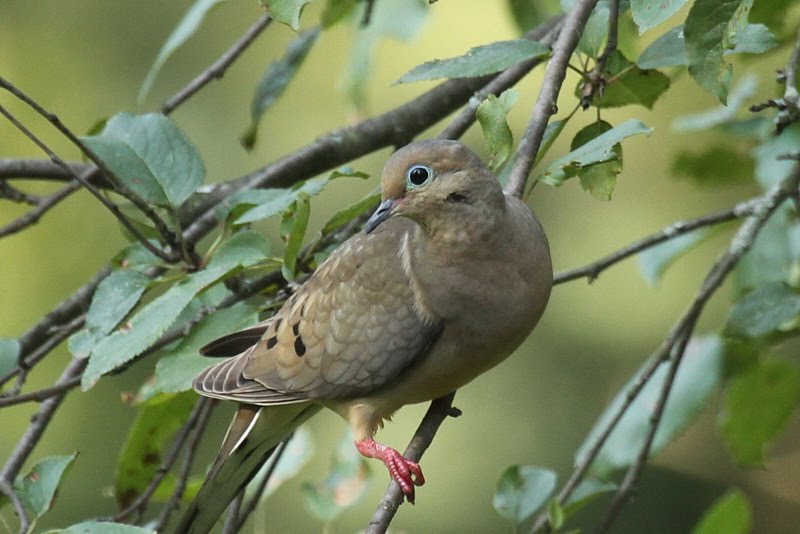
Mourning Dove

Mourning Dove
The Mourning Dove is common is our yards, fields, and towns. It is part of the background and as such, it is often overlooked and taken for granted. I am guilty of that. In a dozen years of writing this column, I don’t think I have ever given the Mourning Dove exclusive attention.

“The mourning dove must have been one of the first birds that attracted the attention of the early settlers when this country was new and wild. They must have recognized the bird as not far removed from some of the Old-World species of pigeons, and its notes must have recalled to them their old home. The writers of these times speak of the bird familiarly, especially as a game bird that relieved the hardships of pioneer life.”

With those words, Bent begins his “Life History” of the Mourning Dove. In Bent’s history and in the writing of other earlier observers, the impression that comes through is that the Mourning Dove is just an assumed part of the landscape and as such does not receive a great deal of attention. It was sometimes called a “turtle dove,” by early colonists because of its resemblance to European turtle doves. The repeated “coo, coo, coo” sounded sad and mournful to colonists homesick for their native land; “mournful” adhered to the dove.

The Mourning Dove’s “coo, coo, coo” is sometimes heard as a “hoot.” As you know, owls “hoot” in popular parlance. On a number of occasions I have had non-nature type people tell me they have heard an owl, leaving me the mournful task of explaining that what they have actually heard is a Mourning Dove.

In addition to its hooting “coo,” the mourning dove also “whistles.” The whistle is not a vocalization; it is produced by the wings when the bird takes off.

Detail - J.J.Audubon's "Mourning Dove"
Whatever imagined sadness the Mourning Dove may have been “cooing” about to earlier generations, it was viewed by them primarily as a game bird.  John James Audubon painted his Mourning Doves as loving and devoted couples, and then with his typical disconnect, described their tastiness: “The flesh of these birds is remarkably fine, when they are obtained young and in the proper season. Such birds become extremely fat, are tender and juicy .... These birds require good shooting to bring them down, when on wing, for they fly with great swiftness, and not always in a direct manner. It is seldom that more than one can be killed at a shot when they are flying, and rarely more than two or three when on the ground.”

Apparently the gunning skill required to shoot Mourning Doves is what still makes them a game bird in many states. It certainly is not, and never was, a major source of food. At just over four ounces in weight, feathers and all, it would take a lot birds to make a meal.

By the early twentieth century the Mourning Dove’s numbers were severely decreased in New England. In 1908, it received protection in the northern states as a songbird, allowing its numbers to increase. Today in appropriate neighborhoods in our area, it can be considered common, to very common, to abundant.

The Mourning Dove ranges throughout the United States and Mexico. In southern Canada  and the northern United States it is seasonal, breeding during the Spring and Summer and then migrating to warmer climes.

In Southern Vermont, the Mourning Dove can be seen throughout the year, but the birds of the summer and the birds of the winter are not necessarily the same birds. Banding studies have demonstrated that many Mourning Doves undertake a long migration. For example, birds banded in Wisconsin have been recovered in Louisiana and Alabama. Texas to northern Florida is the favored winter home; banded birds recovered in these areas have come from across the northern tier of states, from New Jersey and New York through Pennsylvania, Ohio, Michigan, and westward through the northern plains states.

The migratory habits of the Mourning Dove probably account for its remarkable uniformity across its vast range. The birds mingle and mix during the winter. When they return to the breeding grounds their DNA also gets mingled and mixed. Most modern field guides (Sibley in particular) note racial differences among species especially where those differences are notable in the field. Almost no attention is paid to subspecies of the Mourning Dove because the differences are so slight. Bent describes the western race as slightly paler and slightly larger. But note the word, “slightly.”

Charles Lucien Bonaparte
Mourning Dove (Zenaida macroura) belongs to the family, Columbidae, from the Latin for pigeon or dove. In general, the larger members of this family are called pigeons; the smaller members are called doves.

The Mourning Dove was named by Charles Lucien Bonaparte, a nephew of Napoleon Bonaparte. When the family fortunes declined after Waterloo, Charles moved to America with his new wife (and first cousin), Zenaide and his uncle/father-in-law, Joseph. He lived in Bordentown, New Jersey and Philadelphia, Pennsylvania. “While residing in the United States from 1822-1828, he re-edited a volume with the longest title in American ornithology ... ‘American Ornithology, or History of Birds Inhabiting the United States not given by Wilson.’” Bonaparte is considered to be the father of systematic ornithology in America. Bonaparte’s Gull commemorates him.

Zenaide Bonaparte (right)
Bonapare honored his wife with the Genus Zenaida. Mated pairs of Mourning Doves exhibit a very close association. An old common name for the dove was “love bird.” Bonaparte may have linked the name of his wife to this dove as a symbol of conjugal bliss.

 The species name, macroura, comes from the Greek for “long” and “tail.” Thus the literal meaning of the name, Zenaida macroura, is “Zenaida’s long tail.” The long tail of the Mourning Dove is considered by some to be its outstanding characteristic. When the bird is perched, the tail is long and pointed. Then it takes flight and the long tail flares in an elongated triangle with prominent white tips on the outer tail feathers.

More next week. Good birding.

Thursday, June 30, 2011

Mourning Dove

Common ... often overlooked ... food for Sharpies and Coopers, and who knows what else ... and when we have the time to stop and look ... beautiful.

No wonder the dove is a symbol of peace ...

Friday, December 17, 2010

Grosbeaks and Doves

These photos will not win awards for beauty or creativity, but they show some of the activity around the feeders.

The Evening Grosbeak flock numbers 50+. This photo includes 33 grosbeaks, plus 2 jays and 2 doves. Additional grosbeaks were on the feeders and surrounding trees ...


Mourning Doves arrive at the earliest light. It sometimes appears that the ground is alive. There is at least one flock of 50+. The photo has 32 doves.


... and one little field mouse running to and from the stone wall throughout the day - better that the mouse gleans seeds outside, than gnawing on soap bars and toilet paper inside, which some of its relatives did until recently.


Good birding!

LinkWithin

Related Posts with Thumbnails