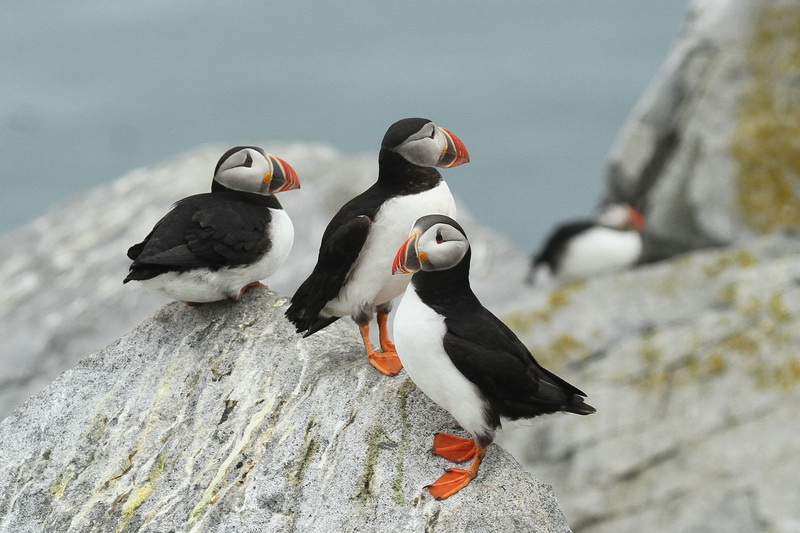
Photographers rarely have the opportunity to get multiple portraits of any species. First you find it, then you photograph it, hoping it will not fly off or dive down before your camera has gotten it burst of shots, with (hopefully) one good pose among the lot.
Machias Seal Island was a notable exception. Two hours of stooping in a blind yielded many images - and portraits - of the species which come to the tiny rock haven to breed and raise young.
A few portraits ...
Atlantic Puffin ...
Razorbill ...
"Bridled" Common Murre (10-25% of Atlantic population) ...
Common Murre ...
Good Birding!
Showing posts with label Razorbill. Show all posts
Wednesday, June 26, 2013
Sunday, June 23, 2013
Thursday, June 20, 2013
Alcid Courtship
This post on Alcid courtship, and the next one Alcid mating, requires a degree of restraint on my part. It is very tempting to anthropomorphize the behaviors I photographed on Machias Seal Island, and to describe those behaviors with the smirking and chuckling terms often used. But alas, I don’t want blogger (or a prudish reader) to flag me for inappropriate content, so I will keep this on as even a keel as possible.
The most common courtship behavior I observed was “billing.” Billing among mated pairs of the birds I observed involves touching, or as it appeared to me, caressing, each other’s bills. The behavior apparently serves to strengthen the pair bond. This was most apparent with the Razorbill pairs.
There were many fewer Common Murres so there were fewer opportunities to observe billing among pairs. When I did photograph it, it appeared a bit more restrained than with the Razorbills.
Is this courtship? Or a beef: Come on, make up your mind? Or a lover's quarrel?
Atlantic Puffins do most of their courtship, and according to Birds of North America, almost all of their successful mating on the water. Occasionally, however, they do billing on land.
A completely different form of courtship is practiced by the Arctic Terns. I only saw these terns in flight. Several were carrying food. Among most land birds, this is a sign of young in the next. However, among the terns, bringing food to one’s mate (or hoped for mate) is a courtship behavior by the male in order to demonstrate, presumably, his ability to provide for the mated pair’s young. I have seen this among Least, Common, and Forster’s Terns, and now Arctic Tern.
Photographed on Machias Seal Island.
Good Birding !!
The most common courtship behavior I observed was “billing.” Billing among mated pairs of the birds I observed involves touching, or as it appeared to me, caressing, each other’s bills. The behavior apparently serves to strengthen the pair bond. This was most apparent with the Razorbill pairs.
| Razorbill pair bonding by "billing" |
| Razorbills |
| Razorbills. |
| Common Murres - apparent billing |
| Common Murre |
A completely different form of courtship is practiced by the Arctic Terns. I only saw these terns in flight. Several were carrying food. Among most land birds, this is a sign of young in the next. However, among the terns, bringing food to one’s mate (or hoped for mate) is a courtship behavior by the male in order to demonstrate, presumably, his ability to provide for the mated pair’s young. I have seen this among Least, Common, and Forster’s Terns, and now Arctic Tern.
| Arctic Tern carrying food as part of its courtship & pair bonding. |
Good Birding !!
Monday, June 17, 2013
Razorbills & Murres - Getting Airborne
The Razorbill and Common Murre are not nearly as charismatic and charming (cute) as the Atlantic Puffin. They are black and white seabirds, without a trace of color, much less the large, colorful bill of the puffin. But they should not be overlooked.
They are adapted to life on the open seas, and like the puffin, when they take to the air they have to work at it. Here are a few photos of the "plain cousins" in flight.
Razorbill and Common Murre in flight ...
The running start of Razorbills ...
Airborne at last ...
Walk (run) on water of the Common Murre ...
Photographed on Machias Seal Island
Good Birding !!
They are adapted to life on the open seas, and like the puffin, when they take to the air they have to work at it. Here are a few photos of the "plain cousins" in flight.
Razorbill and Common Murre in flight ...
| Razorbill |
| Common Murre |
The running start of Razorbills ...
Airborne at last ...
Walk (run) on water of the Common Murre ...
Photographed on Machias Seal Island
Good Birding !!
Wednesday, June 12, 2013
Alcids & Tern - Machias Seal Island
Last week we traveled to the northernmost coast of Maine, known as “Down East” (see note at end of post). The purpose was a trip to Machias Seal Island, a fifteen acre patch of land located about ten miles southeast of Cutler, Maine, at the boundary between the Gulf of Maine and the Bay of Fundy.
The island is a bird sanctuary which hosts the major regional breeding colony of Atlantic Puffins and Razorbills. There are also smaller breeding populations of Common Murre, Arctic Tern, Leach’s Storm Petrel and Savannah Sparrow.
Machias Seal Island is a spot of land which every birder should visit at least once. This was my third trip, but my first trip with a good camera. It was a photographer’s dream! This is the first of several posts.
Alcids are a family of oceanic species which come to land only to nest. In the North Atlantic, the Atlantic Puffin is the icon of the Alcid family, a 12" package of charisma and charm ...
The Razorbill is larger (17"), chunky, and thick-billed. If the bill were a nose, you would describe it as possessing Jimmy Durante proportions (older readers should remember him), or if you have a literary bent, of Cyrano de Bergerac proportions ...
Common Murres are less common on the island; these are sleek and handsome birds ...
Arctic Terns in recent years have had very limited nesting success on the island. Their nest is on the surface and in the open (we saw one egg in the grass close to our boardwalk). This tern nests in the far northern latitudes, and “winters” in the summer of the southern latitudes, making an annual round trip flight of some 24,000 miles. A champion traveler and graceful flyer barely does it credit ...
Note: Down East, The Magazine of Maine explains the origin of the term, "Down East" in New England: "When ships sailed from Boston to ports in Maine (which were to the east of Boston), the wind was at their backs, so they were sailing downwind, hence the term 'Down East.' And it follows that when they returned to Boston they were sailing upwind; many Mainers still speak of going 'up to Boston,' despite the fact that the city lies approximately 50 miles to the south of Maine’s southern border."
IF YOU GO - Machias Seal Island
Bold Coast Charter Company, Cutler, Maine - www.boldcoast.com - Captain Andrew Patterson is the only operator currently taking visitors to the island from Maine. He exceeded my best expectation: knowledgeable, personable, equally concerned for the safety and well-being of his passengers and the birds. (Link on website to accommodations in area)
Riverside Inn & Restaurant (East Machias - 20 minutes from Cutler) - www.riversideinn-maine.com comfortable B&B on the East Machias River. The restaurant was as good as any restaurant anywhere.
Good Birding!!
The island is a bird sanctuary which hosts the major regional breeding colony of Atlantic Puffins and Razorbills. There are also smaller breeding populations of Common Murre, Arctic Tern, Leach’s Storm Petrel and Savannah Sparrow.
Machias Seal Island is a spot of land which every birder should visit at least once. This was my third trip, but my first trip with a good camera. It was a photographer’s dream! This is the first of several posts.
Alcids are a family of oceanic species which come to land only to nest. In the North Atlantic, the Atlantic Puffin is the icon of the Alcid family, a 12" package of charisma and charm ...
| Atlantic Puffin |
| Atlantic Puffin |
| Atlantic Puffin (Razorbills in foreground) |
The Razorbill is larger (17"), chunky, and thick-billed. If the bill were a nose, you would describe it as possessing Jimmy Durante proportions (older readers should remember him), or if you have a literary bent, of Cyrano de Bergerac proportions ...
| Razorbill |
| Razorbills |
| Razorbills |
Common Murres are less common on the island; these are sleek and handsome birds ...
| Common Murre (aka Thin-billed Murre) |
| Common Murre |
| Arctic Tern |
| Arctic Terns |
Note: Down East, The Magazine of Maine explains the origin of the term, "Down East" in New England: "When ships sailed from Boston to ports in Maine (which were to the east of Boston), the wind was at their backs, so they were sailing downwind, hence the term 'Down East.' And it follows that when they returned to Boston they were sailing upwind; many Mainers still speak of going 'up to Boston,' despite the fact that the city lies approximately 50 miles to the south of Maine’s southern border."
IF YOU GO - Machias Seal Island
Bold Coast Charter Company, Cutler, Maine - www.boldcoast.com - Captain Andrew Patterson is the only operator currently taking visitors to the island from Maine. He exceeded my best expectation: knowledgeable, personable, equally concerned for the safety and well-being of his passengers and the birds. (Link on website to accommodations in area)
Riverside Inn & Restaurant (East Machias - 20 minutes from Cutler) - www.riversideinn-maine.com comfortable B&B on the East Machias River. The restaurant was as good as any restaurant anywhere.
Good Birding!!
Friday, July 03, 2009
Machias Seal Island
As reported in the previous post, the trip to Machias Seal Island was unable to land, so we floated among the target birds. Cloudy and foggy, though by the time we began the return trip to Jonesport, Maine, somewhat brighter.
The island through (at 20x with teleconverter) was crowded with birds - Razorbills in forground, Puffins up higher, Arctic Terns overhead, all coming and going from the island.
Misty, but the profile of the Razorbill and Common Murre is distinctive, and with pelagic birds, that is often all you get. Pelagics are difficult for me since I only get on the sea once a year, if that. Not much time to hone ID skills (such as they are) ...
Three photos of Razorbill ...


Common Murre with Atlantic Puffins ...
Two photos of Common Murre ...

Why do we readily call some birds, "cute," such as the puffins, and not other birds? They are all doing the same thing - feeding, breeding, raising young, preening. Are the birds different, or do we just perceive them differently? Come back tomorrow for my offensive opinions on "cute."
Yesterday I headed south into central Mass (what those eastern in Boston call western Mass) for the Henslow's Sparrow. -a life bird. He was cooperative in singing on the grass tops, but distant, so no pics.
Here in the Northeast, maybe the weather will clear someday and we can again get a day of good birding.
The island through (at 20x with teleconverter) was crowded with birds - Razorbills in forground, Puffins up higher, Arctic Terns overhead, all coming and going from the island.
Three photos of Razorbill ...
Common Murre with Atlantic Puffins ...
Why do we readily call some birds, "cute," such as the puffins, and not other birds? They are all doing the same thing - feeding, breeding, raising young, preening. Are the birds different, or do we just perceive them differently? Come back tomorrow for my offensive opinions on "cute."Yesterday I headed south into central Mass (what those eastern in Boston call western Mass) for the Henslow's Sparrow. -a life bird. He was cooperative in singing on the grass tops, but distant, so no pics.
Here in the Northeast, maybe the weather will clear someday and we can again get a day of good birding.
Subscribe to:
Posts (Atom)