In the bird watching world, irruptions are hoped for events, especially as winter imposes its grip. Winter birding can be rather monotonous - the same old, same old, unless one or more irruptions occur. “Bird Source,” the website of National Audubon and Cornell Lab of Ornithology, puts it this way: “Every winter, bird watchers across North America anxiously await the possible incursion of birds that don't normally winter in their areas. These periodic bird irruptions add a dramatic level of excitement to winter birding.”
 |
| Snowy Owl - Brattleboro, Dec, 2011 |
Last winter (2011-12) was an irruptive year for Snowy Owls. These large arctic predators were reported in record numbers across the northern states, often in places where they have rarely, or never, been reported. Sightings extended deep into the Great Plains and even as far south as Texas. The Snowy Owl irruption was driven by a crash in the lemming population in the Arctic; the lemming is the owls’ principal food source.
When a Snowy Owl was reported in mid-December, 2011, in the corn field behind the marina in Brattleboro, the word spread quickly through the birding community. Within an hour of the first report, a dozen birders were focusing their scopes on the white object among the corn stalks. More observers followed in a steady stream.
Finch species which inhabit the northern forests are the most common irruptive birds, and this winter has been a banner year in our area. During October, large flocks of Pine Siskins (closely related to the American Goldfinch) moved through New England and the mid-Atlantic states. The flocks which visited my bird feeders numbered 200+; they put a serious strain on my bird seed budget.
 |
| Common Redpoll have irrupted in New England this winter |
The siskin flocks moved on, to be followed by the Common Redpolls (also closely related to goldfinches). Throughout December and January, and on into February, there have been breathless reports about the sudden appearance of these small finches.
What makes the winter irruptions both exciting, and frustrating, is their unpredictablility. As the birds irrupt into New England, they do so in flocks - often large and typically very nomadic. So you hear about all of these redpolls being seen, and you are frustrated, because you have not seen a single one. And then you are snowshoeing through an old hill farm, or walking along a frozen lane, or sitting in your kitchen watching your bird feeders, and suddenly you have a surfeit of redpolls, scratching the snow, squabbling over seed, and taking hurried flights into the hedges.
Winter finches are notorious for quickly exhausting a food source and then moving on. The epitome of this practice is the Evening Grosbeak. Long time bird feeders describe the Evening Grosbeaks’s winter presence with ambiguity. They are delighted to have these large, colorful, and handsome finches at their feeders, but they cannot avoid the additional use of adjectives such as voracious and greedy to describe their presence. This winter Evening Grosbeaks seem to have taken their blitzkrieg feeding habits further south; I have seen few winter reports from our area.
 |
| Evening Grosbeak flocks are notorious for emptying bird feeders & moving on during winter. |
 |
| Pine Grosbeak - Brattleboro, December, 2012 |
But then there are the frustrating reports of other winter finches - frustrating because you would love to see them, but they do not make it easy. For a couple of weeks in December, a flock of Pine Grosbeaks fed on the yew berries in front of Center Church in Brattleboro. There were females and young males. (The adult males apparently stayed home to defend their territory through the winter). When the berries were exhausted, the flock moved on. If you have not seen the Pine Grosbeaks, you may still have the opportunity. Be alert, because they could be anywhere. On the Christmas Count, we came across several getting grit and salt on a road in Dummerston. If you miss the Pine Grosbeak this winter, I am sorry to tell you that you may not have another opportunity for several years. But, that’s bird watching.
 |
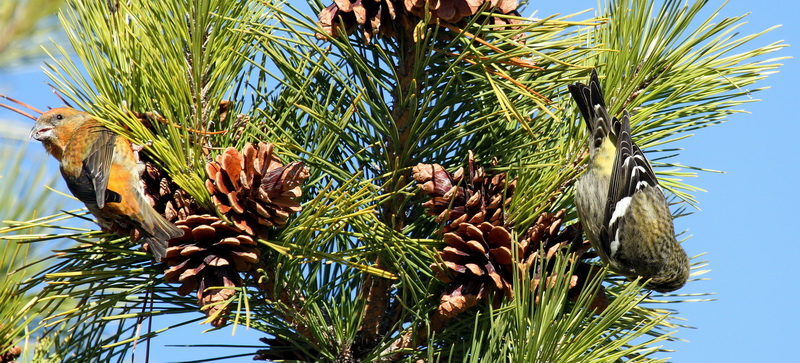
| White-winged Crossbill (l) & Red Crossbill (r), December, 2012 |
On the New England coast, this has been a good winter for Red Crossbills and White-winged Crossbills. I made a trip to Salisbury Beach on the New Hampshire coast and had my best crossbill day ever.
Winter irruptions are driven by conditions in the northern forests. Scientists and naturalists in Ontario and the Maritime Provinces have been studying the preferred food sources of various species for years. Based on their collected data, fairly accurate predictions are possible about which species will irrupt. When they document the shortage of a food that a particular species prefers, they predict an irruption. Winter survival depends upon getting enough food. When local food sources are scarce, the birds go elsewhere.
 |
| Red-breasted Nuthatch |
Finches are the most common irruptive species during winter, but not the only ones. It is easy for us to miss an irruption of the Red-breasted Nuthatch, since this species also nests in the higher elevations of our area and may be seen year-round. Harder to miss when you come across them are the Bohemian Waxwings. When you find Bohemians among the flock of their cousins, the Cedar Waxwings, then you have counted a coup among bird watchers. And when you meet a waxwing flock dominated by Bohemians, you have certainly encountered evidence of an irruption. And, you will be breathless.
 |
| Bohemian Waxwing, Putney, 2011 |
Good birding!