Showing posts with label Ruddy Turnstone. Show all posts

Monday, March 09, 2015

Florida - First Posting

Just less than a week ago, I returned from a week in Florida - a welcome respite from the harsh winter "enjoyed" by the Northeast. It has taken a while to process the photos.

There were several days with good birding, and good bird photography opportunities. This post will get things started. It seems appropriate to start with Florida's state bird, the Northern Mockingbird. These birds were singing their joyful mocking songs everywhere we went ...

Northern Mockingbird

First - Wakodahatchee & Green Cay, in the Boynton Beach-West Palm Beach area. Both are the final stage of water treatment facilities. Wetlands with extended boardwalks provide pond and marsh habitat for wetland birds and some of the best viewing opportunities to be found anywhere. Much more will follow from these sites. For now, three residents: Great Egret, Glossy Ibis, Pied-billed Grebe.

Great Egret

Glossy Ibis (non-breeding plumage)

Pied-billed Grebe

From Everglades Nat'l Park, two year-round residents (although maybe these particular individuals will be moving northward for breeding), Black-necked Stilt and Eastern Meadowlark ...

Black-necked Stilt

Eastern Meadowlark

From the Keys, and everyplace else along the coast, Brown Pelican ...

Brown Pelican (adult non -breeding)

And from Dry Tortugas Nat'l Park, a year-round resident - Royal Tern - and a winter resident - Ruddy Turnstone.

Royal Tern (non-breeding)

Ruddy Turnstone (non-breeding)
The "up-close and personal" wetland birds (and some non-wetland birds) will follow in subsequent posts.

It was a week of warm weather and Good Birding!

Sunday, May 26, 2013

Turning Stones and Forster"s courting

My recent trip to southern New Jersey was a little early for shorebirds, but most species were present in modest numbers.

At Forsyth NWR, Ruddy Turnstones were actively "turning stones" ...

Ruddy Turnstone
Ruddy Turnstone
The bird with the turnstone in the preceding photos was capitalizing on the sand being churned to forage. When it finally presented its profile, it gave itself away as a Sanderling in glorious breeding plumage. I am accustomed to seeing the Sanderling as the wave-chasing white sandpiper ...

Sanderling (foreground)
One more Ruddy Turnstone, just because I like the pose ...

Ruddy Turnstone
Forster's Terns were in hyper-active courtship mode, with the ladies calling for food ...

Forster's Turn

... and the gentlemen doing their best to accommodate, though coming up from a dive empty was not unusual, as seen here ...

Forster's Tern

On his way with a gift for his lady ...

Forster's Tern
Good Birding!!

Wednesday, November 14, 2012

Visit to Hawk Banding Station

I spent several hours today with a friend who was banding hawks in a hawk banding station. Cold and brisk, but several hatch year birds were hungry enough, and inexperienced enough, to come in on the lure birds.

First, is a hatch year female Cooper's Hawk ...

Cooper's Hawk (hatch year) sporting its new jewlery

Cooper's Hawk released after being banded
Several Red-tailed Hawks were caught and received a free metal bracelet. Here a young "Tail" is on the lure ...

Hatch year Red-tailed Hawk
While the hawk was on the lure bird momentarily (the spring-trap net was sprung moments after the photo) the lure bird was carefully examined and found unharmed ...

Red-tailed Hawk
After being measured, weighed, and fitted with a band, the young bird is released ...

Red-tailed Hawk (hatch year) released after being banded
Flying free ...

Red-tailed Hawk
Along the coast there were sizeable flocks of shorebirds, including a few Ruddy Turnstones ...

Ruddy Turnstone

... and elsewhere, Golden-crowned Kinglets continue to provide wonderful photo ops ...

Golden-crowned Kinglet
Good Birding!!

Wednesday, December 14, 2011

Repost Purple Sandpiper

I am reposting the photos of the Purple Sandpiper. Blake Mathys very graciously asked if there might be Dunlin among the Purple Sandpipers. In an email he identified 2 in the first photo and a couple of other possibles in the second photo. I examined both photos in their original unreduced size. I agree with his IDs, and I think I have found additional Dunlin, as indicated by the numbered bubbles. Dunlin have a dark bill, slight downward curve, lighter about the head and body, lighter head, black legs. Sanderlings (which I have not found in these photos) are overall lighter than Dunlin.

But please weigh in - shorebird identification is an acquired skill, and I still have much to acquire. In flight they are also tough, even when frozen by a camera lens and with shorebird guides at the elbow.

Purple Sandpiper - Ruddy Turnstone (top left),  Dunlin indicated by numbered bubbles.

Part of a 4th Dunlin is at bottom of photo between 2 and 3

Purple Sandpiper with Dunlin (numbered bubbles)

Coastal Interlude

Dabbler series will continue, but an interlude first: a day trip to Cape Ann ...

Bufflehead (Gloucester Harbor)
Harlequin Duck (Granite Pier)
Purple Sandpiper - Ruddy Turnstone (top left)
Purple Sandpiper (Andrew's Point)
Harlequin Duck (Andrew's Point)
Iceland Gull (Niles Pond)
Good Birding!!

Saturday, July 02, 2011

The Frayed Carpet at Reed's Beach

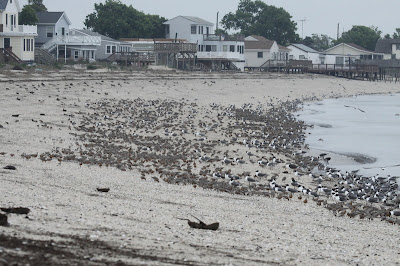
Reed's Beach shoreline
On the single day in May when I was able to find my way to southern New Jersey, one of my destination spots was Reed’s Beach. Reed’s Beach is not a place where people go to lie on the sand and acquire melanoma. For a couple of weeks in May, it is a birding destination of almost legendary proportions, a gathering place for tens of thousands of shorebirds on their way to the Arctic.

Or at least, it used to be. Reed’s Beach is on the Delaware Bay about twenty miles north of Cape May. It is an old coastal fishing settlement. Weather hardened men made, and still make, a living off the rich waters of the Bay. They were, and probably still are, subsistence fishermen, always working against the economics of their time - economics that squeeze hardest on those with the least. When I first visited Reed’s Beach in the 1980s, small weathered homes still held on behind the tenuous protection of the low dunes. Driving down the single road behind the dunes, one could stop anywhere and study the masses of shorebirds along the beach.

Things have changed in the last thirty years. Some of the more ragged homes in Reed’s Beach have been replaced by recreational homes. Reed’s Beach sits on the coast, and accessible waterfront property is highly coveted. A few brand new, oversized, waterfront homes have been built, perched atop the dunes, or just behind them, sitting targets for the hurricane that will one day render them rubble. I wonder if their owners are rehearsing their woeful lament at their horrible loss and have pre-researched how to collect disaster relief.

Eco-tourism has become a significant business. Bird watchers (eco-tourist) come to Cape May in May before the summer season and in the Fall, when the summer season is over. They stay in hotels, motels, and B&Bs, and they eat in restaurants. They improve the occupancy rate during the pre and post summer season. And there are more of them.

Those wandering bird watchers sometimes forget that people live in the places where they are watching birds and that other vehicles need to use the roads. The bird watchers cannot just wander in a bird daze or park in the middle of a road. In Reed’s Beach, there are now signs along the road which prohibit stopping or parking. One must drive to the end of the road where there is a small parking area and defined viewing places. Order is imposed on the many pilgrims to this legendary birding spot.

A dead Horseshoe Crab awaits the scavengers.
The reason Reed’s Beach is legendary is the horseshoe crab. In May, this primeval looking creature crawls out of the Delaware Bay to deposit eggs in the sand. Shorebirds time their migration to arrive on the Delaware Bay when the crabs are laying their eggs. One shorebird, the Red Knot, flies without stopping from Argentina to the Delaware Bay, burning its energy reserves in the process. In a few days, feeding exclusively on horseshoe crab eggs, it can replenish its reserves and continue its journey.

In the early 1980s, I can remember visiting Reed’s Beach during this migratory period. The sand was littered with dead crabs, while shorebirds obscured the beach sands with a living shorebird carpet. When some whim disturbed them, they swirled in dark clouds over the water.

The frayed carpet
More has changed at Reed’s Beach than just recreational homes and eco-tourist viewing areas. The legendary status of Reed’s Beach as a place to see breathtaking numbers of shorebirds is now something of a mystery. It just doesn’t happen. The carpet of shorebirds is badly frayed.

The last few years when I have visited Reed’s Beach, there have been plenty of Laughing Gulls, but very few shorebirds. As I searched the coast of the Delaware Bay, I always managed to find the shorebirds, and even my target species, the Red Knot, but never in large numbers. Most years I blamed myself. I had not timed my trip to southern New Jersey correctly. I was too early for the peak shorebird migration.

Red Knots in flight
My timing was better this year. The flocks of shorebirds which I saw roosting at Heislerville WMA were the largest that I have seen in many years. When they flew, they darkened the sky and blocked the horizon.

At Reed’s Beach, it was also the best I have seen in many years, especially the Red Knots. I took a photo of Red Knots in flight; there are at least three hundred birds in the picture. Feeding clusters of Red Knots on the beach numbered in the hundreds, perhaps even a few thousand. An eco-tourist on that particular day might get a hint at the legendary reputation enjoyed by Reed’s Beach. If they were in need of ticking the Red Knot on their life list, they did so easily and in multiples.

Ruddy Turnstones at Reed's Beach
Mixed among the Red Knots were Ruddy Turnstones and Semipalmated Sandpipers. From time to time a small cloud of the Semis would fly over the water paralleling the shoreline. It was a good day for shorebird viewing IF you had no memory from thirty years ago. Thirty years ago, the Red Knots numbered 150,000 and one aerial survey on one day recorded 270,000 Semipalmated Sandpipers.

In the early 1990s, commercial fishermen began harvesting horseshoe crab females, rich with eggs, in May before they reached the beach and laid their eggs. The crabs were used for bait. And the shorebirds starved.

Unfortunately, when birds burn up their fat reserves during migration, they don’t lie around on city streets starving. No camera crews appear to document their plight and outrage the viewing public. They simply disappear.

Fortunately, the researchers were heard. In 2006 the State of New Jersey acted when the federal government did not. The state banned the harvesting of horseshoe crabs in its waters. In 2008, the Red Knot count was 15,000. In 2010, it was 24,000. Perhaps this is a sign that the crab population, and the bird population are beginning to recover.

Perhaps. I would like to think that the number of Red Knots which I saw this May at Reed’s Beach is a sign of this recovery and that Reed’s Beach may once again become a shorebird viewing site of legendary proportions. Humans have a way of messing up their environment. Occasionally, we have the good sense to fix it, or at least to get out of the way so that the earth can heal itself.

I live with hope.

Saturday, June 11, 2011

The Hot-Pink Sandpiper

Last week I left you hanging when I concluded with a report of a hot-pink breasted sandpiper which I saw at the Heislerville Wildlife Management Area along the Delaware Bay coast in southern New Jersey.

I was driving slowly along Matt’s Landing Road. A few lone peeps and plovers were feeding on the mud flats close to the road. A spot of color caught my attention. Even from the car, and without binoculars, I could see a small shorebird with a hot-pink breast. I pulled to the side and scrambled out of the car with camera in hand.

By the time I had taken my photographs of this hot-pink breasted sandpiper, I knew what it was. But I did not know the full story until I was back home processing my photographs and had done some internet research.

There was a time in my early bird watching career when I would have been super excited at finding some super rare bird with a hot-pink breast. I would have hurried to my books and scoured them for a sandpiper with a pink breast, and may even have tried to bend the guidebook so that it would conform with what I had seen. The temptation to make the evidence fit the conclusion is always seductive. Even the best birders and best scientists are occasionally seduced; I am not the best in either category and it certainly happens to me.

Semipalmated Sandpiper
But not this time. Everything about the bird - its size, its shape, its behavior - said Semipalmated Sandpiper, one of our smallest, and most common, peeps. Peeps are the small sandpipers which are so named because they vocalize with what is generalized as “peep.”

As I climbed back into the car, I concluded that this Semipalmated Sandpiper had acquired its hot-pink breast from researchers who were studying and tracking migrating shorebirds. Its breast had been dyed hot-pink to help in spotting the bird among the thousands of other birds with which it was traveling.

At home I processed my photographs which consists primarily of cropping in order to improve composure or to provide an enlargement of the subject. It was then that I noticed the leg bands. On the left leg there was a conventional aluminum band. The aluminum band contained a unique numeric code. The master data base for bird banding is maintained by the United States Geological Survey. When a bird is first banded, banding data is reported to the USGS, including where and when the bird was banded and who banded it. (A federal license is required.) When a bird is banded, it is also examined to determine weight, health, sex, age, and size. If the same bird is recaught by a licensed bird bander, the same information is gathered again and reported. Bands are also recovered from birds that have had fatal encounters with radio towers, windows, hunters, and your sweet house cat. Collectively, the information gathered from bird banding yields data about migration patterns, how long birds live, environmental stresses, and much more.

One document I found reported 690,000 non-game birds banded and about 8,000 recovered. That’s a 1.2% recovery rate. The smaller the birds, the lower the recovery rate. With vireos and warblers, 131,000 birds were banded; 89 were recovered. That about 6/100ths of 1%. The recovery rate for shorebirds is about 1%: 16,000 banded, 136 recovered.

The difficulty with conventional banding is that the bird must be physically captured (renetted) or recovered (e.g., found dead). Researchers look for alternate ways of gathering information without having to rely on physically holding the bird in their hands.

Semipalmated Sandpiper - green leg flag "E6N"
The hot-pink dye on the breast of the Semipalmated Sandpiper is one of those ways. The bird stands out in a crowd. A bird watcher scanning a flock of sandpipers will notice one sporting the hot color.

When I was processing my photos of the Semipalmated Sandpiper, I noticed a second band. It was a light green flag on the right leg with a three character code which I could read: “E6N.” I made some inquiries and learned of two places where the flag could be reported:

Shorebird Resighting Information: http://bandedbirds.org

USGS Reporting Encounter of Marked Bird: http://www.reportband.gov/

I also emailed my sighting, and a photograph, to New Jersey Audubon. I received this reply: “This bird was banded by NJ Audubon's research staff, almost certainly right there at Heislerville (Matt's Landing) within a few days of when you photographed it (the breast dye indicates it was banded this year). Part of our banding effort is to re-find previously banded birds, and you've helped us in our work.”

Red Knot - green leg flag "3CK"
As I continued processing my photos, I found several additional shorebirds with leg flags and reported them.

I am sure readers can see how these flags can significantly increase the number of resightings. An observer with a scope on Plum Island, in the Bay of Fundy, or along Hudson’s Bay will see the pink breast and focus on the bird. With less luck than it takes to recapture a banded bird, resighting data can be collected and entered into the data base.

Ruddy Turnstone with color-coded leg bands
Colored leg flags and dye are two of the techniques researchers use to track birds. Colored leg bands in various combinations are another technique used to track individual birds. One of the newest techniques is the use of miniaturized radio transmitters and satellite tracking; unfortunately, the expense severely limits this technique.

The first bird banded in North America was an Eastern Phoebe. In 1803, John James Audubon tied a silver thread around the legs of nestling phoebes at his family home, Millgrove, Pennsylvania. Two of those nestlings returned to Millgrove the following year, convincingly demonstrating fidelity to the natal site.

Audubon got banding started on our side of the Atlantic. Today hundreds of researchers and thousands of bird watchers continue to gather data about the migration of birds. It is all part of the ongoing effort to ensure that our next generation can enjoy good birding.

Thursday, May 13, 2010

from southern New Jersey

I had three days in Cape May and southern New Jersey - 1 1/2 days of beautiful, sunny weather, and 1 1/2 days of gray overcast and drizzle.  I'll come back to the nice days in future posts after I've had more time to sort the photos. For now, a few samples from a gray day at Brigantine (Forsyth NWR).

First an observation. On Monday and Tuesday the number of shorebirds was very small, and at the famous Reeds Beach where so many feed on the horseshoe crabs, there were none - zero - on Monday. Then Wednesday morning I began with a drive across Nummy Island: the shorebirds arrived overnight or early morning. There were thousands feeding in the marshy puddles of the island.

The same was true at Brigantine. In spite of the gray day and poor light, the birding was good.

Willets did not just arrive, however. They are well into their courtship and breeding cycle, chasing across the marshes with "pee - will - willet, pee - will - willet." This one was attending to its good grooming - bathing and preening.


Ruddy Turnstones, Dunlin, both yellowlegs, Least and Semipalmated Sandpipers, Semipalmated & Black-bellied Plovers, Whimbrels - all were present in large numbers. Focus here is on the Ruddy Turnstone, with Dunlin nearby ...


Four tern species were busy with their courtship - Common, Forster's, Gull-billed, and Caspian. This Forster's Tern was busy flying the channels and fishing, proving that he could be a good provider for the lady nearby ...


One highlight of the day was the American Bittern, which I do not see every year and seldom see very well ...


Good birding!

LinkWithin

Related Posts with Thumbnails