Showing posts with label Great Horned Owl. Show all posts

Monday, April 13, 2015

Everglades Sampler

I am finally to the Everglades, a uniquely beautiful gem among our National Park system. Many of the birds introduced earlier in this extended blog series were also present in the Everglades. Here I give a sampling of birds not seen - or not photographed - previously in our south Florida travels.

A surprise sighting (and one noted by a naturalist in the Visitor's Center) was this Western Kingbird ...
Western Kingbird

Briefly we watched as 3 Swallow-tailed Kites soared and swooped overhead, a study of winged gracefulness, and one which I wish I could have seen more of ...

Swallow-tailed Kite

Alas, during our Florida travels we had only one encounter with a Roseate Spoonbill, but it was a treat ...
Roseate Spoonbill

The birds of prey were well into their nesting season. We saw Red-shouldered young not long out of the nest. In Flamingo, there were several Osprey nests which were active in incubating or feeding young ...

Osprey

... and on two occasions, nestling Barred Owls tipped off their presence by hooting for food. ...

Barred Owl (nestling)
Not feathered, but still fauna, were these deer ...

White-tailed Deer
And finally, while driving the keys, we stopped at The Laura Quinn Wild Bird Sanctuary, a funky and fascinating rehab center. High in a tree, a Great Horned Owl kept watch over the visitors ...

Great Horned Owl

Wednesday, May 15, 2013

Fledgling Great Horned, et alia

When you are in a birding hotspot and see people lined up and staring intently in one direction, you know there is something noteworthy


In this case, at Heinz NWR in Philadelphia, it was a pair of fledgling Great Horned Owls, just two days out of the nest.

Great Horned Owls - fledglings

For all of the downy cuteness which these young birds exhibit, it is well to remember that if they succeed in "growing up" and making it as adult birds, they will be formidable predators. (See the posting of my column on April 1: "The Winged Tiger in our Woods."

Great Horned Owl - fledgling

There is a section of Heinz NWR known as "warbler woods." On Sunday, the trees were filled with warblers. They were high in the branches and quickly led to severe "warbler neck." As a result, the warblers yielded no photographs, but there were sufficient other opportunities. A sampling ...

Baltimore Oriole - female
Barn Swallow
Swainson's Thrush
Veery
Veery
 Good Birding!

Monday, April 01, 2013

The Winged Tiger in Our Woods

I overheard a conversation some time ago. A woman was lamenting the disappearance of her cat. It was outside at night, and never returned. In the woods near her home, she had seen the tracks of a fisher. With a wavering voice, she concluded that her beloved tom had been taken by the fisher.

Outdoor cats are predators which kill billions of birds and mammals.
The out-of-doors can be a dangerous place for all manner of animals. A house cat out-of-doors is a predator. A recent study has significantly raised the estimate of carnage from outdoor cats; they are the leading cause of death among both birds and mammals in the United States, killing 1.4 billion to 3.7 billion birds each year. A beloved house cat sometimes brags of its prowess by depositing a carcass at the feet of its owner (or cat servant). Sometimes the cat lover will complain about the carcass, but rarely about the unseen toll that the out-of-doors cat may take on other wildlife.

However, fair is fair. Out-of-doors, the distinction between predator and prey is rarely a firm distinction. Beloved domesticated kitty and untamed wild animal means nothing when they all roam, unleashed through the woods, shrubs and fields. Predator may become prey. The predatory house cat may be preyed upon, and not return home come morning.

I was tempted to interrupt the woman whose quavering voice lamented the loss of her beloved tom and tell her that beloved kitties are not killed by fishers if they are kept indoors. I did not say that to her. I say it now to all cat owners. Your outdoor cat is a predator. It is also fair prey. Keep it inside. End of sermon.

Pound for pound and ounce for ounce, the fisher may be the most formidable four legged predator in our woods, quite capable of killing an animal larger than itself, including tame pussy cats and of holding off, or even taking down, most slobbering house dogs. However, I suspect the fisher takes the blame for more house cat disappearances than it deserves. The true tiger in our woods is not fur bearing, but feathered - a stealth hunter.

Great Horned Owl guards its nest at Heinz NWR
Bubo virginianus - The Great Horned Owl. One of the folk names for the Great Horned Owl is Cat Owl. When food is short, wrote Edward Forbush, the Massachusetts ornithologist, “the owl will attack even the domestic cat, and usually with success.”

The Great Horned Owl is our most widespread owl, found throughout North and South America, and adapted to a wide variety of habitats.  “Powerful” and “dangerous” are the adjectives most frequently used by writers from the early nineteenth to the early twenty-first centuries to describe this bird. John James Audubon knew it as one of the most common species along the shores of the Ohio and Mississippi  Rivers. “The Great Horned Owl,” Audubon wrote, “lives retired, and it is seldom that more than one is found in the neighbourhood of a farm, after the breeding season; but as almost every detached farm is visited by one of these dangerous and powerful marauders, it may be said to be abundant. The havoc which it commits is very great. I have known a plantation almost stripped of the whole of the poultry raised upon it during spring, by one of these daring foes of the feathered race, in the course of the ensuing winter.”

Great Horned Owl - Bombay Hook NWR
The Great Horned Owl may have an equal in the Western Hemisphere as a predator, but it has no superior. And in our neighborhoods, it has no superior. The imperial looking Bald Eagle doesn’t begin to compare as a predator. Our national symbol is quite content to feed on a deer carcass (something a Great Horned would never do), or steal fish from an osprey. The Bald Eagle is an adept fish hawk. When necessary, it is capable of taking the similarly sized Canada Goose. But the Great Horned Owl can also take the Canada Goose is spite of the goose weighing three times as much as the owl. It may take a Wild Turkey which can weigh even more than the goose. And, the Great Horned has been observed driving the Bald Eagle away from its aerie and appropriating the nest for its own use.  Again, quoting Forbush: “The Great Horned Owl is no respecter of persons. It kills weaker owls from the Barred Owl down, most of the hawks and such nocturnal animals as weasels and minks.”  In Texas during a three night period, a Great Horned took a Cattle Egret, a Great Blue Heron, and a gray fox.

Great Horned Owl near Bisbee, AZ
The Great Horned Owl has many enemies that hate him, but none that are dangerous, except for humans. It has earned the particular enmity of the crow. And for good reason - its depredations among the crow population can be prodigious. It will take old and young crows from the nest at night and during the winter will pick crows off of their night roosts. It is crows that will most often give away the Great Horn’s presence during the day. When you see crows noisily flying around the top of a tree, it is quite likely that they are mobbing their most dangerous enemy. Eventually the crows’  harassment may stir the desultory owl into flight; as it leisurely flies off, the crows continue their uproarious pursuit.  Pete Dunne writes: “Absolutely hated by crows, who amuse themselves by gathering around roosting owls and haranguing them with a gritty vehemence they inflict on no other enemy.” Except - there is nothing amusing about the crows’ actions. The presence of the Great Horned Owl is a mortal danger to the crows. The crows may be courageous and bold during the day, but when night descends they cede any advantage they might have to the powerful stealth hunter of the night.

The Great Horned Owl shares habitat with the Red-tailed Hawk. If you have the hawk, you  almost certainly have the owl. One is diurnal, the other nocturnal. The Great Horned Owl nests early, often as early as February when winter still holds its grip. It will sometimes appropriate an old Red-tailed Hawk nest.

In our regenerated Vermont woodlands, it is very difficult to sight a Great Horned Owl. One time on a wooded Newfane hill, I was sure there was a Great Horned in a tree overhead - the mobbing crows gave away its presence with their loud and wild cawing. But the owl was impervious to the crows and I never saw a shadow of its flight.

At night it is easier to know its presence. I have often heard this owl at night as it queries the dark landscape and answers itself: “Whooo’s awake? ... Meee, too .... Whooo’s awake? .... Meee too.” The owl is probably calling for its mate, but he is also telling me that the night belongs to him.

Great Horned Owl near Wilcox, AZ
One January day in Arizona, I saw three Great Horned Owls. I was with people who knew where they roosted.  They led the way through the desert to a copse near a watering hole where we searched the bare trees for the owl. Its appearance as it perched on the limb conveyed a somnolent disregard for us, or perhaps a haughty arrogance. But as it turned its head and blinked in my direction I felt a sleepy malice in his stare. I was glad that I was too big to be in danger from this winged tiger. At least, I think I was too big.


Sunday, February 24, 2013

Bombay Hook NWR - Good Birding!

I made my first ever visit to Bombay Hook NWR on the Delaware Bay in Delaware. It was a delightful refuge and will merit return visits during other seasons.

For a late winter day of birding, it was a very good day, and even yielded some good photo opportunities ...

... as for example, the Belted Kingfisher, a species that has been devilishly difficult to photograph. But this female posed on branches above a canal, apparently unconcerned by the several photographers who crept around taking her picture ...

Belted Kingfisher
Belted Kingfisher
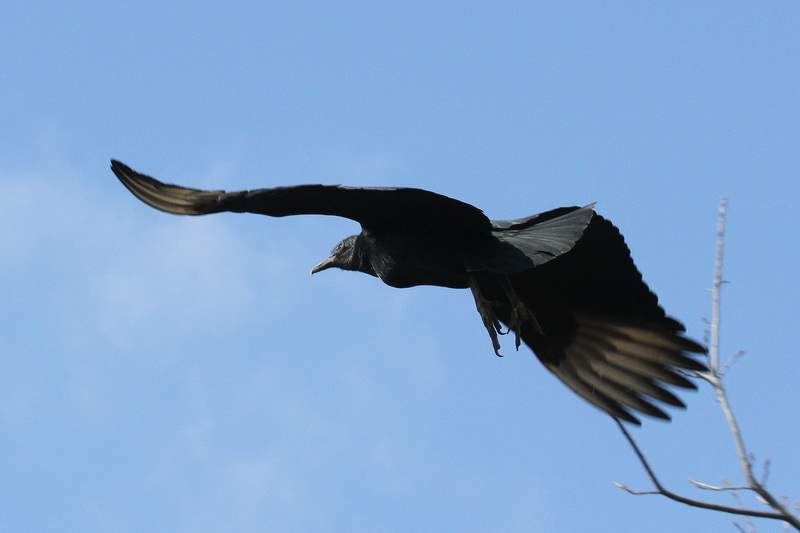
Near the historical Allee House, two Black Vultures, usually seen soaring high overhead, were up close, and almost too personal ...

Black Vulture
Black Vulture
For the second time this winter, I have seen Great Horned Owl - usually at this time of year the limit of contact is their haunting hooting. Not much action from this roosting owl, save for the occasional turn of the head ...

Great Horned Owl
This young red fox hunted in the short grasses along the refuge road ...

Red Fox
And finally ... there were plenty of waterfowl in the pools and ponds, and in nearby fields, several thousand Snow Geese ...

Northern Shoveler
Snow Geese
Good Birding!!

Tuesday, February 05, 2013

Saw-whet & Great Horned

At my home in Vermont, I have had several oblique contacts with the Northern Saw-whet Owl. A neighbor who rehabs raptors had one in his barn that he was nursing back to health. Another neighbor found a dead saw-whet owl in his wood shed. Yet another sent me a photo of one on his front porch. And one more tells me about hearing them in the woods around his home. But until yesterday I have never seen or heard one.

Yesterday, I ticked my first Northern Saw-whet Owl - not in wilds of the Green Mountain State, but within the city limits of Philadelphia, at John Heinz NWR at Tinicum. The little fellow was tucked into a tangle of bittersweet vines about 20 feet from the bike and jogging trail ...

Northern Saw-whet Owl at Heinz NWR, Philadelphia
Northern Saw-whet Owl
It seems like a disconnect to see a "wilderness" bird within the city limits of a major city, but the Northern Saw-whet Owl was not the only such disconnect. Before seeing the saw-whet, a large brown mass in the top of a tall tree drew the focus of my binoculars - a Great-horned Owl. I have had good views of this fierce predator on several occasions in Arizona and Texas. But, around my home in Vermont on only a very few occasions have I heard the haunting hooting sometimes rendered as "who's awake ... you too." From his tree top perch, he followed my steps on the path below ...

Great Horned Owl - Heinze NWR, Philadelphia
Great Horned Owl

Though most of the impoundment and ponds of the refuge were in the frozen grip of winter, the Great Horned Owl was, or soon will be, on the nest. The resident Bald Eagle pair has been remodeling its tree top aerie and will also be on the nest soon. Nearby, planes took off and landed at the Philadelphia airport.
Frozen impoundment at Heinz NWR
Good birding!

Tuesday, December 13, 2011

Owls - Masters of the Night

Athenian tetradrachama, 5th cen. B.C.
Owls are birds of the night. Their nocturnal vigilance was often associated with the studious scholar or the wise elder and made them symbols of wisdom and learning. The Greek goddess of wisdom and learning was Athena; one of her symbols was the owl. The ancient coins of Athens  carried the image of an owl as a sign of the patron goddess who vigilantly watched over the city. The owl was the Little Owl; in an attempt to increase their wisdom, some ancient philosophers ate the Little Owl, hoping to introduce the owl’s attributes of intelligence into their own persons. But they did not know what part of the bird contained the wisdom, so they ate the whole thing.

Athena with Owl, Louvre
The association of the owl with wisdom and learning is still present in a few centers of learning. Temple University in Philadelphia terms itself the “Owls,” while the medieval-style buildings of nearby Bryn Mawr College are decorated with owls. In the corner of Bryn Mawr’s Great Hall, a statue of Athena and her owls receive offerings around exam time.

Owls have large, forward-facing eyes. When we do see a live owl, it appears alert. It surveys its realm with attention and vigilance. It looks intelligent. It looks “wise as an old owl.”

But are owls wise? One writer put it succinctly: “To put it kindly, owls are no wiser than they need to be, i.e., not very.”

Owls are wise enough not to “rotate their heads through 360 degrees as is commonly supposed and which would in the event result in owls heads coming clean off and bouncing about all over the place.” (owlpages.com ) Owls cannot rotate their eyes in their sockets and have compensated by developing extra vertebrae in their necks which allow them to turn their heads about 270 degrees. However, they rarely turn their heads more than 180 degrees. In other words, an owl can look to its left by turning its head to the right but prefers not to.

Owls are primarily night hunters and are superbly equipped for their task Their eyes and ears are adapted to finding prey in the dark. Their feathers are designed for silence. They are the stealth flyers of the bird world.

Owls cannot “see” in the dark. A dead mouse in a totally darkened room went undiscovered by a Barn Owl. But an owl can see in light levels so low that we would be rendered totally blind. Light is measured in “lux”. The lowest number of lux in which humans can see is 37,000. Experiments on a Tawny Owl revealed that the lowest number of lux at which it was able to see was seven!

Or, consider the ears: The ears are asymmetrically located in the skull. The right ear is higher than the left ear. The ear openings are differing shapes. This means that sound reaches each ear a split second apart, enabling the owl to “triangulate” the location of its prey, pinpointing a sound to within ten millimeters with no aid from sight whatsoever. The flat face of the owl, formed by feathers, acts like a satellite dish to capture and direct sound to the ears. Some owls are capable of finding prey by sound alone. An experiment put live mice in a totally darkened room with a Barn Owl. Using hearing alone, the Barn Owl caught the mice every single time.

Barred Owl
The most common owls in Vermont are both nocturnal hunters: Barred Owl and Great Horned Owl. The call of the Barred Owl can be heard throughout our eastern forests; it prefers heavily wooded swamps, hemlock or pine forests. On many occasions I have kayaked on Sunset Lake on a summer evening. Nearly every time I have heard the distinctive call of the Barred Owl: “Who cooks for you? Who cooks for you? Who cooks for you allll?” It is not uncommon to hear a duet from this very vocal owl.

Daytime sightings of the Barred Owl are uncommon, but not unusual. It happens most often in the winter when food may be scarce, or under deep snow cover, or both. A Barred Owl active during the day is a hungry owl. It may also be a young owl which did not have time to hone its hunting and survival skills before winter arrived to make the task of finding food even more difficult.

The Barred Owl is one of the few owls which will reveal itself to humans. In “The Atlas of Breeding Birds of Vermont,” 1985, the Barred Owl is described this way: “A gentle creature with an engaging personality, the Barred Owl can be quite tame and curious even in the wild. One individual raised at the Vermont Institute of Natural Science’s raptor care facility in Woodstock returned there each winter for four years after his release, greeting his former benefactors with hoots, and swooping down to pluck mice from their hands.”

Great Horned Owl
One will often hear expressed something akin to affection for the Barred Owl. Affection is rarely expressed toward the second most common owl in Vermont, the Great Horned Owl. What one hears in relation to the Great Horned Owl is awe. Edward Forbush begins his description of this species this way: “The Great Horned Owl is not only the most formidable in appearance of all our owls, but it is the most powerful. The Great Gray Owl and the Snowy Owl may appear larger, but the Great Horned Owl exceeds them in courage, weight, and strength. Indeed, it little regards the size of its victim, for it strikes down geese and turkeys many times its weight, and has even been said at times to drive the Bald Eagle away from its aery and domicile its own family therein.”

Great Horned Owl - John James Audiubon
The Great Horned Owl (its “horns,” are feather tufts) is the “winged tiger of the woodlands.”Again, Forbush: “The Great Horned Owl is no respecter of persons. It kills weaker owls from the Barred Owl down, most of the hawks and such nocturnal animals as weasels and minks. It is the most deadly enemy of the Eastern Crow, taking old and young from their nests at night and killing many at their winter roosts. Game birds of all kinds, poultry, a few small birds, rabbits, hares, squirrels, gophers, mice, rats, woodchucks, opossums, fish, crawfish and insects are all eaten by this rapacious bird. It is particularly destructive of rats.”

Fishers often get blamed for the disappearance of domestic cats, but it could just as well be the work of a Great Horned Owl. They rule the night, with no natural enemies. Outside of your  home, both of these predators are in their home. Your cat is no match for either. The best way to protect your cat is to keep it indoors.

One early winter morning, I heard through my open window distant hoots: “Who’s awake? Me, too. Who’s awake. Me, too.” The Great Horned Owl was probably calling for its mate, but he also told me that the night belonged to him. I was glad to let him have it. I rolled over and went back to sleep.

Good birding!

Saturday, March 31, 2007

The Winged Tiger in our Woods

I overheard a conversation some time ago. A woman was lamenting the disappearance of her cat. It was outside at night, and never returned. In the woods near her home, she had seen the tracks of a fisher. With a wavering voice, she concluded that her beloved tom had been taken by the fisher.

The out-of-doors can be a dangerous place for all manner of animals. A house cat out-of-doors is a predator; it captures and kills many birds and rodents, and sometimes brags of its prowess by depositing a carcass at the feet of its owner (or cat servant). Sometimes the cat lover will complain about the carcass, but rarely about the unseen toll that the out-of-doors cat may take on other wildlife.

However, fair is fair. Out-of-doors, the distinction between predator and prey is rarely a firm distinction. Beloved domesticated kitty and untamed wild animal means nothing when they all roam, unleashed through the woods, shrubs and fields. Predator may become prey. Predatory house cat may be preyed upon, and not return home come morning.

I was tempted to interrupt the woman whose quavering voice lamented the loss of her beloved tom that beloved kitties are not killed by fishers if they are kept indoors. I did not say that to her. I say it now to all cat owners. Your outdoor cat is a predator. It is also fair prey. Keep it inside. End of sermon.

Pound for pound and ounce for ounce, the fisher may be the most formidable four legged predator in our woods, quite capable of killing an animal larger than itself, including tame pussy cats and of holding off, or even taking down, most slobbering house dogs. However, I suspect it takes the blame for more house cat disappearances than it deserves. The true tiger in our woods is not fur bearing, but feathered - a stealth hunter.

Bubo virginianus - The Great Horned Owl. One of the folk names for the Great Horned Owl is Cat Owl. When food is short, wrote Edward Forbush, the early twentieth century Massachusetts ornithologist, “the owl will attack even the domestic cat, and usually with success.”

The Great Horned Owl is our most widespread owl, found throughout North and South America, and adapted to a wide variety of habitats. “Powerful” and “dangerous” are the adjectives most frequently used by writers from the early nineteenth to the early twenty-first centuries to describe this bird. John James Audubon knew it as one of the most common species along the shores of the Ohio and Mississippi Rivers. “The Great Horned Owl,” Audubon wrote, “lives retired, and it is seldom that more than one is found in the neighbourhood of a farm, after the breeding season; but as almost every detached farm is visited by one of these dangerous and powerful marauders, it may be said to be abundant. The havoc which it commits is very great. I have known a plantation almost stripped of the whole of the poultry raised upon it during spring, by one of these daring foes of the feathered race, in the course of the ensuing winter.”

The Great Horned Owl may have an equal in the Western Hemisphere as a predator, but it has no superior. And in our neighborhoods, it has no superior. The imperial looking Bald Eagle doesn’t begin to compare as a predator. Our national symbol is quite content to feed on a deer carcass (something a Great Horned would never do), or steal fish from an osprey. The Bald Eagle is an adept fish hawk. When necessary, it is capable of taking the similarly sized Canada Goose. But the Great Horned Owl can also take the Canada Goose is spite of the goose weighing three times as much as the owl; it may take a Wild Turkey which can weigh even more than the goose. And, the Great Horned has been observed driving the Bald Eagle away from its aerie and appropriating the nest for its own use. Again, quoting Forbush: “The Great Horned Owl is no respecter of persons. It kills weaker owls from the Barred Owl down, most of the hawks and such nocturnal animals as weasels and minks.” In Texas during a three night period, a Great Horned took a Cattle Egret, a Great Blue Heron, and a gray fox.

The Great Horned Owl has many enemies that hate him, but none that are dangerous, except for humans. It has earned the particular enmity of the crow. And for good reason - its depredations among the crow population can be prodigious. It will take old and young crows from the nest at night and during the winter will pick crows off of their night roosts. It is crows that will most often give away the Great Horn’s presence during the day. When you see crows noisily flying around the top of a tree, it is quite likely that they are mobbing their most dangerous enemy. Eventually the crows’ harassment may stir the desultory owl into flight; as it leisurely flies off, the crows continue their uproarious pursuit. Pete Dunne writes: “Absolutely hated by crows, who amuse themselves by gathering around roosting owls and haranguing them with a gritty vehemence they inflict on no other enemy.” - except that there is nothing amusing about the crows’ actions. The presence of the Great Horned Owl is a mortal danger to the crows. The crows may be courageous and bold during the day, but when night descends they cede any advantage they might have to the powerful stealth hunter of the night.

The Great Horned Owl shares habitat with the Red-tailed Hawk. If you have the hawk, you almost certainly have the owl. One is diurnal, the other nocturnal. The Great Horned Owl nests early, often as early as February when winter still holds its grip. It will sometimes appropriate an old Red-tailed Hawk nest.

In our regenerated Vermont woodlands, it is very difficult to sight a Great Horned Owl. One time on a wooded Newfane hill, I was sure there was a Great Horned in a tree overhead - the mobbing crows gave away its presence with their loud and wild cawing. But the owl was impervious to the crows and I never saw a shadow of its flight.

At night it is easier to know its presence. I have often heard this owl at night as it queries the dark landscape and answers itself: “Whooo’s awake? ... Meee, too .... Whooo’s awake? .... Meee too.” The owl is probably calling for its mate, but he is also telling me that the night belongs to him.

One January day in Arizona, I saw three Great Horned Owls. I was with people who knew where they roosted. They led the way through the desert to a copse near a watering hole where we searched the bare trees for the owl. Its appearance as it perched on the limb conveyed a somnolent disregard for us, or perhaps a haughty arrogance. But as it turned its head and blinked in my direction I felt a sleepy malice in his stare. I was glad that I was too big to be in danger from this winged tiger. At least, I think I was too big.

Photos of Great Horned Owl taken near Willcox, AZ, January, 2005, during "Wings over Willcox" Birding Festival.
Quotation from J.J.Audubon, Birds of America, reprint of 1871 edition. Forbush, et al, A Natural History of American Birds, 1953. Pete Dunne's Essential Field Guide Companion, 2006.

LinkWithin

Related Posts with Thumbnails