Showing posts with label John James Audubon. Show all posts

Saturday, August 20, 2011

Mourning Dove

Mourning Dove
The Mourning Dove is common is our yards, fields, and towns. It is part of the background and as such, it is often overlooked and taken for granted. I am guilty of that. In a dozen years of writing this column, I don’t think I have ever given the Mourning Dove exclusive attention.

“The mourning dove must have been one of the first birds that attracted the attention of the early settlers when this country was new and wild. They must have recognized the bird as not far removed from some of the Old-World species of pigeons, and its notes must have recalled to them their old home. The writers of these times speak of the bird familiarly, especially as a game bird that relieved the hardships of pioneer life.”

With those words, Bent begins his “Life History” of the Mourning Dove. In Bent’s history and in the writing of other earlier observers, the impression that comes through is that the Mourning Dove is just an assumed part of the landscape and as such does not receive a great deal of attention. It was sometimes called a “turtle dove,” by early colonists because of its resemblance to European turtle doves. The repeated “coo, coo, coo” sounded sad and mournful to colonists homesick for their native land; “mournful” adhered to the dove.

The Mourning Dove’s “coo, coo, coo” is sometimes heard as a “hoot.” As you know, owls “hoot” in popular parlance. On a number of occasions I have had non-nature type people tell me they have heard an owl, leaving me the mournful task of explaining that what they have actually heard is a Mourning Dove.

In addition to its hooting “coo,” the mourning dove also “whistles.” The whistle is not a vocalization; it is produced by the wings when the bird takes off.

Detail - J.J.Audubon's "Mourning Dove"
Whatever imagined sadness the Mourning Dove may have been “cooing” about to earlier generations, it was viewed by them primarily as a game bird.  John James Audubon painted his Mourning Doves as loving and devoted couples, and then with his typical disconnect, described their tastiness: “The flesh of these birds is remarkably fine, when they are obtained young and in the proper season. Such birds become extremely fat, are tender and juicy .... These birds require good shooting to bring them down, when on wing, for they fly with great swiftness, and not always in a direct manner. It is seldom that more than one can be killed at a shot when they are flying, and rarely more than two or three when on the ground.”

Apparently the gunning skill required to shoot Mourning Doves is what still makes them a game bird in many states. It certainly is not, and never was, a major source of food. At just over four ounces in weight, feathers and all, it would take a lot birds to make a meal.

By the early twentieth century the Mourning Dove’s numbers were severely decreased in New England. In 1908, it received protection in the northern states as a songbird, allowing its numbers to increase. Today in appropriate neighborhoods in our area, it can be considered common, to very common, to abundant.

The Mourning Dove ranges throughout the United States and Mexico. In southern Canada  and the northern United States it is seasonal, breeding during the Spring and Summer and then migrating to warmer climes.

In Southern Vermont, the Mourning Dove can be seen throughout the year, but the birds of the summer and the birds of the winter are not necessarily the same birds. Banding studies have demonstrated that many Mourning Doves undertake a long migration. For example, birds banded in Wisconsin have been recovered in Louisiana and Alabama. Texas to northern Florida is the favored winter home; banded birds recovered in these areas have come from across the northern tier of states, from New Jersey and New York through Pennsylvania, Ohio, Michigan, and westward through the northern plains states.

The migratory habits of the Mourning Dove probably account for its remarkable uniformity across its vast range. The birds mingle and mix during the winter. When they return to the breeding grounds their DNA also gets mingled and mixed. Most modern field guides (Sibley in particular) note racial differences among species especially where those differences are notable in the field. Almost no attention is paid to subspecies of the Mourning Dove because the differences are so slight. Bent describes the western race as slightly paler and slightly larger. But note the word, “slightly.”

Charles Lucien Bonaparte
Mourning Dove (Zenaida macroura) belongs to the family, Columbidae, from the Latin for pigeon or dove. In general, the larger members of this family are called pigeons; the smaller members are called doves.

The Mourning Dove was named by Charles Lucien Bonaparte, a nephew of Napoleon Bonaparte. When the family fortunes declined after Waterloo, Charles moved to America with his new wife (and first cousin), Zenaide and his uncle/father-in-law, Joseph. He lived in Bordentown, New Jersey and Philadelphia, Pennsylvania. “While residing in the United States from 1822-1828, he re-edited a volume with the longest title in American ornithology ... ‘American Ornithology, or History of Birds Inhabiting the United States not given by Wilson.’” Bonaparte is considered to be the father of systematic ornithology in America. Bonaparte’s Gull commemorates him.

Zenaide Bonaparte (right)
Bonapare honored his wife with the Genus Zenaida. Mated pairs of Mourning Doves exhibit a very close association. An old common name for the dove was “love bird.” Bonaparte may have linked the name of his wife to this dove as a symbol of conjugal bliss.

 The species name, macroura, comes from the Greek for “long” and “tail.” Thus the literal meaning of the name, Zenaida macroura, is “Zenaida’s long tail.” The long tail of the Mourning Dove is considered by some to be its outstanding characteristic. When the bird is perched, the tail is long and pointed. Then it takes flight and the long tail flares in an elongated triangle with prominent white tips on the outer tail feathers.

More next week. Good birding.

Saturday, February 05, 2011

Alexander Wilson and John James Audubon

Alexander Wilson
Alexander Wilson immigrated to America from his native Scotland, a failed poet and political rabble-rouser. John James Audubon immigrated from France, sent to America by his father in order to avoid Napoleon’s draft. Wilson settled in Philadelphia. Audubon went to Millbrook outside of Philadelphia, an estate owned by his father. Wilson tried many jobs, none with much success. Audubon tried to be a merchant, consistently failing. Wilson managed to befriend prominent and well-to-do Philadelphians who encouraged his study of birds. Audubon gained entrance to many of Philadelphia’s prominent circles through his father. Wilson conceived his “American Ornithology” and gained the support of his prominent friends, even though he knew little about drawing and painting and was unable to identify many birds. Audubon preferred wandering the woodlands rather than being a merchant, collecting specimens, and painting watercolors of the birds he collected.

Wilson undertook long journeys throughout the eastern states and territories studying and drawing birds. Audubon traveled extensively throughout North America and the northern hemisphere studying and drawing birds. Wilson worked with an American printer, did his own engraving, traveled extensively to sell his work by subscription, and completed seven of nine volumes. He died prematurely, leaving volume eight to be published posthumously and volume nine to be written by a friend. Audubon went to England to publish his “Birds of America,” engaging a prominent London engraver. He sold his work by subscription. When the double elephant folio was complete, he published a smaller octavo edition, also sold personally by subscription. This seven volume work eventually was issued nine times.

Wilson is known as the father of American ornithology. Audubon is synonymous with birds throughout the world. Wilson was a poor draftsman and artist. Audubon was a talented and creative artist.

Wilson and Audubon shared the Philadelphia area as their home base, but their paths never intersected there. They met one time. Audubon was a merchant in Louisville, Kentucky, on his way to a business failure. Wilson’s journals from the time of their meeting in 1810 have been lost, though there are accounts written by Wilson’s friends who were also Audubon’s enemies. These tell of the two men meeting, and going hunting together for two days.

Audubon recounts the day when Wilson came into the counting room with two volumes of Ornithology under his arm. Wilson showed Audubon his work, and Audubon was ready to subscribe. Aubudon’s partner dissuaded him, telling Audubon (in French) that his drawings were far better than Wilson’s. Audubon did not subscribe and Wilson was miffed. Audubon showed Wilson his own portfolio which purportedly held almost two hundred paintings.

Audubon's "Small-headed Flycatcher"
According to Audubon, Wilson was relieved to learn that Audubon did not intend to publish his paintings. On the other hand, it may be that this meeting planted the idea in Audubon’s mind of publishing his work.

What is certain is that this single meeting led to a rivalry between the two men, a rivalry  which arose mainly after Wilson died in 1813. The rivalry revolved around charges and counter charges of plagiarism.

Wilson’s “American Ornithology” included a drawing of a “Small-headed Flycatcher.” Audubon claimed that Wilson copied from his drawing which he made in 1808. It is certainly possible that Audubon showed his drawing to Wilson in 1810, and Wilson, never having seen the bird and needing a record, made his own drawing based on Audubon’s. The “Small-headed Flycatcher” at the center of the controversy was an immature, warbler-like bird. Here’s the irony in the controversy. Today, nobody knows what the bird is. No one has seen or recognized the bird since Audubon - or Wilson - encountered it and drew it.

Wilson's "White-tailed Eagle" (Bald Eagle)
Audubon's "Bald Eagle"
The charge of plagiarism leveled by Audubon against Wilson had repercussions. Friends of Wilson came to his defense by pointing out that some of Audubon’s paintings were remarkably similar to some of Wilson’s painting.  “Why Audubon, an infinitely superior draftsman, should have been tempted to copy Wilson is mysterious, but the resemblance between his Bald Eagle, his Mississippi Kite, and his Red-winged Blackbirds and the indisputably prior drawing by Wilson of these species is beyond coincidence.” (Leahy, Birdwatcher’s Companion)

Scott Weidensaul in his history of American birding, “Of a Feather,” summarizes the quality of Audubon’s painting: “no one had ever brought such vitality, such raw emotion and surging power, to the painting of birds. Audubon smashed centuries of artistic convention, packing his birds among lovely vignettes or fully realized landscapes .... They were not generic, paste-board silhouettes, although Audubon drew a few of those, too, especially ones he lifted from Wilson.”

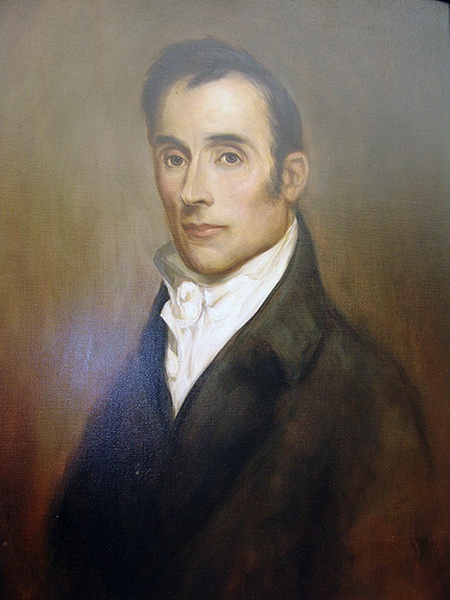
J.J.Audubon
One wonders what the results might have been if these two geniuses, one in ornithology, the other in painting, had managed to collaborate. In those days of slow travel and slow communication, the logistics of such theoretical collaboration are hard to imagine. Then there would have been ego; “no one held a higher opinion of Audubon than Audubon himself.” (Weidensaul) There is not much room in any room for one big ego, let alone two.

Wilson and Audubon are fascinating personalities who made pivotal contributions on the literal frontier of early nineteenth century America, and on the frontiers of science, natural history, painting, and learning in the robust and emerging culture of the New World.

Saturday, March 28, 2009

Audubon's Encounter with a Mallard & Her Family

John James Audubon's The Birds of America holds a well-deserved place in the literature and early nature writing of America. As I wrote about the Mallard, I found many parts of his account useful and informative. The following passage also captured me, but it did not fit into the focus of the columns. So I reproduce it here.

"Once I found a female leading her young through the woods, and no doubt conducting them towards the Ohio. When I first saw her, she had already observed me, and had squatted flat among the grass, with her brood around her. As I moved onwards, she ruffled her feathers, and hissed at me in the manner of a Goose, while the little ones scampered off in all directions. I had an excellent dog, well instructed to catch young birds without injuring them, and I ordered him to seek for them. On this the mother took to wing, and flew through the woods as if about to fall down at every yard or so. She passed and repassed over the dog, as if watching the success of his search; and as one after another the ducklings were brought to me, and struggled in my bird-bag, the distressed parent came to the ground near me, rolled and tumbled about, and so affected me by her despairs that I ordered my dog to lie down, while, with a pleasure that can be felt only by those who are parents themselves, I restored to her the innocent brood, and walked off. As I turned round to observe her, I really thought I could perceive gratitude expressed in her eye; and a happier moment I never felt while rambling in search of knowledge through the woods."

LinkWithin

Related Posts with Thumbnails