Last week I left you hanging when I concluded with a report of a hot-pink breasted sandpiper which I saw at the Heislerville Wildlife Management Area along the Delaware Bay coast in southern New Jersey.
I was driving slowly along Matt’s Landing Road. A few lone peeps and plovers were feeding on the mud flats close to the road. A spot of color caught my attention. Even from the car, and without binoculars, I could see a small shorebird with a hot-pink breast. I pulled to the side and scrambled out of the car with camera in hand.
By the time I had taken my photographs of this hot-pink breasted sandpiper, I knew what it was. But I did not know the full story until I was back home processing my photographs and had done some internet research.
There was a time in my early bird watching career when I would have been super excited at finding some super rare bird with a hot-pink breast. I would have hurried to my books and scoured them for a sandpiper with a pink breast, and may even have tried to bend the guidebook so that it would conform with what I had seen. The temptation to make the evidence fit the conclusion is always seductive. Even the best birders and best scientists are occasionally seduced; I am not the best in either category and it certainly happens to me.
 |
| Semipalmated Sandpiper |
But not this time. Everything about the bird - its size, its shape, its behavior - said Semipalmated Sandpiper, one of our smallest, and most common, peeps. Peeps are the small sandpipers which are so named because they vocalize with what is generalized as “peep.”
As I climbed back into the car, I concluded that this Semipalmated Sandpiper had acquired its hot-pink breast from researchers who were studying and tracking migrating shorebirds. Its breast had been dyed hot-pink to help in spotting the bird among the thousands of other birds with which it was traveling.
At home I processed my photographs which consists primarily of cropping in order to improve composure or to provide an enlargement of the subject. It was then that I noticed the leg bands. On the left leg there was a conventional aluminum band. The aluminum band contained a unique numeric code. The master data base for bird banding is maintained by the United States Geological Survey. When a bird is first banded, banding data is reported to the USGS, including where and when the bird was banded and who banded it. (A federal license is required.) When a bird is banded, it is also examined to determine weight, health, sex, age, and size. If the same bird is recaught by a licensed bird bander, the same information is gathered again and reported. Bands are also recovered from birds that have had fatal encounters with radio towers, windows, hunters, and your sweet house cat. Collectively, the information gathered from bird banding yields data about migration patterns, how long birds live, environmental stresses, and much more.
One document I found reported 690,000 non-game birds banded and about 8,000 recovered. That’s a 1.2% recovery rate. The smaller the birds, the lower the recovery rate. With vireos and warblers, 131,000 birds were banded; 89 were recovered. That about 6/100ths of 1%. The recovery rate for shorebirds is about 1%: 16,000 banded, 136 recovered.
The difficulty with conventional banding is that the bird must be physically captured (renetted) or recovered (e.g., found dead). Researchers look for alternate ways of gathering information without having to rely on physically holding the bird in their hands.
 |
| Semipalmated Sandpiper - green leg flag "E6N" |
The hot-pink dye on the breast of the Semipalmated Sandpiper is one of those ways. The bird stands out in a crowd. A bird watcher scanning a flock of sandpipers will notice one sporting the hot color.
When I was processing my photos of the Semipalmated Sandpiper, I noticed a second band. It was a light green flag on the right leg with a three character code which I could read: “E6N.” I made some inquiries and learned of two places where the flag could be reported:
Shorebird Resighting Information: http://bandedbirds.org
USGS Reporting Encounter of Marked Bird: http://www.reportband.gov/
I also emailed my sighting, and a photograph, to New Jersey Audubon. I received this reply: “This bird was banded by NJ Audubon's research staff, almost certainly right there at Heislerville (Matt's Landing) within a few days of when you photographed it (the breast dye indicates it was banded this year). Part of our banding effort is to re-find previously banded birds, and you've helped us in our work.”
 |
| Red Knot - green leg flag "3CK" |
As I continued processing my photos, I found several additional shorebirds with leg flags and reported them.
I am sure readers can see how these flags can significantly increase the number of resightings. An observer with a scope on Plum Island, in the Bay of Fundy, or along Hudson’s Bay will see the pink breast and focus on the bird. With less luck than it takes to recapture a banded bird, resighting data can be collected and entered into the data base.
 |
| Ruddy Turnstone with color-coded leg bands |
Colored leg flags and dye are two of the techniques researchers use to track birds. Colored leg bands in various combinations are another technique used to track individual birds. One of the newest techniques is the use of miniaturized radio transmitters and satellite tracking; unfortunately, the expense severely limits this technique.
The first bird banded in North America was an Eastern Phoebe. In 1803, John James Audubon tied a silver thread around the legs of nestling phoebes at his family home, Millgrove, Pennsylvania. Two of those nestlings returned to Millgrove the following year, convincingly demonstrating fidelity to the natal site.
Audubon got banding started on our side of the Atlantic. Today hundreds of researchers and thousands of bird watchers continue to gather data about the migration of birds. It is all part of the ongoing effort to ensure that our next generation can enjoy good birding.




 Matt's Landing is part of the Heislerville WMA in the county north of Cape May. After a morning in Belleplain State Forest, I spend the mid-day along this part of the Delaware Bay. The managed impoundment is a great shorebird spot, and I was there at low tide, so there were thousands of birds present. This next picture shows a tiny segment of the roost. Semipalmated Sandpipers dominate in the foreground, Dunlin in the background. Can you find the dowitcher?
 A tight group of Semipalmated Sandpipers (plus three Semipalmated Plovers). The SESA is one of the "easy" peeps. I talked with another birder who had seen a White-rumped Sandpiper. Curlew Sandpiper is also seen regularly here, but I just did not have the patience to search 20,000 birds for either - especially since they regularly rearranged themselves! ....
 .... as this next photo shows. It is likely that a Peregrine Falcon was somewhere overhead, since all of the birds on the impoundment took to the wing at one time, putting a curtain of birds on the scene! Breathtaking - although I have to remind myself that this is just a fraction of the numbers that refueled along the Delaware Bay a few years ago (another issue). Black dots in this mass of birds will clue you to Dunlins.
 Matt's landing has been a dependable place for the Red Knot, but not this year. The only place I saw them was by Stone Harbor. After the cryptic reference to dowitchers, a couple of more satisfying photos are in order. The two dowitchers are notoriously difficult to tell apart, so if anyone thinks I have mis-identified these as Short-billed Dowitchers (adult breeding Atlantic - white belly, buffy to orange neck), please tell me.
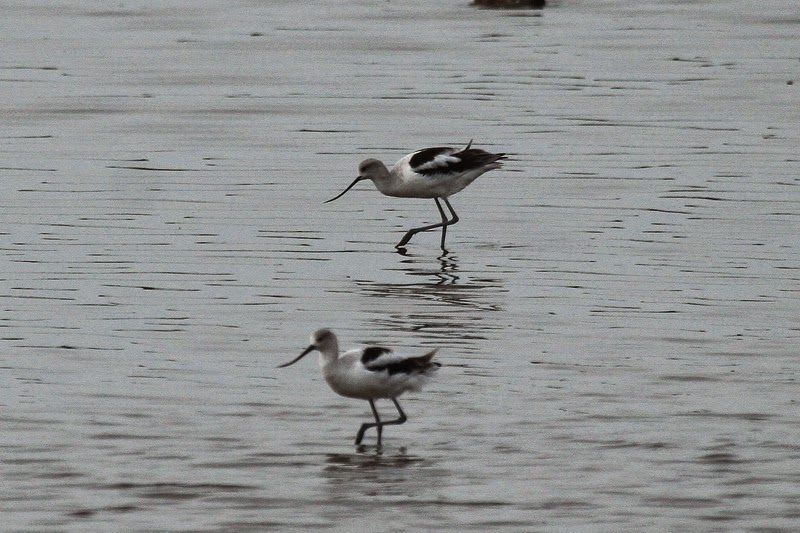
 An unexpected treat was the American Avocet, a bird that is accidental in New England and rare in New Jersey. (This was only my second sighting of one in the Northeast, if the Northeast can be extended as far south as New Jersey.) A beautiful bird! - and I hope it can find its way to breeding grounds and pass along its genes.
 Godd birding!

