Showing posts with label White-winged Crossbill. Show all posts

Thursday, February 28, 2013

Winter Irruptions

Watching birds can do lots of good things for you, including expanding your vocabulary. Or at least, it has expanded my vocabulary. Until I had the time to pay attention to seasonal changes and movements of birds, I did not have the word, “irruption,” in my working vocabulary. I knew “eruption,” which involves something bursting out, like lava from a volcano. Irruption refers to something bursting in, or surging up. It is the word used by ecologists to describe a sudden, rapid, and irregular increase in an animal population. It typically involves some kind of change in the natural ecological checks and balances.

In the bird watching world, irruptions are hoped for events, especially as winter imposes its grip. Winter birding can be rather monotonous - the same old, same old, unless one or more irruptions occur. “Bird Source,” the website of National Audubon and Cornell Lab of Ornithology, puts it this way: “Every winter, bird watchers across North America anxiously await the possible incursion of birds that don't normally winter in their areas. These periodic bird irruptions add a dramatic level of excitement to winter birding.”

Snowy Owl - Brattleboro, Dec, 2011

Last winter (2011-12) was an irruptive year for Snowy Owls. These large arctic predators were reported in record numbers across the northern states, often in places where they have rarely, or never, been reported. Sightings extended deep into the Great Plains and even as far south as Texas. The Snowy Owl irruption was driven by a crash in the lemming population in the Arctic; the lemming is the owls’ principal food source.

When a Snowy Owl was reported in mid-December, 2011, in the corn field behind the marina in Brattleboro, the word spread quickly through the birding community. Within an hour of the first report, a dozen birders were focusing their scopes on the white object among the corn stalks. More observers followed in a steady stream.

Finch species which inhabit the northern forests are the most common irruptive birds, and this winter has been a banner year in our area. During October, large flocks of Pine Siskins (closely related to the American Goldfinch) moved through New England and the mid-Atlantic states. The flocks which visited my bird feeders numbered 200+; they put a serious strain on my bird seed budget.

Common Redpoll have irrupted in New England this winter

The siskin flocks moved on, to be followed by the Common Redpolls (also closely related to goldfinches). Throughout December and January, and on into February, there have been breathless reports about the sudden appearance of these small finches.

What makes the winter irruptions both exciting, and frustrating, is their unpredictablility. As the birds irrupt into New England, they do so in flocks - often large and typically very nomadic. So you hear about all of these redpolls being seen, and you are frustrated, because you have not seen a single one. And then you are snowshoeing through an old hill farm, or walking along a frozen lane, or sitting in your kitchen watching your bird feeders, and suddenly you have a surfeit of redpolls, scratching the snow, squabbling over seed, and taking hurried flights into the hedges.

Winter finches are notorious for quickly exhausting a food source and then moving on. The epitome of this practice is the Evening Grosbeak. Long time bird feeders describe the Evening Grosbeaks’s winter presence with ambiguity. They are delighted to have these large, colorful, and handsome finches at their feeders, but they cannot avoid the additional use of adjectives such as voracious and greedy to describe their presence. This winter Evening Grosbeaks seem to have taken their blitzkrieg feeding habits further south; I have seen few winter reports from our area.
Evening Grosbeak flocks are notorious for emptying bird feeders & moving on during winter.
 The winter finches which are typically more common in our area have been hard to find this year. In addition to the siskins and grosbeaks which have moved on, Purple Finches and goldfinches are scarce.

Pine Grosbeak - Brattleboro, December, 2012

But then there are the frustrating reports of other winter finches - frustrating because you would love to see them, but they do not make it easy. For a couple of weeks in December, a flock of Pine Grosbeaks fed on the yew berries in front of Center Church in Brattleboro. There were females and young males. (The adult males apparently stayed home to defend their territory through the winter). When the berries were exhausted, the flock moved on. If you have not seen the Pine Grosbeaks, you may still have the opportunity. Be alert, because they could be anywhere. On the Christmas Count, we came across several getting grit and salt on a road in Dummerston. If you miss the Pine Grosbeak this winter, I am sorry to tell you that you may not have another opportunity for several years. But, that’s bird watching.

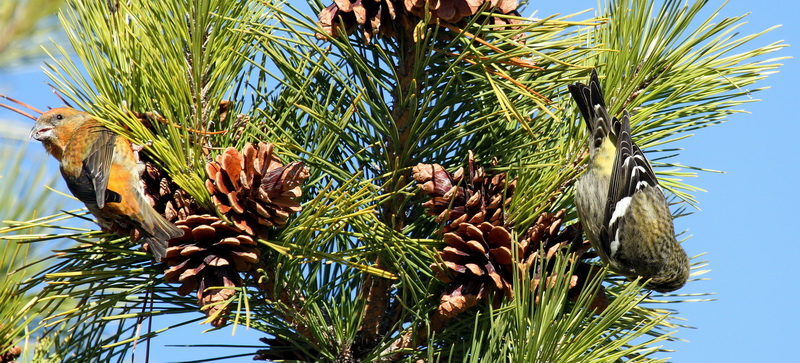
White-winged Crossbill (l) & Red Crossbill (r), December, 2012

On the New England coast, this has been a good winter for Red Crossbills and White-winged Crossbills. I made a trip to Salisbury Beach on the New Hampshire coast and had my best crossbill day ever.

Winter irruptions are driven by conditions in the northern forests. Scientists and naturalists in Ontario and the Maritime Provinces have been studying the preferred food sources of various species for years. Based on their collected data, fairly accurate predictions are possible about which species will irrupt. When they document the shortage of a food that a particular species prefers, they predict an irruption. Winter survival depends upon getting enough food. When local food sources are scarce, the birds go elsewhere.

Red-breasted Nuthatch

Finches are the most common irruptive species during winter, but not the only ones. It is easy for us to miss an irruption of the Red-breasted Nuthatch, since this species also nests in the higher elevations of our area and may be seen year-round. Harder to miss when you come across them are the Bohemian Waxwings. When you find Bohemians among the flock of their cousins, the Cedar Waxwings, then you have counted a coup among bird watchers. And when you meet a waxwing flock dominated by Bohemians, you have certainly encountered evidence of an irruption. And, you will be breathless.


Bohemian Waxwing, Putney, 2011
For any of these winter irruptions, I have two pieces of advice if you are not a hard core birder: First, I am sorry to say, don’t hold your breath. The winter flocks are nomadic and erratic. Hard core birders sometimes spend days trying to chase them down, not always successfully. Second, when you do stumble on one of these flocks, or when one of these flocks stumble on you, don’t forget to breathe!

Good birding!

Thursday, December 13, 2012

Red Crossbill

As promised ... Red Crossbill images from last week at Salisbury Beach State Park campground.

There are 7-9 "types" of Red Crossbill, which some consider to be separate species. Type 1-4 occur continent wide. Type 8 is found (rare) in Newfoundland. The remaining types are western. (Sibley) If anyone has any thoughts as to which type these photos represent, please offer your comment.

Red Crossbill (male)

Red Crossbill (female)


Family Quarrel??

Well, she seems to be ignoring him, whatever his complaint.

Red Crossbill (male) (l) & White-winged Crossbill (female) (r)
Good Birding!!

Monday, December 10, 2012

White-winged Crossbill

Last week's trip to the Massachusetts coast yielded a great day of birding with abundant photo opportunities, highlighted by both crossbills. I promised additional photos, but was delayed by the Pine Grosbeaks close to home.

The cone laden pines in the campground at Salisbury Beach State Park are likely to host these birds for some time.

White-winged Crossbills were the more abundant of the two. Images are below. I'll post Red Crossbill photos in a couple of days.

White-winged Crossbill (female)

White-winged Crossbill (male)


White-winged Crossbill (young male)

White-winged Crossbill (l) & Red Crossbill (r)
Good Birding!


Friday, December 07, 2012

Crossbills

Yesterday was a crisp, clear, bright day - a marvelous day for birding and wonderful light for photography. I drove to the Massachusetts shore. Crossbills were being reported in the campground at Salisbury Beach.

The cone-laden pine trees hosted flocks of White-winged Crossbills and Red Crossbills, the most concentrated winter irruption of these boreal species that I have seen. Here is an early sampling. I'll post additional photos soon.

White-winged Crossbill (male)

Red Crossbill (female and male)
 Crossbills usually travel in single species flock (Sibley), but there was a mixed flock (or two separate flocks which decided to forage in the same trees), as seen in this photo ...

White-winged Crossbill (l) and Red Crossbill (r)
Red-breasted Nuthatches were clearly another irruptive boreal species, with numbers almost rivaling the crossbills ...

Red-breasted Nuthatch
 As I stood with two other birders was watching the crossbills feeding, my binoculars picked up a Common Redpoll. I casually named the bird. A few moments later, one of the birders said, "Thank you. That's a life bird." It is always gratifying to help others add to their observations.

Common Redpoll
 In the estuary near the campground, Bonaparte's Gull provided an accesible display of their tern-like hovering ...

Bonaparte's Gull
At Plum Island, a scan of the ocean produced a rare Western Grebe, plus Horned Grebe, Common and Red-throated Loon, Razorbills, Surf and Black Scoters, Common Eider, and Red-breasted Merganser, all fairly close to shore but too distant for photography. At the waters edge was a flock of Sanderling and Dunlin ...

Sandering (l) and Dunlin (r)
A day of Good Birding!!

Wednesday, February 01, 2012

Road Salt

White-winged Crossbills often become
"intoxicated" on road salt
Not long ago a friend arrived late for a community supper. The reason she gave for being late was received by some in the group as far-fetched, but they acknowledged that it was a creative and original excuse. She said, “I was coming down Newfane Hill and there were a couple of White-winged Crossbills in the middle of the road. They must have been intoxicated with salt because they wouldn’t move, so I had to get out of the car and make them move.” When I came soberly to her defense, it was then suggested that perhaps I had the same problem as the birds.

Intoxicated is not precisely correct, but it is close enough. Crossbills have a fondness for salt, and (according to Forbush) they will eat almost anything that is well-salted. Along our winter roadways, they can get their salt along with a dietary essential - dirt and grit. But too much salt can produce listlessness leading to mortality. That is, the birds don’t feel like moving and get run over, unless the approaching driver has a greater concern for the birds than getting somewhere on time - and there don’t seem to be too many drivers like that on our roads.

This opens a couple of doors on bird biology. Birds lack teeth and have little sense of taste, and so tend to swallow their food whole. Their stomachs have two parts, one with digestive juices which act similar to the human stomach and a second, large stomach known as the gizzard. The tough hard muscular walls of the gizzard, aided by swallowed sand and dirt, serve the function performed by human teeth, grinding and pulverizing solid substances such as seeds. Those flocks of finches and juncos which we see along our roadways in the winter are eating dirt - they are ingesting the grit necessary to enable the gizzard to “chew” the seeds which they swallow whole.

Coincidentally, they are also getting a good bit of salt as well, and this can present a problem for the birds. Human kidneys are not very effective at flushing salt from our system; it requires lots of fresh water. Those old mariners set adrift on oceans of salt water died of thirst: “water, water everywhere, and not a drop to drink.” If they drank the salt water, their kidneys would dehydrate the rest of the body to flush the salt.

The "tubenose" of pelagic birds, like Cory's Shearwater,
is visible evidence of the salt gland
which secrets salt from species which live on salt water

Bird kidneys are even less effective in dealing with excess salt than are human kidneys. However, sea birds will often spend months far removed from any fresh water and must drink sea water. How do they manage? They manage through a special gland located in the skull over and/or in front of the eyeholes and connected to the nasal opening by a duct. It is called the salt gland. The salt gland removes salt from the bloodstream and then secretes it in a highly concentrated form through the nostrils. The head shaking seen in some oceanic birds is done to expel this saline solution. Salt glands are larger and more developed among seabirds than land birds. Birds we are most likely to see with developed salt glands include gulls, terns, sea-going ducks (eiders), geese, coots, and rails.

Savannah Sparrow in a NJ salt marsh

The salt glands is present in songbirds (passerines) but is not functional unless the birds are regularly exposed to salt. The subspecies of the Savannah Sparrow which lives in salt marshes is able to secrete 2-3 times as much salt as other subspecies which live in salt-free habitats.

So why are the crossbills so fond of salt? I have no idea! The Birder’s Handbook simply notes under “Diet” that White-winged Crossbills are fond of salt, and then adds cyrptically: “Fondness for road salt produces occasional heavy mortality as listless birds are run over.” Too much salt is toxic, and so the birds are “intoxicated,” just as my friend said when explaining her tardiness. I guess we might say that salt is to crossbills what alcohol is to some humans; some individuals don’t know when they’ve had enough.

Good Birding!!


Link to additional information on "Birds and Salt"

Monday, February 23, 2009

Coastal Birding

At Salisbury Beach on Friday afternoon, White-winged Crossbills were busy in the pines ...

Around Cape Ann on Saturday, Iceland Gulls were found in several locations, this one at Lighthouse Point ...

Back at Salisbury Beach, the female Merlin which put on a show for us Friday afternoon, simply watched over her domain on Saturday, and again on Sunday morning ...

A clear highlight of the trip was the Snowy Owl seen Saturday afternoon on a dune at Salisbury Beach ...


The owl, of course, attracted the bird watchers and photographers. Here are just a few of those who gathered to observe the owl atop a dune about thirty yards away ...

A day of good birding. I will have more about the day anon.

Saturday, December 22, 2007

More Canadian Birds Show Up in Christmas Bird Count


There was more snow on the ground than I can remember in my eleven years of doing the Brattleboro Area Christmas Bird Count (CBC). And it was colder than previous years. And when the wind blew, it was colder yet. By mid-afternoon, the clouds began moving in; the air became dank and damp and felt even colder. My heavy insulated boots kept my feet warm, but everything became chilled.

Tiny birds moving through tree tops are located by ear, not eye, and that means exposing tender, delicate flesh to the frigid air. We could sort of warm up in the car as we crept slowly from place to place, except that the windows had to be down so we could listen as we crept along, and the fan motor on the heater had to be low or off because it made too much noise. The rivers and ponds were frozen. The fields were barren and cold. There were icy patches on many roads, and no place to pull off the road when we had to stop, walk, listen, count, freeze and shiver.

I had a blast!

The annual CBC is one of my favorite days of birding throughout the year. In the late Spring, I can stand in my backyard and see or hear thirty to forty species in the early morning hours. Last Saturday, the team I was with scoured our assigned area and eventually tallied twenty-nine species. We wandered slowly along dirt roads until somebody watching or listening through the car windows cried, “Stop.” Then we tumbled out of the vehicle before it had stopped to chase an elusive sound or sight.

But in the winter landscape, when all of life seems to have gone into hiding, finding signs of life still on the move - up and about and around - is energizing and affirming. And we never know what we will find.

We almost always find wintering bluebirds in our survey area, and this year we found one lone bluebird perched on a wire not far from Brattleboro. We continued searching the orchards along our route. Sooner or later we almost always find bluebirds working through one or more of these orchards, but not this year.

In the mid-afternoon we were in a dense stand of hemlocks; Juncos moved through the forest understory. Watching them, and counting, we were led to a Golden-crowned Kinglet in a small, leafless beech, and that lone kinglet led us to more kinglets. Conventional wisdom has it that several species will forage together through the winter woods, and we soon found the only Brown Creeper of the day, inching its way up a huge hemlock, then following the juncos and kinglets south along the road. Movement deep in the woods caught our attention. A larger bird ... another ... and another. One landed on the road forty feet from us, picked salt and grit from the road, and flew. Eastern Bluebirds - thirteen in the flock.

About thirty people participated in this year’s CBC. Seven teams surveyed assigned areas and counted the winter birds. One team searched frustratingly all day and tallied only a few species and few numbers. But they had a great time following mammal tracks. Numbers often seemed hard to come by. But by the end of the day, forty-eight species had been tallied with an unofficial total around 3000. Additional “count week” species brought the total for this year’s CBC to fifty-five.


Fifty-plus species has become the norm for the Brattleboro CBC. The species vary from year to year. Each year there are a few species reported which have no business being here; they should have gone south long ago. This year there was a Great Blue Heron seen in flight, and a Northern Flicker. Species recorded for the first time were Yellow-bellied Sapsucker (two) and an American Woodcock. These migrants should have migrated before now, and quite frankly, not having done so may be a fatal mistake.

With almost no open water, it was no surprise that Canada Geese (some years there are hundreds) were completely absent as were most other waterfowl. A few ducks were found in the open water above and below the Vernon Dam and where Whetstone Brook enters the Connecticut River.

Totals for most of the usual wintering birds were close to the average for the last nine years. Here are a few “Average/’07 Count” - American Crow: 230/74; Blue Jay 195/161; Black-capped Chickadee: 447/576; Downy Woodpecker: 42/38; Hairy Woodpecker: 15/27; Tufted Titmouse: 54/54; Northern Cardinal: 34/41; Mourning Dove: 196/206; White-breasted Nuthatch: 58/55.

Count numbers for the invasive birds that no one likes but which feed the wintering hawks also matched recent numbers - European Starling: 362/336; Rock Pigeon: 285/ 271; House Sparrow: 211/166

The significant difference this year was the presence of wintering finches. Reports of birds irrupting south from Canada (where many seeds crops failed this year) have been coming from all over the Northeast. But we had to find them on count day, and we did. We counted fifty-one Common Redpolls, probably an undercount - since these birds are very nomadic as they forage. One year counters found a single flock of redpolls with over 200 birds, but not this year. There was a flock of twenty Snow Buntings, a scattering of forty-plus Tree Sparrows, and fourteen Evening Grosbeaks.

The buzz came with two other winter finch species which have only been recorded once in the last dozen years. In 2001, eleven Pine Grosbeaks were reported. This year, eighty-one were counted. These large, tame, red and gray male - or olive and gray female - finches are being found in fruit trees and berry bushes in many locations in southeastern Vermont. They stripped my loaded crab apple weeks ago.

The other finch species, also last reported in 2001 during count week, was found in a pine forest atop Stratton Hill in Newfane - five White-winged Crossbills. This is be the first time our CBC has recorded an actual count number for this species which feeds on pine and spruce cones.

So it was cold, and wintery, and sometimes difficult to find the birds. But the end result is a snapshot of the bird life present in the Brattleboro area in the middle of December. Added to the results of thousands of other counts done around North America, we also contribute to a snapshot of the continental bird life. These accumulated snapshots from many years help researchers analyze the health and well-being of the birds, and more importantly, of the state of the environment and climate on which the birds - and all other life, including us - depend.

And it was fun. The Christmas Bird Count is always a good day spent with some crazy bird nerds and resulting in - by definition - a day of good birding.

LinkWithin

Related Posts with Thumbnails