Showing posts with label feather trade. Show all posts

Saturday, October 29, 2011

When Feathers Were More Valuable than Gold

Rock Pigeon nesting in Elliott St retaining wall -
a non-native bird that adapts to urban habitat
I enjoy standing on the top deck of the parking garage in Brattleboro and watching the pigeons swirl over the downtown buildings. They are masters of urban adaptation and they thrive in the barren habitats of cities and towns. As I walk down the stairs to Flat Street, I pause to watch their activity in the rock retaining wall beneath Elliott Street. Like the ancient cliffs that gave them their name, Rock Pigeon, they build their simple nests in the wall and raise brood after brood.

On Main Street, nondescript brown birds pick crumbs dropped by diners from beneath sidewalk tables. House Sparrows are the second species that has adapted and manages to make its living in the barren habitat of downtown streets.

Northern Flicker - a species favored by milliners
for adorning feathered hats
By contrast, if I want to see a native species such as the Cedar Waxwing, I will not look for it at Main and Elliott. I’ll go up to the neighborhoods and look for fruit trees, or further out to the orchards, or wherever berries hang heavy on bushes. If I want to see Northern Flickers, I go south of downtown along the Connecticut River in the Spring or Fall when they are migrating along the river and feeding in the mature forest near the banks. A downtown street in any town anywhere is not the place to look for waxwings or flickers or any other perching bird.

But there was a time when a skilled observer could identify many such birds in the barren urban habitats of our cities. Frank M. Chapman was such an observer. He was an ornithologist and curator of the bird collections at the American Museum of Natural History in New York City. He developed the innovative exhibits which displayed birds in their natural habitats.

Feather adorned hat on display at
John James Audubon Center at Millgrove, Pennsylvania
In the late 1880s, Chapman left his museum office and took two bird walks along the streets of Manhattan. He identified 40 species of native birds. (Note that the House Sparrow and pigeon are not native species.) His list included sparrows, warblers, and woodpeckers. The flicker and waxwing were among the most abundant. But none of the birds identified by Chapman were flitting through trees, picking crumbs off of sidewalks, or swirling through the air. They had been “plucked, disassembled, or stuffed, and painstakingly positioned on three-quarters of the 700 women’s hats Chapman saw.” (“A Birder’s Handbook”)

The feather trade was thriving, and birds were dying to provide high fashion ladies with elaborate evidence of their taste and prosperity. Women’s hats became larger and ornamentation more lavish. The feather trade exploded. 64 species of native birds were hunted, and exploited, for their feathers.
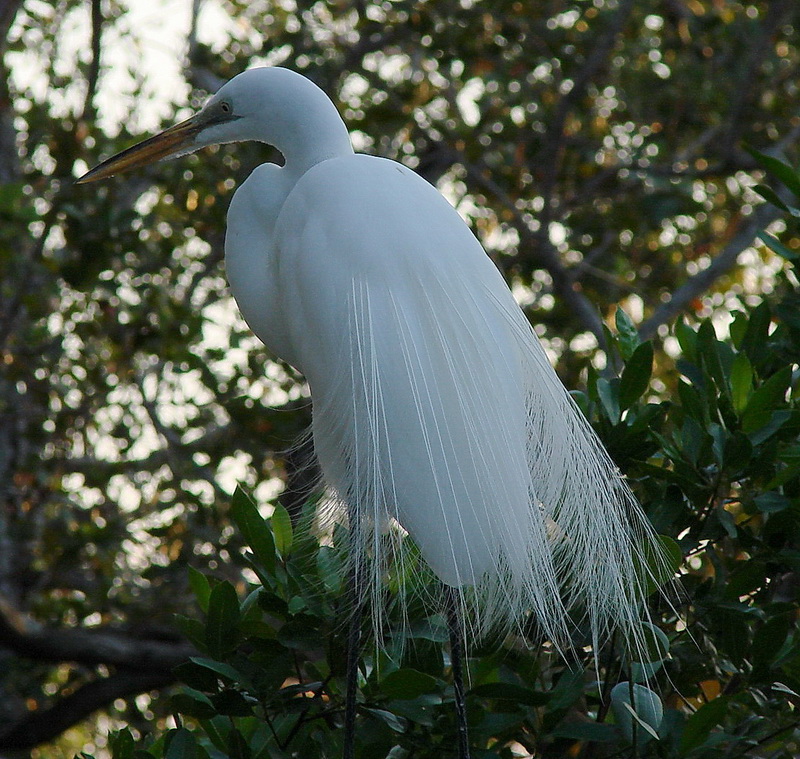
Great Egret - demand for the breeding plumes
nearly led its extinction
The Great Egret and Snowy Egret were favored. At the beginning of the breeding season, both species sport extravagant plumage as sexual advertisements. But they were not given the opportunity to attract mates. They were shot so that their plumage could adorn the hats of Victorian women, a few of whom may even have defied the prudish conventions of the time and used those plumes as part of their own elaborate sexual attractions. Egret populations plummeted.

Herbert Job, an ornithologist and pioneer wildlife photographer, wrote about the feather trade: “Here are some official figures of the trade from one source alone, of auctions at the London Commercial Sales Rooms during 1902. There were sold 1,608 packages of ... herons’ plumes. A package is said to average in weight 30 ounces. This makes a total of 48,240 ounces. As it requires about four birds to make an ounce of plumes, these sales meant 192,960 herons killed at their nests, and from two to three times that number of young or eggs destroyed. Is it, then, any wonder that these species are on the verge of extinction?”

In 1903, feathers sold for $32 per ounce, twice the price for an ounce of gold. The millinery trade employed 83,000 people (1 of every 1000 Americans) in 1900.

Herons, such at the Great Blue, were sought after
by the millinery industry
The Audubon Societies were born in response to the carnage of the feather trade. Its symbol was, and still is, the Great Egret. In 1901 the Brattleboro Bird Club reorganized as the Vermont Audubon Society. Audubon Societies and preservationists began a decades-long push for the enactment of laws. Public awareness was raised through lectures on topics such as “Woman as a bird enemy.”

Gradually the “Age of Extermination” came to an end. Dwindling supplies caused prices to soar. Fashion evolved new directions. Women’s life styles changed. And governments acted. In 1916 the United States and Great Britain (on behalf of Canada) signed the Migratory Bird Treaty and in 1918 Congress enacted the treaty into law. The Act established Federal responsibilities for the protection of nearly all species of birds, their eggs and nests.

The Migratory Bird Treaty Act (MBTA) made it illegal for people to "take" migratory birds, their eggs, feathers or nests.  “Take is defined in the MBTA to include by any means or in any manner, any attempt at hunting, pursuing, wounding, killing, possessing or transporting any migratory bird, nest, egg, or part thereof ...  In total, 836 bird species are protected by the MBTA, 58 of which are currently legally hunted as game birds. A migratory bird is any species or family of birds that live, reproduce or migrate within or across international borders at some point during their annual life cycle.” (www.fws.gov)

Blue Jay feathers are silent evidence of a hawk kill
Recently I received an email from a reader of my blog remarking about how lucky I was to find some blue jay feathers. The emailer wrote: “I live in Holland, and am not so lucky to find these beauty's around. Is there any way you could send some to me?”

He had seen photographs I had posted of the feather remains of a Blue Jay which had been taken by a hawk in my backyard. I replied that I photograph the feathers, sometimes study or examine them, but do not keep them. I could not send feathers to Holland because I do not have any and because it is illegal under the MBTA to possess or transport feathers.

Feather collecting, and the companion hobby, egg collecting (known as oology) are illegal in the United States, Canada, United Kingdom and many other jurisdictions. Underground and illegal collecting continues.

The MBTA allows special permits for protected nongame species that become local pests (e.g., giant flocks of winter roosting blackbirds). No other birds, except those for which there are designated hunting seasons, can be legally killed, trapped, harassed, or possessed (including birds found dead). Even “adoption” of young birds that appear to have been deserted by their parents is illegal without a permit.

Feather adorned hat on display at
John James Audubon Center at Millgrove, Pennsylvania
Fortunately, we can no longer see flickers and waxwings on the fashionable hats of fashionable women walking the sidewalks of downtown Brattleboro or any other downtown. The only birds commonly seen in the most barren urban habitats are pigeons and House Sparrows.

Even more fortunately, we can see the flickers, waxwings, and dozens of other species in our backyards, fields, orchards, ponds, and forests. They are protected. Watch them and enjoy them.
 
Good Birding!

Saturday, July 18, 2009

Serene Beauty in the Great Egret

Bright white birds waded along the muddy edges of the ebbing water in the tidal marsh. They were distant so few details could be seen except for their dark legs and long sinuous necks. Great Egrets.

I was on the viewing tower at the Connecticut Audubon Center at Milford Point on Long Island Sound. Straight out from the tower was a nesting platform with Ospreys. Three large chicks waited impatiently for their mother to return with food. Dad perched on sentinel duty nearby. Over the distant estuary, I counted eight Osprey circling.

On a grassy edge, a Black-crowned Night Heron rested for the day. Another flew slowly pass. A Glossy Ibis probed the muddy bottom with its long curved bill for some morsel. Gulls foraged here and there.

But always my attention was drawn back to those white waders. A couple of smaller ones were Snowy Egrets. Most were the larger Great Egret.

Audubon knew the Great Egret as the Great American White Egret. Taxonomists recognize it as, “Ardea alba.” The same species is found in Europe where it has been called “Large” and most recently, “Great.” The Great Egret’s closest North American relative is the Great Blue Heron.

The Great Egret is common along the eastern seaboard from southern Maine southward. It is seen along river ways and lakes as far north as southern Ontario. There are breeding records in the northen Champlain region. My personal records are incomplete, but I have seen the Great Egret in early March in the Putney Meadows of Windham County and on Plum Island in Massachusetts, and in late November in Cape May. The species is known to disperse widely after the breeding season is complete, which has brought me reports of large white birds in a beaver pond on Augur Hole Road in mid September.

This handsome white bird is common. Its bright white plumage makes it conspicuous, even at a distance. Many birders, searching for something unusual, slide over it quickly. I often do so. But in my better moments, I linger on this egret as it stalks carefully through the marsh, listening and looking, lifting a foot from the water, stepping with precision. Here is Audubon’s description: “On foot its movements are as graceful as those of the Louisiana Heron, its steps measured, its long neck gracefully retracted and curved, and its silk train reminded one of the flowing robes of the noble ladies of Europe. The train of this Egret ... makes its appearance a few weeks previous to the love season, continues to grow and increase in beauty, until incubation has commenced.”

And that is why the Great Egret almost became extinct: beautiful breeding plumage and female vanity (“flowing robes of noble ladies”) fed into human greed. In the mid to late nineteenth century, growing prosperity spurred the middle class to emulate the fashionable elite. Women’s hats became larger and more ornate and were adorned with”aigrettes” (sprays) of breeding plumage from many birds. The Great Egret was one of the favored birds; it was slaughtered by the tens of thousands and the breeding plumage feathers sold to the millinery trade. The carnage of the feather hunters on the egret and dozens of other species was massive. At one sales auction in London in 1902, the packages of feathers sold would have required the killing of almost 200,000 herons.

The Great Egret was one of the first birds whose population was decimated by the feather trade, but hardly the last. In 1886, Frank Chapman, ornithologist at New York’s Museum of Natural History, took a famous walk along the streets of Manhattan. He counted forty native species of birds - often just the wings or tails, but also fully stuffed birds - on the hats of women.

The carnage of the feather trade led to preservation activism by many groups. Many local Audubon Societies were organized to fight against the feather trade. From those local societies emerged the National Audubon Society. The logo of the NAS was, and still is, the Great Egret. Public lectures by the Audubon Societies on such topics as, “Woman as a Bird Enemy,” and extensive lobbying for legislative protections for birds, eventually led to the end of the feather trade.

The recovery of the Great Egret has been remarkable, and provides a larger lesson for endangered and threatened species. In general, if we can remove or mitigate the human caused reasons for a species’ decline, the species can then recover on its own (e.g. egrets) or with some help (e.g. eagles and falcons).

With protections in place, the Great Egret seems to have expanded into places where it was historically almost unknown. When Forbush wrote of the Great Egret in the 1920s, he wrote about the bird only from observations in Florida; he says nothing about a New England presence. Likewise, when Bent’s life histories of marsh birds was first published in 1926, the breeding range was restricted to the Gulf Coast states. Prior to the plume hunters, they bred as far north as Virginia and Cape May, New Jersey. Now their breeding range extends much further north, perhaps due to reduced habitat in historic ranges, perhaps a result of more favorable climates in the north.

The Great Egret is always graceful and elegant. When I am fortunate enough to get close to the bird (close being a relative term, since they are cautious and wary birds), I am mesmerized by their beauty.

I once watched this three foot wader stalking the shallows during low tide at Brigantine in New Jersey. A sudden strike with long neck and bill, and up came the egret’s beak, gripping a small catfish sideways. The catch was deftly maneuvered, and then swallowed head first, the form of the fish bulging the neck as it slid down.

Also at Brigantine, this time in early April, the birds were in splendid nuptial plumage. In the chilly, early Spring breeze, they were tuning up for their courtship displays, long plumes held nearly erect as they practiced their majestic strut and challenged other males.

But at any time, in an early morning glow or an evening sunset, I am mesmerized when an egret is stands perfectly still in quiet pond or puddle waters. His white form reflects off the surface, and the real becomes the mirrored. Those are moments of exquisite peace, when time is as still as the Great Egret and life is serene.

Good birding!

Quote is from John James Audubon, The Birds of America, 1848.
Post of "Tailfeathers," Brattleboro Reformer, Friday, July 17

LinkWithin

Related Posts with Thumbnails