Showing posts with label hermit thrush. Show all posts

Tuesday, March 11, 2014

Bushtit et al

I love songbirds, and the challenge of finding them and photographing them, but there are few of them to be found in the East during winter. This winter has discouraged wandering outdoors, which makes finding songbirds even more difficult. One of the delights of California last month, was finding different songbirds. A few examples ...

"Pacific" Bushtit

Bushtit

Bushtit
Chestnut-backed Chickadee ...

Chestnut-backed Chickadee

Chestnut-backed Chickadee
I was delighted to see the Varied Thrush, our most colorful thrush and only a rare vagrant in the East, but a little disappointed that none gave me good photo ops. This was the best I managed ...

Varied Thrush
I love the corvids, and especially the jays. Stellar's Jay is the Blue Jay's closest relative, with a very similar personality ...

Stellar's Jay
The Hermit Thrush is Vermont's state bird. His haunting, flute-like, and ethereal song carries through the forests in late Spring and Summer. On the breeding grounds, the Hermit Thrush is secretive and often very hard to see.

When the breeding season is over, the hormones subside and a personality change occurs. Hermit Thrushes were common, feeding in the open like a bunch of East Coast winter robins ...

Hermit Thrush

Hermit Thrush
Good Birding !!

Thursday, September 26, 2013

Random Images from a Hawk Watch

When the Broad-winged Hawk migration over Putney Mountain concludes, somewhere around the September 20-23, there is usually a lull until other species begin moving seriously around October 1. But there are always a few stalwart watches who make sure that those slow days are covered, and the few birds counted, and  just in case ....

But most of the action takes places other than in the skies overhead. Here are a few random images from Putney Mountain during the last few days ...

Hermit Thrush
Whittling away the watch hours


Migrating Blue Jays often pass overhead in significant numbers

School groups visit Putney Mountain, and sometimes serenade the watchers
Northern Flicker migration has begun
Golden-crowned Kinglet

Good Birding - wherever you may be!

Thursday, November 03, 2011

More from Cape May

This Brown Thrasher posed beautifully for me (Higbee Beach WMA), then added to his esteem when he flew as I was in mid-burst ...

Brown Thrasher
Late October migrants included (as expected) Northern Flicker, Gray Catbird, and Hermit Thrush in considerable numbers ...

Northern Flicker (Yellow-shafted)

Gray Catbird
Hermit Thrush
The most common migrant was the Yellow-rumped Warbler ...

Yellow-rumped Warbler (Myrtle)
Good Birding!!

Monday, May 09, 2011

White-eyed Vireo, et alia

From what I can gather from the Vermont bird list maintained by the records committee, the White-eyed Vireo has been recorded in Vermont often enough so that it does not need a rare bird report to be filed. Even so, most Vermont birders have not seen the bird within the state's borders. One is currently hanging out in the alders of an old beaver pond near by home, first found by a neighbor. The vireo's distinctive song finally led to some decent photos this morning. I can only hope that he successfully attracts a mate, but since he is well north of the usual range for this species, his chances of breeding may not be very good. As healthy and enthusiastic as he appears, I can only wish him good luck.

White-eyed Vireo

White-eyed Vireo
In Vermont, winter is a constant present. The last patch of snow disappeared from behind the barn on April 26. Nine days later, I began preparing for next winter by stacking the first delivery of fire wood. But at least the task was attended by bird song, and all the habitats are welcoming the return of the migrants. Just a few images of the past couple of days.
.
Rose-breasted Grosbeak

Northern Flicker

Northern Rough-winged Swallow

Hermit Thrush

Monday, November 08, 2010

Hermit Thrush

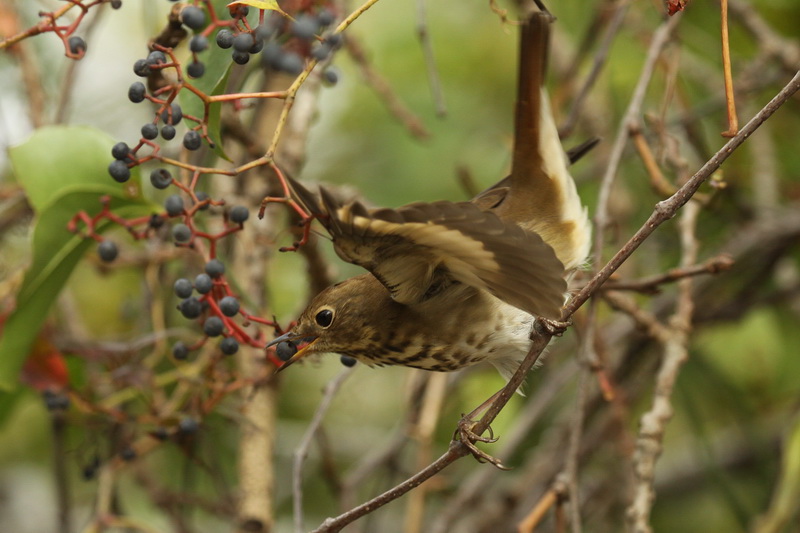
The Hermit Thrush epitomized the songbird fall out at Cape May, October 29-30. Dozens moved through the trees, bushes, and vines in a feeding frenzy. Here are images of one Hermit Thrush:


Good birding!

Saturday, November 06, 2010

Fall Out

Hermit Thrush - June, 2010
Last June on Hogback Mountain, I clawed my way through a thicket until I reached mature forest where the understory was sparse. I found an old log and sat down to wait for whatever might appear. As the disturbance of my conspicuous arrival gradually faded, the birds in the neighbor resumed their activity - a Downy Woodpecker drummed on a hollow branch - a Yellow-rumped Warbler sang overhead. Then a Hermit Thrush came from the forest floor and perched in a scraggly viburnum. He raised his head and sang his haunting, flute-like song.

The Hermit Thrush glanced in my direction as I raised my camera. Instantly he dismissed me as benign, and continued his song, though he may sensed the camera pointed toward him. He stood  erect for his portrait.

The Hermit Thrush is Vermont’s state bird. It is quite common in our woods during the summer, living in the lower parts of the forest and blending with the debris of the understory. I see it flash across a forest road. Or I see something scratching on the ground and glimpse a rusty red tail as it flies. It is not often that the Hermit Thrush will stay still so that a bird watcher can have a leisurely look. I was thrilled.

Hermit Thrush, Cape May, October, 29

Last Friday, I was in Cape May. In the mid-morning, I stood near the edge of the parking area at Higbee Beach WMA looking at a tangled grape vine which wound its way up a tree. I was twenty feet from the vine. Ten Hermit Thrushes were feeding on the grapes. On the ground to the right of the tree, six thrushes scratched in the leaves. To my immediate left, more thrushes hurried through the thicket. The birds in the grape vine flew, to be replaced immediately by a dozen more. In the gravel of the parking area, three thrushes drank from a puddle while four more picked grit for the gizzard. In the surrounding canopy, even more thrushes moved. Occasionally one would pause on a sunlit branch for a quick portrait.

During last Friday morning, I probably saw more Hermit Thrushes than I have seen in thirty years of birding. I witnessed a fall out.

Last week the East Coast was under a southern weather system. It was rainy and warm. I watched the weather reports, and when I saw that at least three consecutive sunny days were predicted for southern New Jersey, I drove south. The first day was in the upper 70s, too warm for Vermonters in late October whose blood is thickening for winter.

Overnight, a strong high pressure system cleared the warm air, scattered the remaining clouds, and plunged the temperature. Friday morning was clear, crisp, and blustery. I began the day at dawn at the morning songbird watch, where migrating songbirds are counted as they finish their night flight. I had on my fleece and flannel jacket, windbreaker, knit hat, and wool gloves.

The cold front did more than just change the temperature. Songbirds migrate at night. The strong northwest winds swept them east to the coast. At dawn they came to ground at land’s end, the southern tip of New Jersey.

Rusty Blackbird

The viewing platform for the morning songbird watch looks over a stretch of coastal reeds. There are a few low trees scattered through the reeds. The birds came from, or flew over, the protective line of forest to the left. Often they paused on the trees midway across the open area, then continued on to another copse of trees with their protective cover. The flight was continuous, and the numbers beyond counting for the casual observer. There were mixed flocks of blackbirds, including Rusty Blackbirds, three to five flickers pausing in a tree at one time, sparrows rushing over and through the reeds, kinglets and phoebes. The flight was led by robins and Yellow-rumped Warblers. The count reported over 73,000 robins and over 63,000 yellow-rumps during the few hours following dawn. How do you count such numbers?

I made no effort. For long stretches, I did not even raise my binoculars. I just watched the birds fly. If you can remember a time when the word “awesome” was not used for trivial purposes, then that is the word that best describes the phenomenon.

Yellow-rumped Warblers
I am not overstating. As I brushed past veteran Cape May birders they were shaking their heads in wonder. When was the last time there had been a fall out like this? Was it 1999 when there were a million robins? Or 1989 when yellow-rumps were everywhere, just like this year?

Mid-morning I stood along the dirt road between the parking area and the watch platform, trying to decide which bird to photograph next. An elderly lady walked slowly down the road toward the viewing platform with her cane. She was bundled up against the wind. She had binoculars around her neck. “Unbelievable,” she said in greeting as she passed me. Forty minutes later she returned up the road. In awe she said, “Once in a lifetime.” Then she thought for a moment. “Maybe not, but you’ve got to be lucky to experience something like this once, and really lucky to see it again.”

Eastern Phoebe

 I did not do much walking last Friday morning. All that was necessary was to pick a spot and watch the birds moving through the branches, thickets, or grasses. Last Spring I tried to get a good representative photograph of an Eastern Phoebe, without success. With the Cape May fall out, I got a dozen good photos. My encounters with Swamp Sparrows this year have been few, and no photo ops. Last Friday I took dozens of Swamp Sparrow photos.

And so it went. There were occasional interruptions when the birds suddenly scattered as a Sharp-shinned or Cooper’s Hawk made a foraging attack. The birds returned to their feeding within moments. They had been carried to the coast by the strong northwest winds, but they had also struggled in those winds, and possibly against those winds. They were exhausted, and they needed to eat.

Hermit Thrushes

That’s the irony. It was a big birding weekend and festival in Cape May. The fall out was great for the birders. Birds were swept from all over the northeast into the southern New Jersey peninsula. Some may have been swept even further out over the ocean, and burned their energy reserves before they could fight their way back to land. Weather conditions which result in a fall out are probably bad for the birds.

That said, standing in one spot, having six Hermit Thrushes in my binoculars at one time, counting twelve thrushes in one grape vine and sixty moving through the thickets and tree branches, is beyond words. Perhaps “euphoria” begins to convey the experience. It is certainly inadequate to say, “Good birding.”

Tuesday, July 13, 2010

Luck and Patience

I am learning that luck and patience are key ingredients to bird photography. Here are one instance of luck, and two of patience.

Veerys sing along our river but I rarely see one. On a gray day in mid-June, I was with a group on Hogback Mountain and had excellent looks at a Veery, but due to the distance of the bird, my photos were indifferent. A couple of days later, I returned to the spot in hopes that I could improve on the photos. I heard the Veery in many spots, but never had a glimpse of one. At one point, I wandered from the trail to a forest opening near where I thought I had heard one singing. I pished quietly a few times. Almost immediately, this Hermit Thrush appeared, stayed still, and sang for me ...


That same afternoon, I went to a neighbor's field where a pair Great-crested Flycatchers had claimed one of his nest boxes. I put my camera on a tripod, attached the remote button, then sat for an hour in the grass in the hot sun as the birds went to and from the nest box ...


When I had enough of the sun, I moved to a shady spot and focused on a nest box where Tree Swallows were feeding young, and waited for the arrival of the parents ...


Good birding!

Friday, October 03, 2008

Another Day on the Mountain

On Putney Mountain today, the northwest winds were brisk and the ceiling was low. There were not many hawks, but neither were there long waits between hawks. Sharpies were streaking along the ridge, wings tucked, here and gone, but low so that picking them up and following them was easy. Highlights were five Peregrine Falcons and a Golden Eagle, the sixth on the year. When rain approached, I wimped out and headed home, but a few watchers stayed on.

During one slow bit, I went into the woods to "kick a tree and set loose some hawks," the euphemism we tend to use for the call of nature (another quaint euphemism). In the woods, I was delayed by this Hermit Thrush who posed very nicely.


Saturday, March 24, 2007

Signs of Spring Are Everywhere

Last weekend’s winter storm notwithstanding, March is the month of Spring’s return. As the dark snow clouds thickened, the change of the seasons was everywhere. Even non-birders will have seen the signs - the curling trails of smoke and rising clouds of vapor from sugar shacks - automobiles thickly crusted with mud - snatched conversations about impassable dirt roads. A mid-March snow storm is a brief hiatus in the calendar’s turn, a temporary pause. Spring is coming ... and the signs are everywhere.

Last Friday, before the snows began, I went out to look at Spring. I gave myself an edge by traveling to Vermont’s tropics - Vernon. In every bare pasture and fallow field, robins were hurrying about, busy feeding. With the robins were the Red-winged Blackbirds ... all males, feeding, yes, but often finding time to proclaim from a tree top their “conk-a-ree” while flashing their red epaulets. They come north before the females to claim their territory.

The blackbirds are one of the surest signs of Spring, and the red-wings are not the only blackbird on the move. On my pre-snow storm Spring survey, dove-sized blackbirds with long keel-shaped tails flew across the road and perched in trees - Common Grackles.

Other smaller, nondescript blackbirds were among the flocks of robins and red-wings feeding in the fields. When these blackbirds were closer to the road or when I paused to scan with my binoculars, I could see the brown heads of the cowbirds. Among North America’s native species, most birders loath the Brown-headed Cowbird; it is a brood parasite, dropping its eggs indiscriminately in the nests of smaller songbirds like the colorful warblers, or songster thrushes, seriously threatening the reproductive success of its hosts. But in March, even the cowbird’s return is noted, because it is a sign of spring.

For the last couple of months, I have known the birds coming to my feeders. When I did my backyard feeder count in mid-February, I knew I would have thirty juncos, twenty jays, twelve chickadees, six titmice, eight doves, six pigeons, four downies, and a pair each of cardinals, nuthatches, Hairy Woodpeckers, and Tree Sparrows.

Last Saturday, with the deepest snow cover of the winter and a four foot barrier built by avalanching roof snow to surmount in order to reach the feeders, signs and sounds of Spring abounded. Red-wings joined the juncos and jays to feed on the seed which I scattered across the top of the new snow. Grackles joined doves on the bulk feeder. Song sparrows scratched beside the Tree Sparrows and squabbled about who was going to eat that seed. And when I stepped outside, I heard the “conk-a-ree” of the red-wing, the “cooooo” of the dove, the “peeer, peeer” of the titmouse, and the discordant songs of the starling. Spring!

Along with the singing of our wintering birds, the large flocks of robins and mixed blackbirds are the most obvious avian signs of Spring to most people. But the signs are everywhere, although you may have to go looking and be alert for them.

Vermont’s state bird is the Hermit Thrush. Considered by many to be the premier vocalist among our birds, its ethereal, flute-like song carries through our late-Spring and early-Summer woodlands. Unlike the other woodland thrushes, the Hermit Thrush winters in southern North America, sometimes as far north as southern Connecticut. It is the first thrush (not counting the robin and bluebird) to return to our neighborhoods. But during March, this premier songster is silent, moving quietly through woods and thickets. He’s still curious. When I’ve seen movement in a brushy tangle, I’ve sometimes been able to “phish” him into the open where his spotted breast and upright, rufous tail betray his identity.

As the ice goes out of our rivers and ponds and the waters open, waterfowl move north. On my pre-snow storm survey, I found a hundred Common Goldeneyes in the Connecticut River near Stebbins Island. Between dives, the drakes were doing their whip-lash display for the hens. I also saw a couple dozen Hooded Mergansers, although if I had wandered around the old beaver pond with my neighbor I would have seen, as he did, a pair of hoodies in a small pool; they were probably on an early reconnaissance for a hollow tree in a wetlands to use for nesting.

Where there is open water, there will soon be a kingfisher or two, rattling from tree branch perch to tree branch perch.

Shorebirds are returning. Two weeks ago friends in West Brattleboro heard the “peent” of the American Woodcock (yes, the woodcock is a shorebird). Secretive and nocturnal - both when it feeds and when it migrates - the woodcock starts to move north from its southern wintering range as early as January. Its migration peaks in March. We can be concerned for the earliest woodcocks to arrive in our woods, especially those caught in last week’s storm. They feed almost entirely by probing soft ground for earthworms. With a foot of new snow and refrozen ground, survival for the earliest arrivals is challenging.

Killdeer are also being reported, although we will not see (or hear) significant numbers until later in the month. I remember one recent winter’s end, when the spring thaw took a long time because of the depth of the snow pack. Only the road edges by the Retreat pastures were snow free, but there were dozens of killdeer working those snow free edges, and dozens more scurrying across the snow fields, as well as the ice on the West River. It is still early to expect to see killdeer in any numbers, but this noisy plover is likely to betray his presence at any time with his strident “keeldee” as he flies over head or dashes across a barren patch of ground - or snow covered pasture.

Humans are diurnal creatures. We have color vision because we are genetically intended to be active during the day and to sleep at night. But if your genes are screwy and you’re active at night, then listen for owls. The Spring breeding season begins as early as February for the Great-horned Owl, and for the Northern Saw-whet Owl and Barred Owl it is swinging into full activity. They are hooting, tooting and calling, seeking mates, defending territory, and preparing to nest.

It is hard to imagine why some birds would be incubating eggs in such (to us) foul weather, but it is undoubtedly timed to the emergence of food sources. With the melting of winter snows, chipmunks, mice, and voles emerge from their winter quarters, sometimes atop the remaining snow, or just beneath the matted, and now snow free, grasses. Many birds return. And all of life seems distracted with the advent of the breeding season. There will soon be much food available for the soon to hatch owlets.

So too for the eagles, whose nesting seems timed to coincide with the running of the shad and salmon. Last Friday the Vernon/Hinsdale eagles appeared to be incubating. Where early in the week they were observed moving sticks about their aerie - some last minute nest remodeling - with the approaching snow storm one was seated deep in the nest, a sign that an egg had been laid.

It’s Spring! Forget the snow. The signs of Spring are everywhere!

Photos: Top - Ring-necked Ducks near the Vernon Dam in March. Middle - Hermit Thrust returns early to Vermont woods.

LinkWithin

Related Posts with Thumbnails