|
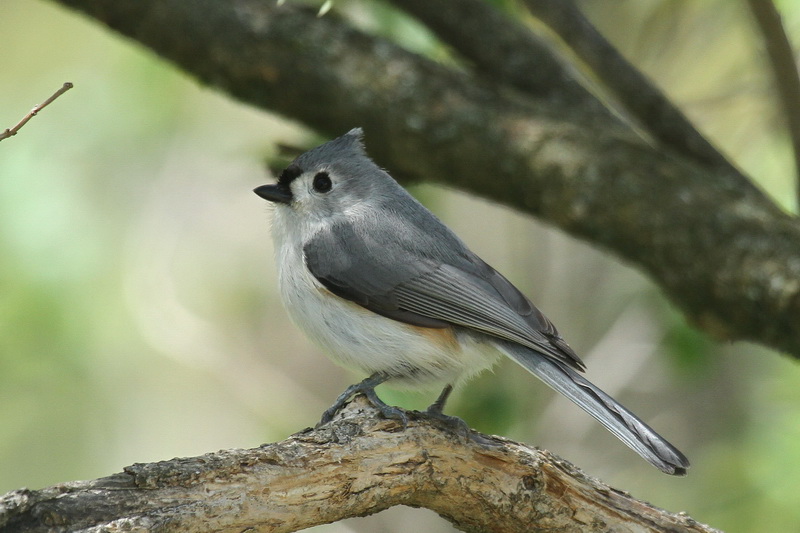
| Tufted Titmouse |
In the last couple of weeks, entertainment duties in my backyard venue have been taken over by my favorite bird, the Tufted Titmouse. A troupe of these tiny, crested, gray birds gather around the feeders, coming in from all directions, grabbing a seed, and taking off in all directions.
There is at least one family, with at least six members - it is hard to count because they are always on the move. When an adult flies to the maple, or into the thicket of the lilac, there are two or three youngsters waiting, chirping away, fluttering their wings, and demanding food. A friend once described young Blue Jays begging for food by saying, “Boy, I’d hate to be their parents. They are a bunch of demanding kids.” The titmouse youngsters are no less insistent or demanding, although a third the size of th
e Blue Jays. They make a terrific racket as their parents retrieve food. The racket ratchets up as the food comes near, is interrupted only for the microsecond needed to gulp it down, and then resumes unabated
The common presence of the Tufted Titmouse in Vermont is a recent occurrence. When Forbush, the Massachusetts ornithologist wrote “Birds of Massachusetts,” he included the Tufted Titmouse, but had no field experience with the bird to draw from. Instead, he quoted the work of a southern ornithologist on its nesting practices. The Tufted Titmouse was a southern species, its range reaching north only to southern Pennsylvania and New Jersey.
 |
| Tufted Titmouse in winter |
Since 1927 when Forbush published his work on New England birds, the Tufted Titmouse has been extending its range northward. Vermont Christmas Bird Counts in the 1970s recorded fewer than ten birds until late in the decade when the numbers began climbing significantly. The first Vermont nesting record was in 1976. When the first Vermont Breeding Bird Atlas field surveys were conducted from1977 to 1981, the Tufted Titmouse was recorded in only nine survey blocks. Each confirmed breeding was recorded in the Atlas: nest building in Peru in June; adults feeding young in Stowe in June; recently fledged young in Brattleboro in July, and so on, for the eight confirmed breeding records.
The second Vermont Breeding Bird atlas (2003-2007) documented the dramatic expansion of the Tufted Titmouse in the state. It was recorded in 104 priority blocks. It was scarce only in the northeast of the state.
The Tufted Titmouse is a member of the family “Paridae,” a group of small birds which are often described as treetop acrobats because of the way they flit about and clamber over twigs and branches in search of insects. Titmice are close relatives of chickadees. For most of their taxonomic life, titmice and chickadees have belonged to the same Genus: “Parus.” About five years ago, the taxonomic gurus decided that titmice and chickadees were not quite so closely related, and assigned them to new genera: “Poecile” for chickadees, and “Baeolophus” for titmice.
 |
| Tufted Titmouse - small bird with a crest |
On the other side of the Atlantic pond, the relatives of these birds are known collectively as “tits,” and include some birds which look remarkably similar to our Black-capped Chickadee, such as the Willow Tit or the Marsh Tit. The Crested Tit has a striking pattern to its head and crest; only the crest (as well as size and shape) brings to mind our plain, gray Tufted Titmouse.
“Titmouse” derives from Old Icelandic “titr” meaning something small; “mouse” is a corruption of “mase” from the Anglo-Saxon for a kind of bird. The plural form, “titmice,” has been influenced by the unrelated word, “mouse.” Hence, the Tufted Titmouse is a small bird with a tuft, or crest. And its relatives in the Old World are “Tits,” or small - the “mase” or “mouse” having been dropped. If you ever hear a British birder rave about all the great tits he saw, he is not being crudely sexist; he is talking about our chickadees and titmice.
 |
A young Tufted Titmouse watches
a parent getting food from a suet feeder |
The Tufted Titmouse’s range expansion is probably the result of a complex combination of habitat change, environmental alteration, and climate warming. I worry about that in general, but I am delighted that it is a year round resident in my neighborhood. It will brighten even a winter day. Most birds wait until winter is on the wane before beginning their courtship singing. Not the titmouse. On a sunny day after a major snowstorm, you may hear his “peer, peer, peer” piercing through the crisp atmosphere, a sound of promise and a promise of life.
The titmouse prefers deciduous woods, especially those of swamps and river bottoms, but has adapted to residential woods, village shade trees, and city parks. One summary description of the titmouse goes like this: “active, vivacious, flits about foliage of trees, often hangs head downward while inspecting twigs, leaves, or clings to trunk or branches, searching in bark crevices for insect food, wanders about in winter in small flocks; tame ... intelligent, quick to learn.” (Terres)
The Tufted Titmouse is a cavity nester, using an old woodpecker hole, natural cavity, or occasionally a nest box. Pairs stay together all year. The male feeds the female during courtship and while she is incubating her 5-6 eggs (or sometimes 3-9 eggs). When the eggs hatch, the female stays with the young most of the time, while the male brings food. He often has a “helper,” one of their offspring from a previous nesting. Families tend to stay together through the Fall and Winter, often joining flocks of other small birds, such as chickadees, nuthatches, and Downy Woodpeckers.
 |
Young Tufted Titmouse with raised crest, a sign of alertness.
The parent’s crest (right) is down, perhaps out of parental weariness |
|
The young titmice in my backyard in late August are probably a second brood. At first, I tried to sort out the family relationships, tried to deduce whether I had one or more families. I gave up; I could not even figure out how many titmice there were, they moved about so fast. What with parents, helpers from a previous year or an earlier brood, and a half dozen ( plus or minus), juveniles, there was more chaos and confusion than I could make order out of. A half dozen resources, consulted after the titmice headed for their nighttime roost, helped me understand some of what was going on. Mostly, I just enjoyed the show.
And ... by watching, I learn. Chickadees have now joined the backyard activity, occasionally announcing themselves with their familiar “chick-a-dee-dee-dee” or even an abbreviated “dee, dee, dee.” I looked more closely when I heard a “chee, chee, chee, chee.” A titmouse seemed to be saying to its youngsters, “Hey, gimme a break. I’m getting it as fast as I can.” He repeated himself and another joined him at the feeder and grabbed a seed. So maybe he was calling for help.
In late summer and early fall, sitting out back with feet up and a cold tonic at hand, is almost guaranteed to produce some Good Birding!