Showing posts with label American Crow. Show all posts

Monday, May 25, 2015

Bank Swallow et al

On Saturday's Audubon walk in Hinsdlae (the last of five Saturdays), it was clear that the migrants had passed through while the residents were into full breeding mode with territorial singing and defense, courtship display, nest building, and all of the other activities associated with perpetuation of the species.

The highlight for me was the Bank Swallows whose in flight courtship was frenetic and exciting. Occasionally, they even came to rest, and presented a wonderful photo op. Bank Swallow is a new species in my photo library.

Bank Swallow
Bank Swallows

Bank Swallow
Bank Swallow
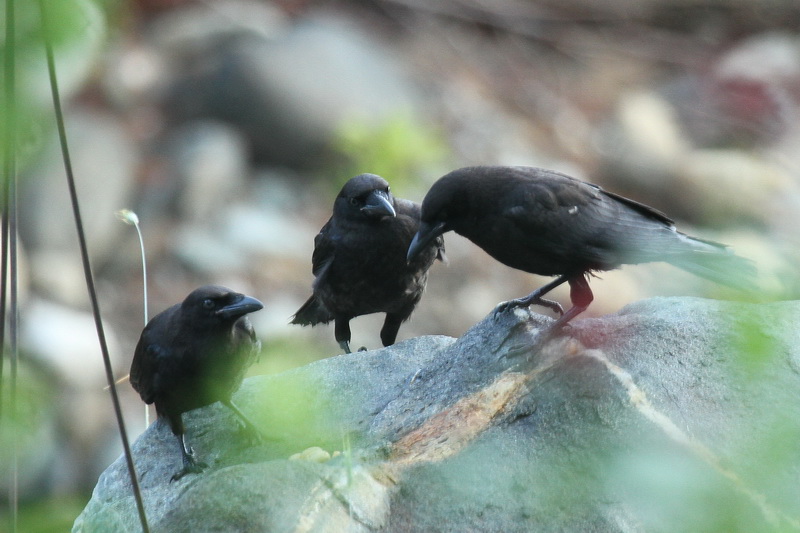
Back home in the back yard, those fascinating creatures, crows, continue to amuse and delight us as they sneak up on the dog food we put out for them, and go about their own form of family dynamics.

American Crows
 Evening Grosbeaks have returned for yet another year and another round of family raising. While it is considered "uncool" in some nature photography circles, to photograph birds with any evidence of human presence (roads, fences, roof ridges, or whatever), including bird feeders, I have not such qualms. The breeding presence of these colorful birds is in clear evidence at the beginning of the breeding cycle with courtship feeding, as seen here ...

Evening Grosbeaks - courtship feeding
Good birding!!


Tuesday, March 04, 2014

A Murder of Crows

“A Murder of Crows” was a 1999 thriller film which you’ve probably never heard of. The movie reviews were so bad that oblivion was its natural state rather than something which it faded into.

“A Murder of Crows” is also the name of several rock bands, one from Michigan, another from Washington State, and yet another from San Francisco. All seem to have the same prominence as the movie.

What is curious to me is why a term for a large number of crows shows up in popular culture. Does the phrase have play in a darker sub-culture that I know nothing about? Perhaps.

What is certain is that most cultures and folklore have, at best, a very ambivalent attitude toward crows.

The phrase, “a murder of crows,” refers to a large number of crows. The term seems to derive from the persistent folk tale that crows form tribunals to judge and punish the bad behavior of a member of the flock. If the verdict goes against the defendant, that bird is killed (murdered) by the flock. The basis in fact may be that occasionally crows will kill a dying crow who doesn’t belong in their territory - or, much more commonly, that they will feed on carcasses of dead crows. Also, both crows and ravens are associated with battlefields, medieval hospitals, execution sites and cemeteries, all places where crows scavenged on human remains. These are not the most endearing characteristics.

The lore and myths of Native Americans in the Pacific Northwest attributed more endearing and benevolent characteristics to crows, but they were generally an exception. Crow was often a trickster in Native American folklore, similar to Coyote. However, Crow’s tricks tended to be more malicious, probably because they were considered a pest to crops which the tribes needed to survive.

Most folklore and most appearances of “crow” in our language and culture are negative, or at best, neutral.

I grew up in Detroit at that ancient time when the Detroit Lions played the only Thanksgiving Day professional football game. My Dad and I attended the Noon kickoff, then went to my Grandfather’s home for the family turkey dinner. I remember one year when the headline on the next day’s sports page proclaimed that the Lions ate crow for Thanksgiving. I was sure that crow did not taste as good as turkey. Given that the Lions had been totally embarrassed by their opponent, it was not difficult to figure out that “to eat crow” was not a good thing.

Crows get a bad rap. Loud vain bragging is sometimes referred to as “crowing,” a reference to the sounds that crows often make. But why have crows become that kind of adjective? Why not jays - or gulls? I guess “jaying” or “gulling” doesn’t sound quite right.

Then there are those lines and wrinkles, usually on the face, often by the eyes - they could be sandpiper feet, or robin feet, or neutrally, birds’ feet. But no, they are associated with aging, a flaw in a culture of youthful beauty, and so they are “crows feet.”

There are some familiar terms in our language contributed by this common black bird which are not negative. A crowbar is used to pry up an object, much as a crow uses its beak with adeptness. The crow’s nest is the look out point atop the tallest mast of old sailing ships; notice the large dark masses high up in winter’s leafless trees. “As the crow flies” describes the straight line flight of crows.

From Georgia there comes the folk tale about the farmer and his wife who decided to sleep late one Sunday morning, the way the rich folk do. “The crows were gathered in a large oak tree, having a big morning meeting. They noticed that there was nobody stirring around the house, and that the corn was ripe in the field. So they adjourned their meeting mighty quick and flew over to the field to eat some corn. ‘Caw-n, caw-n,’ they cackled excitedly.”

The rooster continually cock-a-doodle-dooed, warning that “the crows are in the corn!” To no avail. The farmer and his wife slept on. “The old turkey came strolling into the yard and watched the proceedings. Finally he said to the rooster: ‘The corns all et up, all et up, all et up.’ When the farmer and his wife finally rolled out of bed, they found that the corn was all gone.”

Thus, in Georgia they say “the crows are in the corn” when it is time to get up.

In the Epic of Gilgamesh (the origin of Noah and the flood in Genesis), the hero releases a dove and a raven to find land. The dove flies in circles and returns, but when the raven is sent forth it does not return, leading the hero to conclude that it has found dry land. This suggests that the intelligence  of these large black birds was apparent even in ancient times.

One summer day on a hill in Newfane, I heard a murderous racket from a murder of crows  somewhere in the tree tops high overhead. The crows were angrily mobbing an owl, diving and harassing and screaming at the roosting nocturnal raptor. The Great Horned Owl, the Barred Owl, and some of the larger hawks, are among the crow’s few natural enemies. Driving the interstates, it is not uncommon to see crows driving off a Red-tailed Hawk or carrying on over the forest canopy. On that summer day, the hellish racket which accompanied their actions were an audio  etymology for a “murder of crows.”

On a completely different note, recently I once concluded a day of coastal birding by stopping for a quick scan of resting gulls.  Among the flock of mixed adult and juvenile Ring-billed and Herring Gulls, I found a single adult Iceland Gull. Gulls can be very difficult to break into their respective species, but I picked out the Iceland Gull with confidence. It stayed still so that my wife could carefully compare and contrast it with its cousins. I reminded her that she had never been with me on previous occasions when I had seen this gull; it was a life bird for her. At the very end of a day of birding, we had something to crow about!

Good birding!

Monday, July 02, 2012

The Crow Family

I am trying to make friends with the resident crow family.

A mated pair has nest near the river behind my home for several years. They appear in early Spring with a helper - a young bird from the previous year's brood. They did so again this year, cleaning seeds beneath the feeders.


In late May, there was lots of noisy activity as the four chicks from this year's brood fledged, and called for food. The parents and their helper scurried about to meet the demands of the young birds.

The family is still together, though the young birds are beginning to figure out how to feed themselves.

Of course, I am making a lot of surmises about this pair, helper, and family, but the surmises are reasonable and supported by research and observation. Crows are intelligent. They have language and culture which they pass along to the generations.

While much of what they say sounds like "caw," as I have listened this summer, I hear many nuances and variations.

One day recently, five of the family were milling about on the neighbor's grass near the river. My surmise: the helper was baby sitting. Keeping an eye of the youngsters and watching for danger. A mere glance in their direction on my part sent them flying.

So how am I trying to make friends with them? Two or three times a day I put a quarter cup of kernel corn, shelled peanuts, and unshelled peanuts on a rock. I often do this when I know the crows are nearby and watching. I speak to them. I show them the cup with food ... and I ring a bell.

Young crows on a venture - trying the cord & peanuts I put out for them.


Am I making friends? I don't know. They are wary (as well they should be considering how often creatures like me fire guns at them).

Occasionally, one perches on the rock, as though waiting for me to come with food.

I put out the food. I watch. Then I go about my business, return, and the food is gone. A few times I have seen them eating my offerings.

It will take time to build trust, but I enjoy the company of creatures that are intelligent - even some who might be smarter than I am. Maybe I can learn something.

Saturday, June 09, 2012

Delivering Breakfast ...

I have not been out much. We had the house painted, and there has bee much to do getting the house put back together post painting, plus post-Irene yard work, and unstable weather. But this morning I got out for a couple of hours.

I begin with the end of the morning when breakfast was being delivered. This crow iscarrying food; it appears to be a frog or toad. The young have probably fledged, and there was one flying hurriedly behind this parent ...

American Crow - carrying food

Just a sampling of additional images ...

Pink Lady's Slipper

Chestnut-sided Warbler - female

Red Squirrel

Willow Flycather - "Fitz-bew!"
Good Birding!

Thursday, May 17, 2012

As the Crow Flies

American Crow

Large, black, ubiquitous, and noisy - the crow does not make many people’s list of favorite birds. Maybe that’s because the crow is also intelligent. Forbush wrote that the crow “knows too much; his judgment of the range of a gun is too nearly correct. If Crows could be shot oftener they would be more popular.”

Birdwatcher’s Companion says: “Some taxonomists believe the crows to be the most highly evolved of all bird families, based on the charming (if self-serving) notion that mental development is proof of evolutionary ‘excellence.’”

Henry Ward Beecher, the prominent nineteenth century Congregationalist minister, is reported to have said that if men wore feathers and wings a very few of them would be clever enough to be crows.

There’s the problem. Crows are intelligent. They threaten our position as the most intelligent creatures on the planet. If intelligence is judged by the ability to ruin environment and destroy the planet, I guess we are the most intelligent.

Blue Jay - member of the Corvid family
Crows belong to the family, Corvidae, familiarly called “corvids” (crows, jays, magpies), and the genus, Corvus. Worldwide there are about 43 species of the genus Corvus, including jackdaws, rooks, and ravens, as well as crows.

In North America there are six species. The Fish Crow is fairly common in the southeast along the coast, rivers and swamps. The Northwestern Crow lives along the Pacific coast from southern Alaska to Washington State. The Chihuahuan Raven in found in the deserts of Texas, New Mexico and Arizona and southward. Rarest in North America is the Tamaulipas Crow which occasionally visits South Texas, particularly the Brownsville landfill.

Common Raven
In our neighborhood, we have two species of Corvus. The Common Raven is still scarce, but  continues to recover in our eastern mountains. It is quite common in the northern forests of Canada and in the mountains, forests, and deserts of the West.

And of course, there is the widespread and common American Crow.

All of these are big, black birds. They range is size from the diminutive Tamaulipas Crow (15 inches) to the hawk-sized raven (25 inches). They belong to the Order, Passeriformes (perching birds) and the sub-Order, Passeri (songbirds).

Yes, crows are songbirds. Now before you begin to grumble that the raucous cawing of the crows hardly qualifies as a song and bears not the slightest comparison to the other-worldly beauty of the thrushes, remember that the Grammy Music Awards include categories for “rap” and “heavy metal.” Perhaps the corvids lost their musical ability as they evolved their intelligence, which as an evolutionary principle, seems contrary to what has occurred  in our species; modern music genres suggest that musical ability and intelligence are both evolving downward.

American Crows
Crows are remarkable creatures. They are omnivorous. They will consume just about anything except green plants, which the youngster trying to choke down his spinach would undoubtedly see as a sign of their intelligence. Their diet includes insects, crustaceans, shellfish, small vertebrates (including nestling birds), garbage, fruit, and fast-food French fries. Corn is a favorite, which is what has made them anathema to generations of farmers.

Fall and winter, crows gather in large communal roosts which can number in the hundreds, and even thousands. During the day they disperse over a wide area. Then as dusk approaches, they reassemble in staging areas before retiring to the roost for the night. The roosts are sometimes viewed as nuisances, leading officials to try all sorts of bizarre things in order to relocate or eliminate the “problem.” Among those efforts are the occasional sanctioned murder of crows in which guns blaze away at the gathered birds. Like all efforts, it has little lasting effect. The crows fly away - for a while.

One problem for the crows in these large communal roosts, is that the birds perching on the lower branches often get struck by the dropping from those higher up. By morning, their backs may be speckled white. Maybe this is reflective of the cultures of more “intelligent” creatures, since it is certainly analogous to what happens to those at the bottom of the human society tree by those at the top of the tree.

Little is known about these roosts, but one thought is that the roosting crows may be younger, unmated birds that have yet to establish their own territory. The roost serves a social function, allowing the younger birds to find mates, challenge one another, and communicate their experiences. Bernd Heinrich has demonstrated this theory in relation to ravens.

American Crow
What is evident is that crows have a complex social structure and language, although very little is understood about either. Crow vocalizations go far beyond the familiar caws that we usually attribute to them. They can imitate sounds of other species, including elements of human speech. They have a wide variety of low volume vocalizations for communicating among one another. They have alarm calls, assembly calls, distress calls, and many others. And there is evidence to suggest that they may have different languages, i.e., different groups of crows, belonging to the same species but in different geographical areas, may not use or understand all of the same calls.

The March full moon is the “Crow Moon.” The cawing of the crows tells of the waning of winter. The roosts break up and by the end of March, crows begin nesting in their crow’s nests in the tops of tall trees.

American Crow
Henry David Thoreau wrote of the crow: “This bird sees the white man come and the Indian withdraw, but it withdraws not. Its untamed voice is still heard above the tinkling of the forge. It sees a race pass away but it passes not away. It remains to remind us of aboriginal nature.”

Good birding!


Quotations are from Forbush, “American Birds,” Leahy, “Birdwatcher’s Companion,” and crows.net.

Saturday, May 05, 2012

The way a crow ...


American Crow


The way a crow
Shook down on me
The dust of snow
From a hemlock tree
Has given my heart
A change of mood
And saved some part
Of a day I had rued.


– Robert Frost


Sunday, February 21, 2010

Sounds of Spring

Last week's snow has disappeared and hints of Spring are beginning to be seen - dirty snow and mud. February can often be the snowiest and most brutal month, but that doesn't look like the case for this year.

The most certain signs of spring, however, are not what is in weather forecasts, temperature, or what can be seen. The first signs of spring are what I hear.

And what I have been hearing is the "peer, peer, peer" of the Tufted Titmouse ...


The wonderful cheerful song of the Northern Cardinal ...


The first tentative songs from the American Goldfinch, still in the drab winter wear ...


... and American Crows which are moving around the village in ones or two, a sign that there wintering flocks is dispersing, and that they are busy with nest building. They noisily talk about their work ...

 
... and best of all, I have begun to hear the drumming of the Yellow-bellied Sapsucker - best of all because they go southwards for the winter, so when their drumming is heard it means they are beginning to drift northward again, and beginning to think about the activities of spring ...


A final note - these photos are from the past year, not the past week. I am hearing the sounds of spring, but not necessarily seeing them. But soon ....

Good birding!

Sunday, June 14, 2009

Progress of the Breeding Season

My intended hike up Stratton Mountain this morning was canceled due to the unsettled weather. I've rescheduled to Wednesday AM. Most of those planning to join me have can do the change, but if a couple more would like to join, let me know. We meet at 6:15am at the trailhead - early start so that (hopefully) Bicknell's Thrush will still be singing when we reach the top. Also likely - Yellow-bellied Flycatcher, Blackpoll Warbler, plus other edge, woodland, and montane species. So instead of hiking 3.5 miles this morning, I am revisiting the birding of the last week (inbetween the rain).

The male Ruby-throated Hummingbird makes regular visits to the feeders while patrolling his domain. He makes only one contribution to the next generation, albeit an important one. Occassionally a female sneaks past his guard and feeds on the columbine or the nectar provided by my bounty.

Cedar Waxwings flocks seem everywhere. Most are still a few weeks from nesting.

Red-eyed Vireos are lactive into their breeding season. Males sing in between their nesting responsibilities and occasionally one even has allowed me a brief glimpse.

Some American Robin pairs are close to fledging their first brood. I have no idea if this one was building a first or second nest for the season, but was certainly busy in construction. The bird made regular trips to the muddy edge of Herrick's Cove, returning with big loads of building materials. Nest was somewhere in a dense tangle of brush roses.

After a couple of days of rain, I returned to where I had seen the Blue-headed Vireos in the early stages of nest building. There was no sign of the pair, but the nest appears ready for occupancy, and perhaps deep in the nest, incubation is proceeding. The bottom of the nest is comprised of wood chips and wood shavings. A couple hundred yards away I saw an old tree which had been heavily worked by Pileated Woodpecker, perhaps excavating a nest hole. A Blue-headed Vireo was carrying wood chips. They were singing in many places along the old road, so I can't claim it was "my" pair. Clearly the nest building activity of one species was assisting the nest building activity of another species.

American Crows are nesting down river from my home. Evidence suggests a pair and a helper, since 3 are often around the feeders. This one is "carrying" food - note the bulge in its crop. I have seen the crop much larger. They are very wary birds able to sense when someone is inside watching them. It is difficult to get close to the window for a photo without having them fly off.

The Eastern Phoebes at Herrick's Cove fledged their first brood at least a week ago. The youngster is here waiting for another meal, but occasionally tried some things on his own.

I have been astounded at how much suet is being consumed by the birds. At least two pair of Downy Woodpeckers, one pair of Hairy, and two pair of starlings seem to be relying on the suet for feeding their nestlings. Plus a wide assortment of other birds are also using the suet. The suet gets taken in at night. In the morning the woodpeckers are lined up on the tree waiting for us to bring it out.

The European Starling brought the fledglings to the suet this week. We typically say, "aww, cute," when other birds bring the young to the feeders, but respond with "oh ugh" when the starlings do the same. I would suggest that is not evidence of birdy cuteness, but human prejudice.

Fledgling Downy Woodpeckers were at the suet this morning. At one time, there were five Downies, from two families - all female. The youngster is clinging to the post; its understanding of life is that someone will feed. Well, for a while someone will.

Good Birding!

Monday, March 09, 2009

Love among the Corvids

Yesterday (Sunday) was sunny and mild. I took my snowshoes and found a raven nest in the old granite quarry. Mother Raven appeared to be on the nest, incubating. I plan on returning when the snow melts, and the climb is less hazardous, to watch the nest.

Mud season is in its full, semi-liquid glory. The road to the Black Mountain trail was so bad, I decided I should stay off of it, even though I have four wheel drive on the truck. Why make it worse for the people who must drive the road?

So instead, we returned home and walked Augur Hole Road looking for the shrike that a neighbor called me about. No shrike, but the crows were into their love season - calling and displaying - turned on by the Spring hormone rush.


LinkWithin

Related Posts with Thumbnails