Showing posts with label American Robin. Show all posts

Wednesday, November 04, 2015

November birding - sunny, 70s, beautiful

November - sunny, 70s, beautiful. Seems like an oxymoron, but that was yesterday. I made a late morning trip to Heinz NWR. Songbirds were quiet and resting. Most waterfowl were sleeping or preening. Only the Greater Yellowlegs were noisy and busy (next post will be GRYE).

But a very pleasant day for a walk. A sampling of the morning.

Ducks in the impoundment were all dabblers. The numbers were modest, but a few were fairly close to the pond edges.

Northern Shoveler
Northern Shoveler
Green-winged Teal
Green-winged Teal

Autumn Meadowhawks were flying all along the trails. They are so small that often they seem like a figment of the imagination, especially the females whose orange-brown color camouflages them among the brown and yellow leaves. The occasional male perched for me, and a pair flew locked in the copulatory circle.

Autumn Meadowhawk (male)
Autumn Meadowhawk (male and female)

 Only a few butterflies were still about. This Eastern Comma was a particular treat.

 
Eastern Comma
 Most sparrows were deep in the thickets, while robins were moving about, but rarely pausing for more than a few moments.

White-throated Sparrow
American Robin
 Good Birding!!

Friday, June 26, 2015

Nesting in Center City

In the last week I have done a lot of walking in the Museum District and Center City, Philadelphia. While birding was not my intent, I picked up a lot of incidental evidence of nesting birds, even among the high rise buildings and concrete/asphalt streets.

In addition to the three expected exotics - Rock Pigeon, House Sparrow, and European Starling - there was Northern Mockingbird, Canada Goose, House Wren, Gray Catbird, Mallard, Red-tailed Hawk, Downy Woodpecker, House Finch, Barn, Tree, and Northern Rough-winged Swallow, American Robin, Northern Cardinal, Blue Jay. (This does not include the long list in our Roxborough neighborhood and Wissahickon Valley.)

Returning from dinner on Main Street in Manayunk, young Peregrine Falcons were making a racket overhead. Parents nest in a church steeple next to Pretzel Park, one of several pairs in the city.

Again, I was not birding, but could not resist the opportunity to photograph when it came. Here are a few ...

European Starling

American Robin

American Robin

Northern Rough-winged Swallow

Northern Rough-winged Swallow

Saturday, November 30, 2013

Wintering Robins

Once robins have completed their breeding season - which may involve raising three broods - they begin to collect in flocks, often of hundreds, or even thousands of birds. As the season progresses, their diet shifts from animal protein during spring and summer (earthworms, grubs, insects and the like) to vegetable matter, principally fruit in the fall and winter.

These large flocks wander, roam, and migrate. My late October trip to Cape May coincided with the passage of robins through southern New Jersey. Huge numbers of robins fell out of the morning sky after their night flight, feeding on the junipers, winterberry, bittersweet, sumac, and other berries. (Not coincidentally, the robins’ descent into the trees and shrubs was followed by Sharp-shinned and Cooper’s Hawks.)

The American Robin is one of the most widespread, familiar, adaptable, and successful species in North America. Except for southern Florida, extreme southern Texas, and the southern  Arizona and California deserts, it breeds throughout the continent, north to the Arctic tree line. As winter approaches, it abandons its northern range and heads south.  Most range maps show it absent from the northern Rockies, northern Great Plains and most of New England in the winter. But not necessarily ... when I went to Montreal a few winters ago in pursuit of the Great Gray Owl, I also saw many wintering robins.


Unfortunately, that wonderful old piece of folklore about “Spring is on its way, I just saw the first robin” is not true. Robins can be found just about anywhere in the lower forty-eight during the winter. While typically wintering in large flocks, those flocks can be very nomadic; if their nomadic ways don’t intersect with our ways, then we conclude that they are not present - gone south.

The robins that nest in our neighborhood have probably gone south, while the hardier birds which breed far to the north, have moved down to replace them. But, through the whole continent, there is little variation in the American Robin (Turdus migratorius), an indication that breeding populations are constantly being mixed. Only in Sibley’s Guide are regional variations noted, and those variations are very minor - western robins have limited white tail corners - Atlantic Canada robins have a blacker nape and upper back.

Protein is essential to raising young, so "robins eat worms ..."

The species name, “migratorius,” does suggest that a characteristic of the robin is its migration. It wanders (migrates) all over the place.

The American Robin belongs to the thrush family, subfamily Turdinae, and the Genus Turdus. It is the only member of its Genus that any of us are likely to see. Rufous-backed Robin and Clay-colored Robin are accidental at a few places near the southern border, and the Fieldfare from Europe turns up in the East only on very rare occasions. The full and official common name is “American Robin,” but Turdus migratorius is so common that almost everyone knows what you are talking about when you talk about “robins.”

... but when protein is scarce, they turn to fruit and berries.

Nevertheless, we should never underestimate the ability of grammar to create confusion. When looking for information, I googled “winter  robin” and found many articles referring to, or even titled, “Winter Robin.”  “Winter Robin” sounds like the common name of a bird species, and I have had a couple of occasions when I have had to explain otherwise. “Winter robin” refers to an American Robin that is wintering in a wintery area - staying the winter, or being seen during the winter. It might better be referred to as a “wintering” robin. Not all robins abandon our north country and head south. Not all robins pass through our north country for more temperate winter climes. Some robins, probably from father north, stop here, and may even stay here for the winter. They are wintering.


You should not be surprised to see robins throughout the winter. They are warm-blooded. They have remarkable insulation from their down feathers. They can maintain body heat through a cold night by shivering. They can survive as long as they can get enough food during the day to replenish their stored fat reserves.

There are factors which will affect whether you see robins during the winter or not. The biggest correlation is snow cover. Data from the Great Backyard Bird Count done annually in mid-February indicates that the probability of seeing robins  drops “dramatically in areas with even just a few centimeters of snow cover.” Unusually low snow cover often results in unusually high numbers of robins, a pattern which has been seen over several years of accumulated data. It seems that robins, which are primarily ground feeders, avoid snow-covered areas.


Robins are self-sufficient and quite capable of finding their own food sources. If they appear around backyard feeders, it is because there is some other food source. They do not eat bird seed; their stomach and intestines are not designed to digest such food. Some people have enticed robins to bird feeders by putting out cut up fruits (apples, pears, cranberries, blueberries), softened dog food, or a variety of worms. The problem is that most robins have never heard of such a thing as a bird feeder. It just doesn’t occur to them to seek human handouts. It has been suggested that putting out “robin food” during severe weather might be helpful, but it is more likely that the squirrels will find the food before the robins do.

Do not be surprised if you see robins this winter. They are American Robins which are wintering - hence “wintering” robins. Their rattling call can brighten the dreariest of winter days, and should any of those winter days turn pleasant and mild, they are likely to burst into cheerful caroling.

Good birding!


Saturday, September 07, 2013

Litlle Blue, Green, Snowy

The past week in Pennsylvania and south New Jersey was delightful. Just a few highlights of the waders we encountered.

At Cape May State Park, and elsewhere, young immature Little Blue Herons were common sights ...

Little Blue Heron (immature)
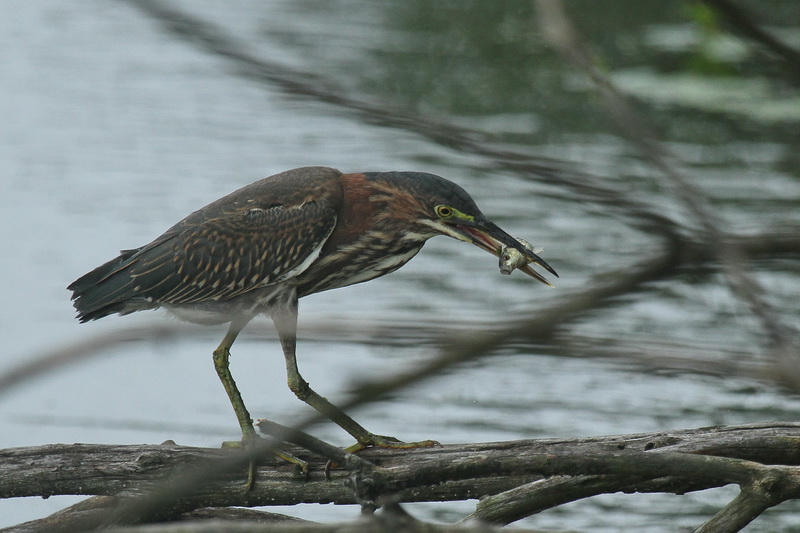
In the salt marsh behind the Wetlands Institute, this immature Green Heron posed in the open in a manner not often seen ...

Green Heron (immature)
Nearby, a Snowy Egret was resting a weary leg ...

Snowy Egret
The young robin is obviously not a wader, but it has gotten the idea about how it needs to make it own way in the world ...

American Robin (immature)
Good Birding!!

Saturday, August 31, 2013

Young Green Heron, eclipse Wood Duck

Birds were generally quiet and secretive at John Heinz NWR on Friday, but there were many signs of the recent breeding season and the change of seasons.

This young Green Heron waited with patience for food to come near ...

Green Heron - immature

... much more patiently than the photographer who hoped to capture its strike. Within seconds of my turning away from the heron, it made a strike and then retreated along the branches to down its meals ...

Green Heron - a successful strike
Green Heron - lunch
 

Elsewhere, hen Wood Ducks watched over young, and a pair took over a log which rightfully belonged to painted turtles ... at least that seems to be the opinion of the turtle looking on. The Wood Duck on the right is a drake in eclipse plumage.

Wood Ducks & painted turtles


Wood Duck - drake, eclipse plumage


Many young American Robins were following parents, but this young fledgling appears hopeful that a parent will come to it ...

American Robin - fledgling
But the really notable feature of the day was the insects, to be posted soon.

Good Birding!!

Saturday, December 22, 2012

CHRISTMAS BIRD COUNT - A SNAPSHOT OF WINTER BIRDS

Eastern Bluebirds favor orchards during winter.
During the winter months, it is not uncommon to hear the question, “Where are all the birds?”

A flip answer would be - “They’ve gone south” - which they have. Most of the birds which fill our landscapes during the summer are tropical birds which return to the tropics in Central and South America during our winter months. Most of the warblers, vireos, thrushes, and flycatchers fall into this category. Many other birds move to the milder climate of the southern states: This includes many species of waterfowl, wading birds, and raptors, plus some of the hardy songbirds.

On the other hand, boreal species from the north also move south, driven by changes in the weather, but also, and probably more importantly, by the availability of food in their northern homes. Food availability means that some winters they more or less stay home, while other winters they irrupt southward. When there is an irruption, we may notice their numbers. When they stay home, we may ask that question about where they are.

Common Redpoll has irrupted into New England this winter.
As we watch our feeders, or wander about on our skis or snow shoes during winter months, it often seems as though we are seeing very few birds compared to what we remember seeing in other years. For example, two years ago during the holidays, my feeders were inundated with northern birds. Flocks of Common Redpolls, and mixed flocks of Evening Grosbeaks and redpolls descended in swarms. I was filling my bulk feeders twice a day. This year as of the time of writing, my feeders have been visited by a small flocks of 15 redpolls, while the grosbeaks have been completely absent.

In October, flocks of 200+ Pine Siskins swarmed about my feeders. During December they have been absent. Where are they? Undoubtedly, they have gone further south, in spite of the dependable food source at my feeders ... because ... birds do not simply rely on bird feeders, but in fact, derive most of their food most of the time from naturally occurring food sources. If those sources do not seem adequate, they move on.

White-breasted Nuthatch is a year-round feeder bird.
There are two citizen science projects which provide a snapshot of where the birds are during the winter. One is the Great Backyard Bird Count. This is primarily a feeder count which is conducted on the President’s Day weekend in February. To learn how you can participate (in the comfort of your home) visit this website: www.birdsource.org/gbbc.

The second citizen science project is the Christmas Bird Count. In its 113th year, the CBC engages over 60,000 people in about 2500 locations.

There are several Christmas Bird Counts done in southeastern Vermont and southwestern New Hampshire. I participate in the Brattleboro Area CBC on the third Saturday in December, so that is the one I can write about.  Here is a snapshot of where the birds are around Brattleboro.

Many participants returned from their day of counting speaking of how hard it was to find birds and how low the numbers were. But when the counts were tallied, the number of birds counted (4100) was slightly above the ten year average (3900).

With open water in the Connecticut and West Rivers, waterfowl were well represented by Canada Goose, Mallard, and American Black Duck. Most significant was the number of Hooded Mergansers. Consistently present on the count, this year the 138 “hoodies” was five times greater than in any previous year.

The winter finches and boreal species showed no consistency as a group. The American Goldfinch was hard to find and the count was the lowest in the last 15 years. Pine Siskin, so abundant in October, was absent. Evening Grosbeak, consistently present the last 11 years was absent. There are usually a few Purple Finches in December; not this year.

Pine Grosbeaks appear in SE Vermont every 5 or 6 years.
On the other hand, Pine Grosbeaks appear every 5 to 6 years. This was their year. Common Redpolls show a consistent pattern of being present every other year. This was the year they were expected, and they did not disappoint; counters tabulated the largest number of redpolls (almost 300) in recent years.

Sparrows were hard to find, but the winter sparrows, American Tree Sparrow and Dark-eyed Junco were within their expected numbers, along with small numbers of Song and White-throated Sparrows.

Red-bellied Woodpecker has continued its expansion in Vermont.
The Red-bellied Woodpecker which first nested in Vermont in Brattleboro in 2001 continued its steady population increase.

Blue Jay and American Crow had their smallest numbers in years. Putney Mountain Hawk Watch counts migrating Blue Jays (when not counting hawks); they counted hundreds of jays. Apparently, the Blue Jays kept on moving because they were difficult to find in the Brattleboro area.

Other common feeders birds were present in average or above average numbers: Black-capped Chickadee (up), White-breasted Nuthatch (up), Downy Woodpecker (down slightly), Tufted Titmouse and Northern Cardinal (steady).

American Robin often winter in Vermont, feeding on fruit.
Some species are seen in flocks, and may be very localized. Horned Larks were in Vernon (180). Eastern Bluebirds were mostly in Dummerston (total 59 verses 10 year average 25). American Robins were scattered, but with a large flock in an old Dummerston orchard (total 244 verses 10 year average 44). Only one small flock of Cedar Waxwings (31) was found around Sunset Lake.

There are always a few birds which should have migrated, but have not. Brattleboro recorded this year a Red-shouldered Hawk and a Common Yellowthroat (a first CBC record for Brattleboro).

If you are a reader who is worried about a lack of birds at the bird feeders, I say, “Don’t be.” The CBC suggests that the birds are still around. Except when humans really screw up the environment, the birds are resilient and adaptable. Their population numbers go through regular and natural fluctuations. Once the counters on a CBC thaw out and examine the count numbers, this is confirmed (for most species) year after year.

Stay warm, and if the birds don’t come to your feeders, go out and look for them. Good birding!!

Tuesday, August 28, 2012

The Challenges Faced by Breeding Birds

The breeding season for the birds is just about over. In my yard it has been a successful and entertaining season, with a succession of young birds being fed in the trees and bushes, and around the feeders. But what I see in my yard is just a fraction of the activity, challenges, and drama of the breeding birds.

American Robin with two fledglings
As an example, let’s begin with a few dry facts about the American Robin.  The male and female build a cup nest from scratch. Typically four eggs are laid and are incubated by the female for two weeks. The young are fed in the nest for two weeks and are then fed by both parents as fledglings. A pair of robins will raise two or three broods each year.

Now consider: if every egg hatches and every hatchling fledges and every fledgling survives, this would mean that a single pair of robins would add eight to twelve new robins to the robin population in a single year. If all robins were similarly successful, the robin population would increase on average five times in one breeding season. Clearly, we would soon be overrun with robins.

Rose-breasted Grosbeak fledgling flutters and calls for food
But that degree of nesting success rarely occurs. The eggs and the nestlings of birds are threatened by many predators: weasels, raccoons, red squirrels, snakes, jays, crows, hawks, and owls (to name just a few). And don’t forget your house cat among the predators. Birds are hosts to many parasites; bird-lice, fleas, louse flies, ticks, and mites all dine on the birds and their young. Storms can damage nests. If the nest has been built anywhere near humans, deliberate or inadvertent disturbance may occur. Once the young are out of the nest, the dangers increase. Young birds are squawking and fluttering to attract the attention of their parents so that they can be fed, but this may also attract the attention of all of those nest predators and more.

Food supplies effect the ability of birds to successfully raise young. A few years ago, cuckoos were common in our area, in conjunction with a variety of caterpillars chewing up the leaves of the trees. Several years ago, our yards were overrun with chipmunks. That same summer, Barred Owls had remarkable success in raising their young. But then came the winter when the food disappeared beneath the snow pack and the young owls were unable to feed themselves. A few were found and taken to wildlife rehabilitation centers; the others perished. This summer has been another banner year for chipmunks, and probably for owls and hawks as well. What will happen to those young if the coming winter is typically harsh?

The likelihood that a nesting pair of birds will successfully hatch and raise a full clutch is quite low: an egg may not hatch, a nestling may be out-competed for food by its nest mates, a fledgling may be too quiet or too weak to attract a parent with food or simply get too far away from its parents. Cornell Lab or Ornithology has citizen scientists doing nest box studies. For the Eastern Bluebird, for example, nesting success is about 72%; this is the percentage of nests that produce at least one fledgling.

Tufted Titmouse juvenile
When I see young birds being fed around my feeders or in the trees around my home, I am seeing young that have already beaten many odds, but who still have many long odds still to overcome. In mid-July, I was entertained by a pair Evening Grosbeaks. One was the mother; the other  a youngster. He was constantly calling for her. When she fed him and flew off, he followed her noisily. Eventually, he followed her to the bird feeder, where she ate and occasionally fed him. Bit by bit, he got the idea that he could get food on his own, although he gave up mom’s service only reluctantly.

The next day, the young grosbeak was at the feeder by himself and feeding himself, endlessly scarfing down seed and even chasing off other, sometimes larger, birds. But he had no sense of fear. I approached to within three feet and felt as though I could have picked him up, he was so tame - or perhaps, clueless. Instead, I clapped my hands and shouted. This finally induced him to fly off. Young Downy Woodpeckers on the suet feeder also show a cluelessness to danger, so I’ve taken to chasing them off as well in an attempt to teach a bit of wariness.

They need wariness, as the pile of dove feathers on the back lawn one morning testified. Probably a young Mourning Dove roosted on the tree branch too long, and became a meal for a hawk or owl. But in doing so, that dove fulfilled its life purpose; it became a part of the food chain.

Therein is a truth that is an unpleasant one for many people. We look on the birds at our feeders as entertainment, cute bundles of energy and activity. We give them human attributes. The titmice are sweet, the chickadees acrobatic, and the nuthatches comic. The crows are noisy and the jays are greedy bullies. But they are all “our” birds.

Blue Jay juvenile
Watch all of them more closely. Once the young are cut free from parental dependence, the birds may occasionally cooperate in alerting others to danger, as when a hawk is perched in a nearby tree. They may travel in flocks, communicating with one another about  food sources, and benefitting from safety in numbers. But they are also competing with one another for food, regardless of how full the feeders may be or how laden with fruit the bushes are. One bird chases off another bird - its own kind and other kinds - as though the food supply might suddenly run out.

The life expectancy of small birds is not long. Occasionally a song bird may live 5 to 10 years. The host of dangers and challenges facing small birds probably means that few ever “die of old age,” though old age may eventually weaken them or slow them so that they succumb to one of the dangers or challenges. Some studies suggest that only 20% of the birds which are successfully raised during a breeding season survive to the second year, while 80% of the adults survive to the following year. Clearly, mortality among small birds is very high.

Early this month, I was entertained by a young Chipping Sparrow which begged from a Song Sparrow, then begged from another young Chipping Sparrow, and eventually was fed by a parent. I am amused by the demanding calls of the young Blue Jays; they seem like the noisiest, most obnoxious juveniles imaginable. I am taken by the simple naivete of the young birds and wish them well even as I try to teach them a few lessons about getting on in the world.

Male Downy Woodpecker feeds his fledgling son
But then I consider the realities behind my entertainment. The cycles of nature are not there for my amusement. They are serious business for the life involved. I may occasionally cite dry facts about common breeding birds, but those dry facts point to the larger challenge which each species and its individuals face in the cycle of life.

Monday, July 16, 2012

More Youngsters

The next generation of birds keep passing through the yard. Two families of Black-capped Chickadees made a rapid transit. The family of Tufted Titmice paused briefly in a bush, giving the young one a brief opportunity to beg.Chipping Sparrow young are feeding themselves.

Yesterday was a gray - and finally rainy - day, but many young were about. Probably the best juvenile for the yard this year was a Black-and-White Warbler. (The young age is more apparent in another photo, but it is not sharp enough for posting, and even this photo is marginal) ...

Black-and-White Warbler - juvenile
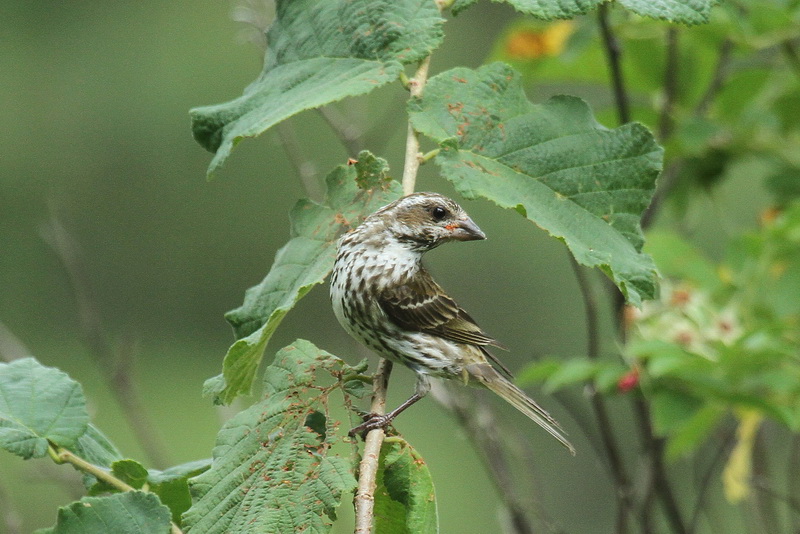
 The Purple Finch juveniles were everywhere. This one may look slightly perplexed - or hopeful that someone might still provide food - but it figured things out on its own ...


Purple Finch - juvenile

American Robins were not at the feeders, but were working the lawns and the river bed, although this young bird seemed a bit perplexed about it all ...

American Robin - fledgling
 The Northern Cardinal juvenile was very skittish and especially shy about having his picture taken, but it eventually managed to grab a seeds ...

Northern Cardinal - juvenile

Red-winged Blackbirds are regular and common visitors to the yard, but yesterday I had a first ever observation when fledglings begged for food and were fed by a male. The nesting habitat is probably marginal for the blackbirds, so the males are unable to acquire the usual harem. Obviously, this drives them to desperate measures ... like helping with the child rearing ...

Red-winged Blackbird - fledgling begging

Red-winged Blackbird - fledgling being fed

And finally ... I paid attention yesterday and saw what I have been missing in the past - a juvenile Brown-headed Cowbird. As many cowbirds as there are around, I knew they must be parasitizing nests, but have not had confirmation ...

Brown-headed Cowbird - juvenile
Good Birding (well, maybe with the exception of the cowbird) !!


LinkWithin

Related Posts with Thumbnails