Showing posts with label White-breasted Nuthatch. Show all posts

Wednesday, July 01, 2015

A Busy Day in the Yard


This afternoon alternated between heavy showers and golden sunshine, and the yard was as busy as ever. At least two dozen species (maybe three dozen) nest in our immediate neighborhood, and most of those make regular visits to our bird feeders. I sat on the back porch and watched the show! Hardly a pause in the activity ... a captivating way to spend an afternoon.

Here is just a sample ...

Rose-breasted Grosbeak
Rose-breasted Grosbeak - immature male

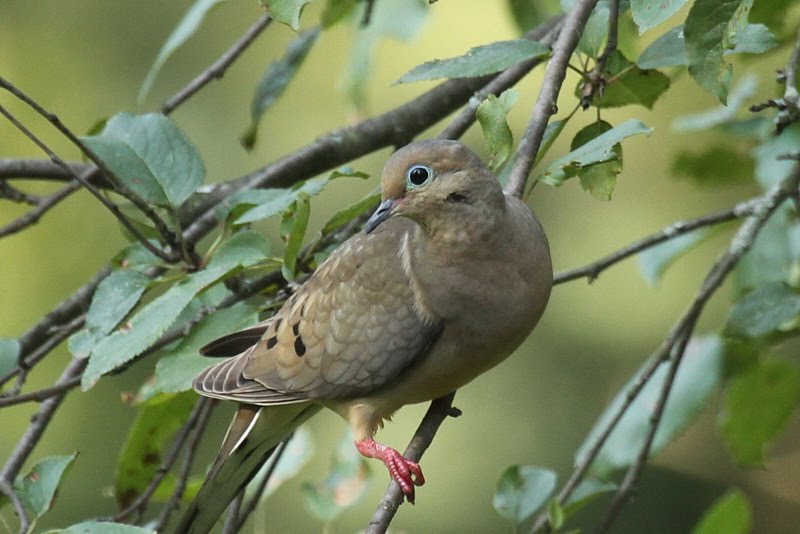
Mourning Dove
Red-bellied Woodpecker

Evening Grosbeak
Northern Cardinal

Purple Finch
 
American Goldfinch
Gray Catbird
White-breasted Nuthatch waits its turn - Evening Grosbeak (female)
It is a BIRD Feeder!! What do you not understand about BIRD FEEDER?


Good Birding !!

Tuesday, September 02, 2014

Western Birds

In early July, we took our 11 year old grand-daughter to the national parks of the fours corners. It was not a birding trip, but from time to time birds posed for me.

In that monumental geography, most photography was with the 25mm-125mm lens - not so great for photographing birds. But a few did come within range of the lens, or presented themselves when I had the longer lens mounted. Here are a few samples:

Ravens were common throughout our trip - noisy and evident, as youngsters tried to prolong their dependence on parents. In some places, the ravens were prominent beggars. This young bird was in Petrified Forest NP - Common Raven

Petrified Forest National Park

Common Raven
from Mesa Verde NP - Green-tailed Towhee and Western Bluebird ...

Mesa Verde National Park

Green-tailed Towhee

Western Bluebird
from Bryce Canyon NP - White-breasted Nuthatch feeding young and Western Tanager ...

  
Bryce Canyon National Park

White-breasted Nuthatch

Western Tanager

Western Tanager
 from Zion NP - Broad-tailed Hummingbird and Ash-throated Flycatcher ...
  
Zion National Park


Broad-tailed Hummingbird

Ash-throated Flycatcher
from Grand Canyon NP, North Rim- Black-throated Gray Warbler and Spotted Towhee ...
  
Grand Canyon National Park - North Rim


Black-throated Gray Warbler

Spotted Towhee
On the last day of travel, I got a new bird, but that will have to wait for a future posting - hopefully soon.


Thursday, February 14, 2013

Heinz NWR redux

Last Sunday I returned to Heinz NWR in Philadelphia for another delightful morning walk. Still no sighting of the Northern Shrike that has been reported, but there were sights and sounds which provided evidence that Spring-time thoughts are in the minds of some birds, in spite of the recent winter storm.

For example, along Darby Creek, this Hooded Merganser had his crest up as he proclaimed his handsomeness to the nearby hen ...

Hooded Merganser - drake displaying

Many songbirds were trying out their territorial / attract a mate songs including White-throated and Song Sparrows ...

White-throated Sparrow - "pooor sam peabody peabody peabody"
Song Sparrow

Along Darby Creek, this Belted Kingfisher gave me an opportunity that the residents along the Rock River behind my Vermont home have not given me - a reasonable photo opportunity as it flew up and down the creek ...

Belted Kingfisher

Several minutes of entertainment were provided by the White-breasted Nuthatch displaying its acrobatic foraging techniques. The following photo does not conveys something of that acrobaticism. I include it because in this case I especially like the photo's composition, the texture of the branch, and the wispy details hanging from the branch. Deep in the rotting crevices, it found tasty morsels ...

White-breasted Nuthatch

And ... in the same tangled mass of bittersweet, the Northern Saw-whet Owl was once again roosting. Its position was just slightly different from my previous sighting, giving a better opportunity for a photograph ...

Northern Saw-whet Owl
Good birding!

Saturday, December 22, 2012

CHRISTMAS BIRD COUNT - A SNAPSHOT OF WINTER BIRDS

Eastern Bluebirds favor orchards during winter.
During the winter months, it is not uncommon to hear the question, “Where are all the birds?”

A flip answer would be - “They’ve gone south” - which they have. Most of the birds which fill our landscapes during the summer are tropical birds which return to the tropics in Central and South America during our winter months. Most of the warblers, vireos, thrushes, and flycatchers fall into this category. Many other birds move to the milder climate of the southern states: This includes many species of waterfowl, wading birds, and raptors, plus some of the hardy songbirds.

On the other hand, boreal species from the north also move south, driven by changes in the weather, but also, and probably more importantly, by the availability of food in their northern homes. Food availability means that some winters they more or less stay home, while other winters they irrupt southward. When there is an irruption, we may notice their numbers. When they stay home, we may ask that question about where they are.

Common Redpoll has irrupted into New England this winter.
As we watch our feeders, or wander about on our skis or snow shoes during winter months, it often seems as though we are seeing very few birds compared to what we remember seeing in other years. For example, two years ago during the holidays, my feeders were inundated with northern birds. Flocks of Common Redpolls, and mixed flocks of Evening Grosbeaks and redpolls descended in swarms. I was filling my bulk feeders twice a day. This year as of the time of writing, my feeders have been visited by a small flocks of 15 redpolls, while the grosbeaks have been completely absent.

In October, flocks of 200+ Pine Siskins swarmed about my feeders. During December they have been absent. Where are they? Undoubtedly, they have gone further south, in spite of the dependable food source at my feeders ... because ... birds do not simply rely on bird feeders, but in fact, derive most of their food most of the time from naturally occurring food sources. If those sources do not seem adequate, they move on.

White-breasted Nuthatch is a year-round feeder bird.
There are two citizen science projects which provide a snapshot of where the birds are during the winter. One is the Great Backyard Bird Count. This is primarily a feeder count which is conducted on the President’s Day weekend in February. To learn how you can participate (in the comfort of your home) visit this website: www.birdsource.org/gbbc.

The second citizen science project is the Christmas Bird Count. In its 113th year, the CBC engages over 60,000 people in about 2500 locations.

There are several Christmas Bird Counts done in southeastern Vermont and southwestern New Hampshire. I participate in the Brattleboro Area CBC on the third Saturday in December, so that is the one I can write about.  Here is a snapshot of where the birds are around Brattleboro.

Many participants returned from their day of counting speaking of how hard it was to find birds and how low the numbers were. But when the counts were tallied, the number of birds counted (4100) was slightly above the ten year average (3900).

With open water in the Connecticut and West Rivers, waterfowl were well represented by Canada Goose, Mallard, and American Black Duck. Most significant was the number of Hooded Mergansers. Consistently present on the count, this year the 138 “hoodies” was five times greater than in any previous year.

The winter finches and boreal species showed no consistency as a group. The American Goldfinch was hard to find and the count was the lowest in the last 15 years. Pine Siskin, so abundant in October, was absent. Evening Grosbeak, consistently present the last 11 years was absent. There are usually a few Purple Finches in December; not this year.

Pine Grosbeaks appear in SE Vermont every 5 or 6 years.
On the other hand, Pine Grosbeaks appear every 5 to 6 years. This was their year. Common Redpolls show a consistent pattern of being present every other year. This was the year they were expected, and they did not disappoint; counters tabulated the largest number of redpolls (almost 300) in recent years.

Sparrows were hard to find, but the winter sparrows, American Tree Sparrow and Dark-eyed Junco were within their expected numbers, along with small numbers of Song and White-throated Sparrows.

Red-bellied Woodpecker has continued its expansion in Vermont.
The Red-bellied Woodpecker which first nested in Vermont in Brattleboro in 2001 continued its steady population increase.

Blue Jay and American Crow had their smallest numbers in years. Putney Mountain Hawk Watch counts migrating Blue Jays (when not counting hawks); they counted hundreds of jays. Apparently, the Blue Jays kept on moving because they were difficult to find in the Brattleboro area.

Other common feeders birds were present in average or above average numbers: Black-capped Chickadee (up), White-breasted Nuthatch (up), Downy Woodpecker (down slightly), Tufted Titmouse and Northern Cardinal (steady).

American Robin often winter in Vermont, feeding on fruit.
Some species are seen in flocks, and may be very localized. Horned Larks were in Vernon (180). Eastern Bluebirds were mostly in Dummerston (total 59 verses 10 year average 25). American Robins were scattered, but with a large flock in an old Dummerston orchard (total 244 verses 10 year average 44). Only one small flock of Cedar Waxwings (31) was found around Sunset Lake.

There are always a few birds which should have migrated, but have not. Brattleboro recorded this year a Red-shouldered Hawk and a Common Yellowthroat (a first CBC record for Brattleboro).

If you are a reader who is worried about a lack of birds at the bird feeders, I say, “Don’t be.” The CBC suggests that the birds are still around. Except when humans really screw up the environment, the birds are resilient and adaptable. Their population numbers go through regular and natural fluctuations. Once the counters on a CBC thaw out and examine the count numbers, this is confirmed (for most species) year after year.

Stay warm, and if the birds don’t come to your feeders, go out and look for them. Good birding!!

Wednesday, October 27, 2010

Backyard Birds

A low grade fever has kept me from doing much of anything, but it takes little effort to sit on the back porch and watch the birds. Yesterday was an Indian Summer type of day which was irresistible to that kind of inactivity.

This has been one of the busiest falls in the backyard in recent years, with sparrows and finches in large numbers, including some of the winter finches (subject of this week's column). Note: in the captions, I indicate relative numbers in the yard.

American Goldfinch (common) and Pine Siskin (very common)

White-crowned Sparrow - juvenile (uncommon)

Little Brown Birds (l to r): Song Sparrow (very common), Purple Finch - female (common), White-throated Sparrow (abundant). Also, Dark-eyed Junco (abundant)
I don't know if the Blue Jays are residents who raised families in the neighborhood, or irruptive migrants from the north, but the evidence suggests that many of them will be wintering in the area. Note that this jay is filling its crop with seed. In good Corvid fashion, it is probably stashing seeds somewhere for a cold winter day. Filling the crop (and emptying my feeders) is a daily occurrence with the jays.

Blue Jay - a year-round resident? or visitor from the north? (very common)

White-breasted Nuthatch  - year-round resident (common)

Tufted Titmouse - year-round resident (common)
Good birding!!

Saturday, February 13, 2010

Devil Down-Head Bird

Many people have asked me, “Where are the birds this winter.”

Birds that we are used to seeing around our bird feeders have been absent this year. My bird seed bill is lower this winter than last year. Winter finches are missing; occasionally I have had a few goldfinches, but nothing like the hoards of goldfinches and siskins that were around in ‘09. My thistle feeder, a favorite of the finches, has not needed refilling once this year.

There are two possibilities. I saw a brief notice somewhere that the natural food supply in Canada, where many of our winter finches come from, produced an abundant crop last year, meaning that the birds did not have to engage in energy expensive travel. Canadian siskins, finches, redpolls, and grosbeaks stayed home. From further south in New England, the reports of finches seems normal. Our summer finches have gone south, while northern finches have stayed north. Apparently.

I’ve had a banner year for juncos with a foraging flock of 60+ making several visits every day. Beyond these small snowbirds, my feeder birds have been limited to the year round residents - those hardy birds that live and breed through the seasons.

One of those birds is the “Devil Down-head,” a little gray and white bird, that is delightful to watch. It “is a droll, earnest little bird, rather sedate and unemotional. He is no great musician .... He is short-necked, broad-shouldered, sturdy, quick and sure in his motions, suggesting an athlete, and as we study him on his daily round, as he hops up and down over the bark, we see that he is an athlete with marked skill as an acrobat, like the tumbling kind, as much at home upside down as right side up.”

That description opens Bent’s Life History and describes characteristics of this bird which give it some of its folk names. It is a songbird that can’t sing. Its song can be accurately rendered as a nasal “ank, ank, ank,” leading many birders to refer to it as the ank-ank.

It is the upside-down bird. Many birds can run up a tree trunk. This bird can run up and down a tree trunk with equal alacrity. “They seem to have taken lessons from the squirrel,” wrote Edward Forbush, “ which runs down the tree head first, stretching out his hind feet backward and so clinging to the bark with his claws as he goes down ....” With only two feet, this little bird “hitches nimbly down the tree head first - something that other birds hardly attempt - and it runs around the trunk in the same way with feet wide apart.”

I am, of course, talking about the “topsy-turvy,” rather boringly named in common parlance as the White-breasted Nuthatch. Banding studies have shown that they return to the same wintering grounds in succeeding years. Although I have no way of proving it, I am quite certain that the ones that patronize my feeders in the winter are the same birds that breed in the neighbor. In the summer time, a topsy-turvy will perch upside down on a tree trunk and watch as I fill the feeders. As I go in the kitchen door, I hear “ank, ank,” and through the window I see the nuthatch hurry in to grab a seed. The same routine is played out in the winter; the only difference is in the temperature and the color of the ground. In all seasons, I like to think that my nuthatch neighbor is politely saying “thank you” with its “ank, ank,” and I always respond, “You’re welcome.”

There is nothing mysterious about the nuthatch name. “Hatch” derives from “hack.” The nuthatch often flies off with a nut, or seed (like a sunflower seed) that needs to be opened. It wedges the seed or nut into a crevice and hacks the hull open, or hacks the nut into small pieces. The same lack of mystery is true for its genus name, Sitta, which comes from the Greek and means “nuthatch.”

Europeans moving to North America were familiar with nuthatches (there are six species in Birds of Europe). Consequently, the early naturalists gave them descriptive names, by which I also mean boring names. Audubon, for example, described the White-breasted Nuthatch which has a white breast, the Red-bellied Nuthatch (now known as the Red-breasted) which has a reddish belly or breast, the Brown-headed Nuthatch which has a brown head, and the Pygmy Nuthatch, which is the smallest nuthatch. Ho-hum.

Audubon speculated that there were two more nuthatches to be discovered: “one larger than any of those known, in the high wooded plains bordering the Pacific Ocean; the other, of nearly the size of the present species, towards the boundary line of Texas and the United States.” He was wrong, but I wonder if he was trying to achieve a balance between Europe with its six nuthatch species and North America.

Today the White-breasted Nuthatch is our most common nuthatch, a reversal of what Audubon observed. He knew the White-breasted as “the least numerous; there being to appearance more than three of the Brown-headed, and two of the Red-bellied, for every one of the White-breasted.” The White-breasted inhabits leafy forests, but also frequents large trees in parks and suburbs. The Brown-headed is found in southeastern pine forests, while the Red-breasted (Red-bellied) prefers dense coniferous forests of the north and high mountains. The change in the relative populations since Audubon’s observations reflects the vast changes in the landscape which humans have effected.

The White-breasted Nuthatch which frequents my feeders grabs a preferred sunflower seed and flies off. Most of the time it is probably taking the seed to a tree where it can wedge it in a crack, and then hatch it open. But not always. Forbush again: “In winter the nuthatches have a habit of storing food in the crevices of the bark of trees or in cracks of poles, under loose shingles, clapboards, etc. I have seen quantities of chestnuts thus stored by them under the flakes of the bark of a shag-bark walnut tree. Seeds and acorns are often so stored and are used by the birds in time of want when ice storms coat the trees, if the jays and squirrels have not already stolen them.”

Yesterday I watched a nuthatch on a bell feeder just outside the kitchen window. Its feet grasped the ring at the top, an upside-down-bird clinging acrobatically to its perch while it picked off the seeds.

Head first, the Devil-down-head creeps down the trunk of the tree outside my window. The folk name is often reported by writers, but parsing its origin has been difficult. The Devil is said to turn everything upside down, so I guess the name suggests that this bird which creeps down head first has been turned on its head by the devil. The nuthatch has become a victim of the Devil; there does not seem to be any animosity toward the bird due to its having been victimized. I should hope not. Watching the acrobatics of the nuthatch during the winter is what I imagine keeps the angels entertained.

Good birding!

LinkWithin

Related Posts with Thumbnails