Showing posts with label American Redstart. Show all posts

Monday, June 13, 2016

On May 30, I posted a photo of a redstart female building her nest. I returned to the location at the Hinsdale setbacks last Thursday. Although I knew "almost exactly" where that nest was being built, I could not find it, which I am sure is what the birds would want.

So I had to settle for a male redstart further down the bike trail, still protecting his territory with song. American Redstarts have been especially common this year (as opposed to Chestnut-sided and Black-throated Green Warblers which have been hard to find, even by voice, let along see them)

American Redstart
An amusing observation was a passing Great Blue Heron being angrily and aggressively escorted out of the territory of a Red-winged Blackbird.

Red-winged Blackbird and Great Blue Heron


At Wilson Wetlands in Putney, a Wood Duck hen led her two (surviving?) ducklings across open water and quickly disappeared in the willow thicket ...

Wood Duck hen with ducklings
Good Birding!!

Monday, May 30, 2016

Early Nesting Activity

In the last week and a half I have seen lots of breeding evidence, with a few opportunities to photograph this activity.

When Vermont did the breeding bird atlas (2003-2007), June 1 was the safe date for many species, particularily for neo-tropical migrants. "Possible" and "Probable" designation were not acceptable. Breeding had to be confirmed. Of course, there were earlier safe dates, depending on the species.Those "safe dates" were pushed earlier for nearly all species during the course of the atlas survey.

Ten years later, I don't remember how that applied to different species, but my sense it that breeding is generally becoming earlier as Spring becomes earlier.

On May 15, I posted a photo of a Baltimore Oriole nest whose construction was nearly complete. The female was working on the nest (but not when I had my camera aimed, alas).

Here are a few more "Confirmed" breeding photos ...

American Redstart, female, May 21, Hinsdale setbacks, checking size, shape, and fit of the nest she was building ...

American Redstart
Eastern Phoebe, May 21, Hinsdale setbacks, carrying food to nest ...

Eastern Phoebe
Brown Thrasher, May 21, Hinsdale setbacks, carrying food to nest ...

Brown Thrasher
Black-throated Blue Warbler, female, May 23, West Dover, gathering nesting material (birch bark) while her mate kept an eye on me ...

Black-throated Blue Warbler, female
Black-throated Blue Warbler
Yellow-rumped Warbler, female, May 21, West Dover, gathering nesting material ...

Yellow-rumped Warbler, female
And finally ... no birds. Just one of the many beaver ponds scattered throughout the Green Mountains and creating open space, edge, wetlands, and assorted nesting places for many species, and a tranquil scene for an early morning wanderer ...


Good birding!!

Saturday, May 09, 2015

Birding Heinz NWR

We are using Philly for a birding base for a few days. Began yesterday at Heinz NWR at Tinicum.

Highlight for me was the Bay-breasted Warbler which I have not seen for several years as it heads north to the boreal forest for breeding.

The bird was working high in the trees, so the photo is at best documentary ...

Bay-breasted Warbler
Of special interest was watching a Yellow Warbler visiting a local home building center, in this case an oriole nest. Nest seems in good order, as though it may be this year's nest. On other hand, no landlord appeared to chase off the materials gatherer, so perhaps the nest survived from last year ...

Yellow Warbler

Yellow Warbler
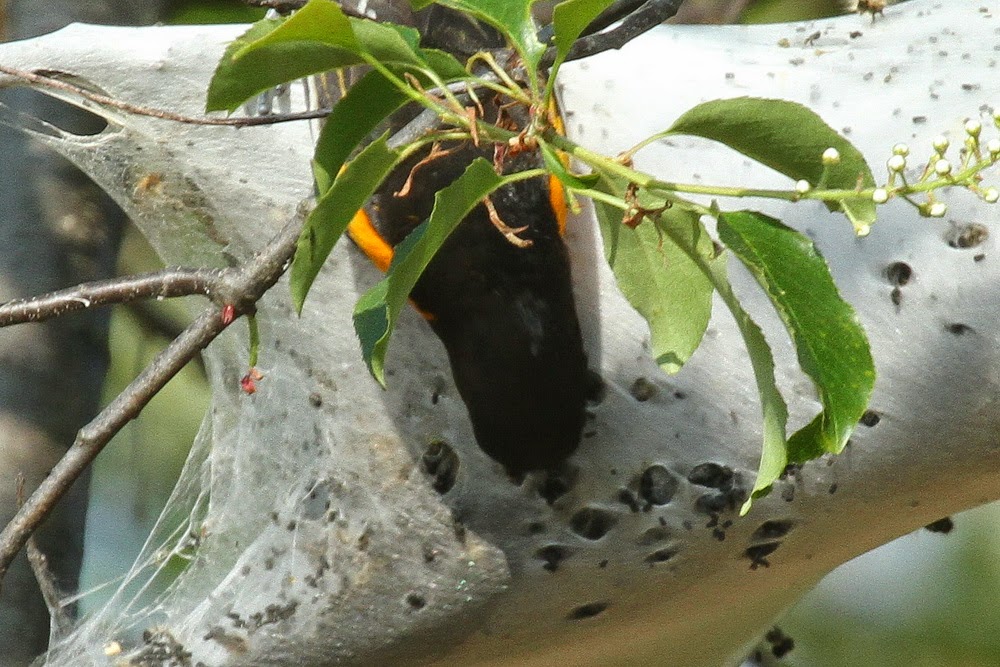
Another highlight was to see this Baltimore Oriole shopping at his local Whole Foods market.

Baltimore Oriole and webworm nest

Baltimore Oriole

Baltimore Oriole
A few additional photos, beginning with Gray Catbird which was everywhere!

Gray Catbird

Blue-gray Gnatcatcher

American Redstart

American Redstart
Good Birding!!


Thursday, August 25, 2011

Youngsters

One of the things I enjoy about late summer is seeing the young birds learning how to be independent. Here are a few recent encounters.

This fledgling Northern Cardinal had only been on its own for a few days when he visited the platform. It is probably a second brood youngster. The parents are probably back on the nest, and in mid-September, new youngsters will be coming around.

Northern Cardinal
Movement through the willow tree caught my attention, and then briefly I had a few glimpses of recently fledged American Redstarts chasing their parents. Even with difficult lighting, lots of foliage, and constant movement, a few passable photos were possible.

American Redstart
Again this year the Evening Grosbeaks have been nesting in the neighborhood, raising multiple broods. This one had been on its own for a while and was faring quite well.

Evening Grosbeak
The Eastern Towhee had just left the nest and was waiting impatiently for a parent to bring food.

Eastern Towhee
This is a "just because" photo. In early August, the resident male Ruby-throated Hummingbird was still vigorously defending his flowers and feeders. Now he has just about given up, or perhaps moved on, leaving the territory to the young birds and the females. But he'll be back next Spring, with a pugnacious attitude that gram for gram significantly outweighs anything else in the neighborhood.


Ruby-throated Hummingbird
Good birding!

Saturday, November 27, 2010

Unexpected Winter Birds

Dark-eyed Junco in February - a common winter sparrow
It is only a matter of time before winter arrives in full fury. Freezing nighttime temperatures are becoming more common than frosty nighttime temperatures.

You see the effects of this reality whenever you look at your bird feeders, go out for the mail, wander in the woods, or amble a town street. Most species which fill our woods and fields with song and movement from late Spring through early Fall are gone.

Internet bird notes and e-mail bird list-serves provide regular updates about what is being seen where; in particular they report on the unusual and unexpected birds for this time of year and our corner of the world. When someone from outside of the active bird watching community sees something that strikes them as unusual or unexpected, the report often comes with a surprised, “I’ve never seen that bird around here” ... or an implied, “What is that bird doing here at this time of year?”

Red-bellied Woodpecker in February
In the category of “never seen that bird before,” there are two which often bring such a response in southeastern Vermont. One is the Red-bellied Woodpecker. A feathered flatlander, this southern species has been extending its range northward. The first confirmed nesting in Vermont was in Brattleboro in 2001. Like the Downy, Hairy, and Pileated Woodpeckers, it does not migrate.

An aside: Birders have an imprecise vocabulary for describing bird populations: Abundant (you can’t miss it) - Common (you will probably see it) - Uncommon (you might see it if you are lucky, but no surprise) - Rare (you are really lucky if you see) - Accidental (you won’t see it because it just doesn’t belong here).

Red-bellied Woodpecker is uncommon in southeastern Vermont. You might see it, but it’s no surprise. It may even live in your neighborhood, in which case you will think it is common. The Red-bellied Woodpecker population in our area has grown significantly since its first nesting in 2001. It may not be too long before it will be as common as the Downy or Hairy Woodpecker. The Red-bellied is larger than the Hairy Woodpecker. It has a red stripe over the top and back of its head, a plain white breast, a barred black and white back, and a red belly that is almost never seen.

Caroline Wren in December
Also uncommon is the Carolina Wren. Like the Red-bellied Woodpecker, this is a southern species which is moving northward. Unlike our other wrens, the House, Winter, and Marsh Wrens, it does not migrate, though in severe weather it may “withdraw” (which may mean that many individuals get done-in by the severe weather). The Carolina Wren is solitary, or in pairs. It stays on territory year-round, and defends its territory against other intruding Carolina Wrens. It has the delightful habit of singing year-round. If you have a Carolina Wren, you may hear its rich, rolling, triplet notes that sound something like “tea-kettle, tea-kettle, tea-kettle” or “chur-ee, chur-ee, chur-ee.”  This wren will sing any time during the day, and any time during the year, except in the most atrocious weather.

American Robin in January
In the category of “What is that bird doing here at this time of year?”, there are also two that commonly elicit the question. The first is often reported with words such as, “I just saw a robin!” This is followed by, “It sure doesn’t look like spring out there to me!” or “Aren’t they supposed to go south for the winter?” No, it is not spring and won’t be for some months, and, yes, and they do go south. But for American Robins which nest far north in Canada, this is the south! Most range maps for the robin show it as a year-round resident in southern New England, barely fifty miles to the south of my home. Birds are not very good at reading range maps, however, and consequently robins may be seen in our region any month of the year. Some robins, I am sure, winter in our woods. Others move north and south with changes in the weather.

American Robin in February
I grew up watching robins hunting earth worms on the lawn of my city home, and so concluded that robins eat worms. But like most birds, they are omnivorous. Worms provide protein for nestlings during Spring and Summer, but during the rest of the year, berries and fruit with their high sugar content fuel a robin’s energy needs and keep its metabolism functioning.

In Spring, the robins disperse in pairs to raise their young. They are seen everywhere. If you don’t see or hear a robin when outdoors during the breeding season, you simply are not looking or listening. But in winter, they gather in flocks and wander about. Int the last ten years, the Brattleboro Area Christmas Bird Count has recorded robins every year except one. The number counted has ranged from one robin, to over 150 robins. During winter, there is no assurance that you will see a robin on any given day, but on any given day you may see a robin.

What is true for the American Robin is also true for another member of the thrush family, the Eastern Bluebird. If the response to the winter sighting of a robin is surprise, the response to a winter sighting of a bluebird is likely to be astonishment. Some of the reason for this reaction to the bluebird in winter is undoubtedly due to its recent rarity. For many years, bluebirds were so uncommon, that any sighting at any time of the year was greeted with joy and astonishment. The population recovery of the bluebird has been a conservation success story.

Eastern Bluebird in November
During breeding season, the bluebird disperses in pairs. The rest of the year, it gathers in small, loose flocks. Like the robin, it is a year-round resident in southern New England. Like the robin, it does not read range maps and may be seen any month of the year in southern Vermont. Like the robin, it migrates in late fall and early spring, perhaps. The Brattleboro CBC has counted an average 20 bluebirds during the last ten years.

There is no need to be astonished, or surprised, at seeing a bluebird during the winter. On the other hand, elation at a winter bluebird sighting is always in order. Few birds have the ability to catch my breath the way a bluebird does. In the words of naturalist John Burroughs, the Eastern Bluebird is the “bird that carries the sky on its back and the earth on its breast.”

Good Birding!

Thursday, June 10, 2010

... and More Riches

On Wantastiquet Mtn, I heard the Cerulean Warbler, but never saw it.

However, I had leisurely opportunity to watch a pair of Black-and-White Warblers carrying food to their nest. I did not try to find the nest, since they were a bit upset just with my presence.


Also gathering food by scratching among the leaves and forest floor debris was this Wood Thrush ...


Along an old railroad bed parallel to the Connecticut River, I found this one year old male American Redstart singing for all he was worth. The male does not acquire his black and orange nuptial plumage until his second breeding year, but this young man clearly hopes he charms will be noticed.


Unlike the more mature American Redstarts which almost never show any interest in "pishers," this one reacted immediately, flying back and forth, and singing with vigor ...


Good birding!

Thursday, May 06, 2010

Good Birding!

Purple Finches in the backyard are at the peak of their wine red plumage ...


Rose-breasted Grosbeak returned to the backyard on Tuesday ...


Along the Connecticut River flyway, on Wednesday morning I happened on a fall-out of American Redstart ...


In the surrounding trees, Warbling Vireos were playing hard to find, but singing so they would not be hard to find to the right companion ...


Likewise the Yellow Warblers were busy singing when not chasing other males ...


A redundancy to add - Good Birding!

LinkWithin

Related Posts with Thumbnails