Showing posts with label Common Merganser. Show all posts

Wednesday, June 01, 2016

Neighborhood Mergansers

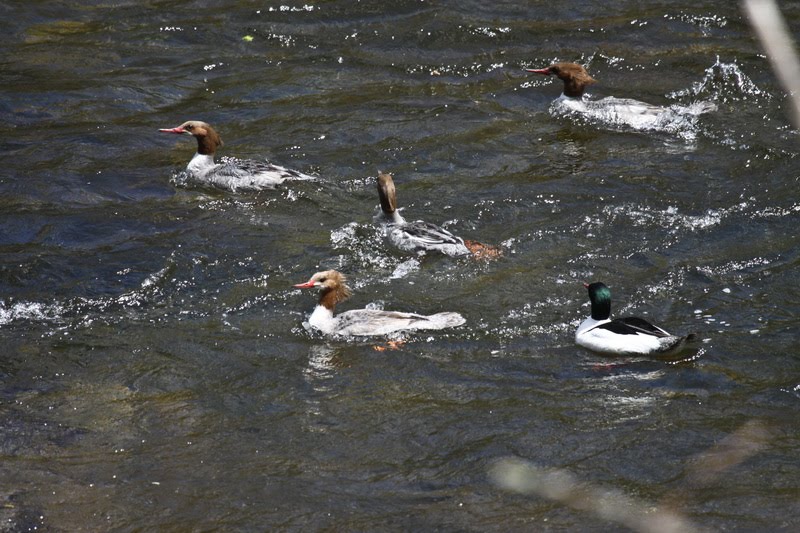
On the Rock River behind my home, two pair of Common Mergansers were foraging and coyly courting until I wandered a little too close along the bank. Then they headed up-river, either to escape my prying eyes or to find an appropriate nest site.

Common Merganser, male

Common Merganser, male

Common Merganser, female
So great to have Good Birding right in the back yard!!

Monday, May 05, 2014

Common Merganser Nuptials

My neighbor reported to me that a pair of Common Mergansers were courting on the gravel island in the river behind his home. I can see the area from my yard, so I have kept an eye on the area.

The truth was even more fun - one handsome drake appeared to be at the center of a love triangle, pursing one on the island, though a merganser on land hardly poses much of a pursuit threat. (On the other hand, she's not great at fleeing on land.)


Next he headed back to the water to impress a second hen ...


That's when the watching became really fun. To a lay observer, it looked like the two hens were displaying for the drake, or trying to intimidate the other ...


Sunday, July 14, 2013

The Merganser Family

At least dozen species nest on or near my home and/or forage for food for their young in the yard. Many of these bring their fledglings around as a reminder that parenting is a demanding task.

The family that I most look forward to seeing is Mother Merganser and her young. She nests somewhere upriver from our home and leads her brood up and down the river, alerting them to danger and teaching them how to feed themselves.

A couple of days ago, I was reading on the lower lawn when I saw Mother Merganser. I went inside for my camera and was delighted to find her still nearby and with her young.

It appeared that she was trying to lead them upriver, but there were snags and rapids blocking the way, and my presence made her nervous ...

Looking for a way upstream


Waiting for Mom

Perhaps a walk around?
Unable to find an easy passage, she led them hurriedly down river instead ...


Mom takes a short-cut ...

... while the kids follow the shallow current

Mom rides the rapids ...

... and the kids join her.
Good Birding!!

Tuesday, May 07, 2013

The First Week of May - Part I

Many local birders are on pins and needles, wondering when the tropical migrants will finally arrive. The consensus is that the warblers, vireos, flycatchers, et alia, are scarce and overdue. Time will tell (trite, but true).

Meanwhile, the predominantly North American birds which come mainly from the southern portions of the continent, are well into their Spring activities. A sampling ...

Song Sparrows are well along in forming their breeding pairs and getting the season's activity underway, as this one illustrates by carrying nesting material ...

Song Sparrow
 The Yellow Warbler is the first warbler to grace us with his full-throated song, although he certainly is not doing it for our benefit ...

Yellow Warbler
 Common Merganser pairs are along the rivers and streams, including behind my home. This lady seems miffed that her beau has departed!

Common Merganser - female
 Common Grackle singing - at least, that is what he would call it. We might call it something else ...

Common Grackle
 Male Red-winged Blackbirds do a competitive display. The one on the right prevailed in the duel of the epaulets, and the other - intimidated, no doubt - flew off.

Red-winged Blackbirds
Good Birding!

Saturday, July 07, 2012

Riding the Rapids ...

Riding the rapids ... and more from the bird nursery.

Shortly after 7pm last evening, when the sun was below the hills and the light beginning to fade, we received our hoped-for summer treat when Mrs. Common Merganser led ten chicks down the river behind our home. I had to run for my camera, and missed them as they went over the "big" falls. But then they gathered to ride the rapids ...

Common Merganser mothers gathers ten chicks in preparation for riding the rapids

Let's go gang ...


In addition to the treat of seeing the mergansers, there is also the reassurance that the river and its environs is rapidly recovering from the violent scouring it received last year from Hurricane Irene. Additional evidence is seen in this Belted Kingfisher which emerged from a dive with a fish in its mouth. He has been foraging up and down the river, and in the last few days has been pursued by a youngster noisily demanding food ...

Belted Kingfisher (male) pauses across the river with food for young
 The backyard nursery continues in full swing. The jays and grackles are raucous and demanding. By far, the quietest, and I could say most polite, are the Rose-breasted Grosbeak fledglings. They flutter their wings inconspicuously while softly peeping for food ...

Fledgling Rose-breasted Grosbeak calling for food
All of the young are beginning to get the idea that mom and dad only feed them for a short while. Then they have to figure things out for themselves. This young Evening Grosbeak has definitely gotten the idea ...

Juvenile Evening Grosbeak deftly cracks sunflower seeds
Good birding!

Monday, January 23, 2012

Dabblers Take Flight

The dabbling ducks (Genus Anas) are inhabitants of marshes, ponds, and small lakes. These habitats often are thick and tangled. When danger comes, they have to get up and out quickly. They leap into the air - virtually straight up - and then get going.

Taking flight in this manner is very different from almost all other other waterfowl, which need a running start - often a very long running start.

When any of these birds take flight, it happens so fast that we can easily miss the details. My photography is a relatively new addition to my birding (about 6 years - less than 3 with good equipment). Freezing the moment with the camera has allowed me to see the detail and to learn - plus, it's fun!

This first photograph captures dabbling ducks as they "leap" into flight. In subsequent posts, I will have details from a burst of photos. This is the first in that burst.

Mallard (drake) and 3 Northern Pintails (females) "leap" from the water's surface
 In the next photo, a Gadwall is in the air, while American Coots are just beginning to "run" on the water's surface in order to gather enough speed to get airborne.

A Gadwall "leaps" into flight while American Coots "run" to take flight
The mixed flock of Green-winged Teal and Northern Pintail are on the wing. The American Coot (lower left) is still running, not quite airborne. Note the splashes from the coot's feet.

Green-winged Teal and Northern Pintail - American Coot lower left
To illustrate the contrast with the dabblers, next are two photographs of mergansers. Mergansers are adept divers with legs located toward the rear of the body to assist as they swim underwater; this also makes them very awkward on land. When taking off, they need room to run ...

Common Mergansers (hens)

Hood Merganser (hen)
Where dabblers leap into the air, American Coots patter across the water, flapping furiously in the effort to get airborne. They are tough, adaptable, and common - and thoroughly entertaining. Watching them take flight, or watching them doing whatever they may be doing, will explain the origin of such phrases as - "He is crazy as a coot." - or - "He's a crazy old coot." (This last saying is one I am beginning to find offensive.)

American Coot
More on dabblers leaping into the air in a few days.

Good Birding!

Thursday, February 17, 2011

Nostalgic for Spring, 1

Winter drags on. The January thaw was a blip. The February thaw has reduced the snow pack in my back yard by about 6". Only 19" remain. The predictions call for a return to the deep freeze.

I am nostalgic for Spring. So I returned to a few images from the distant past - the long ago Spring of 2010 ...

... like a bluebird, a spot of deep blue sky, singing atop a snag ...

Eastern Bluebird
... or a goldfinch molting into his nuptial plumage, a yellow that will define the primary color ...

American Goldfinch
... or the primal pursuit in the open, but still cold, river waters of the drake merganser for the right to mate with a hen ...

Common Merganser
... and a robin busy with nest building, her pairing issue resolved.

American Robin
Good birding!

Thursday, April 29, 2010

Today

Few new arrivals today, but old friends are always welcomed. At Bennett Meadows in Bernardston, MA, there were 8 Wood Ducks, and at least two Hooded Merganser hens. Here's one of those hens ...


Along the West River, a single Common Merganser drake was guarding his harem of eight hens, though I only got four of the hens in this picture. Some appeared a bit reticent toward him ...


Then they all got spooked by the long thing that I was pointing at them ...


But the highlight of the morning birding had no feathers. Along the railroad tracks near the boat launch on the Connecticut River, this mink came up the bank and started to cross the trestle ...


... then it became aware of some odd creature on the other side. Curiosity did not get the better; the mink retreated ...


The sighting of the mink sent me to resources about this mammal. Kaufman's Mammal Guide says that it is fairly common in marshes, rivers, & lakes. It sometimes appropriates the use of a muskrat lodge for its den, "often after killing and eating the previous owners."  So, behind that sweet face is the soul of a foreclosure banker.

Good birding!

Wednesday, April 28, 2010

Wednesday

From the West River in Brattleboro - Common Merganser ...


... and from the backyard, a House Finch, usually expected in the town neighborhoods along the Connecticut, but an uncommon visitor in my village.


Good birding!

Saturday, January 23, 2010

Along the Rock River


I usually begin this weekly exercise very early on Monday morning. But on this past Monday morning, I awoke to the wonderland of a new snowfall, and to the need to dig out. When that task was done, I brought in wood for the wood stove. Then I walked down to the river that runs behind my home.

“River” is a bit of a misnomer. River implies something large and long. The Rock River is neither. I am only a few miles from its headwaters. It flows past me for a few miles and then joins the more appropriately named West River and eventually the Connecticut. During Spring melt and following torrential rains, the Rock River rages like a river for a day or two. Then it settles back into its placid mode. In all seasons, it would be better described by “brook,” “creek,” or “stream,” but whoever made the entry on the geographical maps preferred the alliteration of Rock River.


So Monday morning I waded through the new snow to the river bank to look at the river. The day after Christmas, rain washed out the ice, heaving large chunks onto each bank and leaving the water open. Now, three weeks later, the ice has returned. In most places it spans between the river banks, giving animals a dry bridge across the frigid water. Tracks crisscrossed the snow covered ice giving evidence that life has continued its activity even as I lay abed, enjoying the snow muffled quiet of the winter morning.


Where the river flows swiftly, there are still open places, but if a frigid January returns, it will quickly close up, forming an ice cover of eighteen or more inches. It happens most winters. A few winters, I have been able to snow shoe down the middle of the river for long distances.

On those winters when the Rock River is completely frozen over, it then becomes a gauge by which the return of Spring can be measured. As the sun acquires more warming power and the temperatures begin to moderate, the river slowly opens up, with a patch here and a patch there.

About ten years ago, the river had frozen completely. Around the beginning of March, hints of Spring began to be felt in the air and the ice slowly began to retreat on the river. By the middle of March a couple of pools had opened up and the flowing water could be seen for the first time in weeks.

By happenstance, I was watching the river from my kitchen window when two birds flew upstream along the river highway and landed in the first open pool. One was a drake Common Merganser, his large, bright white body, breast, and neck prominent against his dark back and green head. The other was a hen merganser with her gray back and rusty-brown head. They rested for a few moments, and then both dove. When they surfaced, it was about ten yards upstream in the second open patch in the river. They paused again for a few moments, then took flight and headed swiftly upstream.

I see Common Mergansers along the Rock River waterfowl highway several times every year. In the spring, a pair flies rapidly upstream a few feet above the water. Sometimes an hour or so later, I will see a pair fly rapidly downstream. Less often, when I am especially lucky, I may see one or two swimming down the river. The mergansers are very wary. When they even sense my presence, they take to the wing.

In March and April when the mergansers fly up the Rock River, I know what they are doing. They are in search of a nest site. Looking through my records, I found that there was one year when I recorded a Common Merganser on January 18. I think it was a mild winter and the river was open. Even so, that seems like a very early date for one to be wandering so far from good fishing grounds.

Common Mergansers prefer deep, clear lakes and rivers where they can pursue their foraging-by-diving lifestyle. You will often see them on the waters of the Retreat Meadows, lower West River, and Connecticut River. They are hardy birds, and in winter some will go no further south than the nearest open water.


Fast moving shallow water is not the Common Merganser’s preferred habitat except when there are other overriding urges. Early last May along the West River I watched four drake Mergansers courting a single hen. They swam in a tight circle, posturing before one another. Occasionally a powerful kick from a drake’s foot sent a spurt of water 3 or 4 feet long. The splash was the merganser variation of sexual display. He was showing off his bright red foot, and the power contained in it.


One June I was in an evergreen blind along the Rock River when a pair swam downstream. The bright red feet of the drake were clearly seen through the clear water. He had won her over, and they were returning from their upstream inspection of nesting sights.

I know that mergansers nest along the Rock River somewhere upstream from my home. Their nest is probably in a hollow tree; it could also be on the ground. When Audubon found their nests, they were on a marshy island, but most accounts describe nest holes. When I see a pair of Mergansers going upstream, or downstream, I know that journey is related to breeding. However, as soon as the eggs are laid, the drake disappears. The hen does the incubating and cares for the young alone.


In the mid-summer, the hen leads her young brood down the Rock River to the deeper waters of the real rivers downstream. Bobbing downy fluff balls float with her on the river’s current. She is as wary as ever, and when she senses my presence she speeds up, paddling her feet so rapidly that she almost walks on the water. Her young, desperate that she may disappear ahead of them, follow her in a near panic.

The Rock River behind my home is still partially open, but I do not expect to see any mergansers for a couple of months. For the time being, this rocky mountain stream flows gently, mostly hidden by the covering ice.

In our culture of instant gratification, the frozen river reminds me to be patient, and to accept what the day brings. A merganser pair is not going to be flying upriver on this day. It will be many months before a brood of young mergansers goes bobbing downstream. Today’s gift is new snow, a clearing sky, and sun sparkling on frozen water crystals. I am gratified ... and grateful.

LinkWithin

Related Posts with Thumbnails