Showing posts with label Northern Mockingbird. Show all posts

Wednesday, February 24, 2016

Birding in DC

No winter birding trip this year.

Spent 4 days last weekend in Washington DC, with coincidental birding during long walks each day around the National Mall, with a species tally somewhere around 25.

(I had my "walk-around" lens (16-300mm) which is adequate for landscape and cityscape, but not that great for birds.)

Most entertaining sighting was a Red-tailed Hawk being mobbed by American Crows.

Red-tailed Hawk being mobbed by crows

"Enough, already!!"
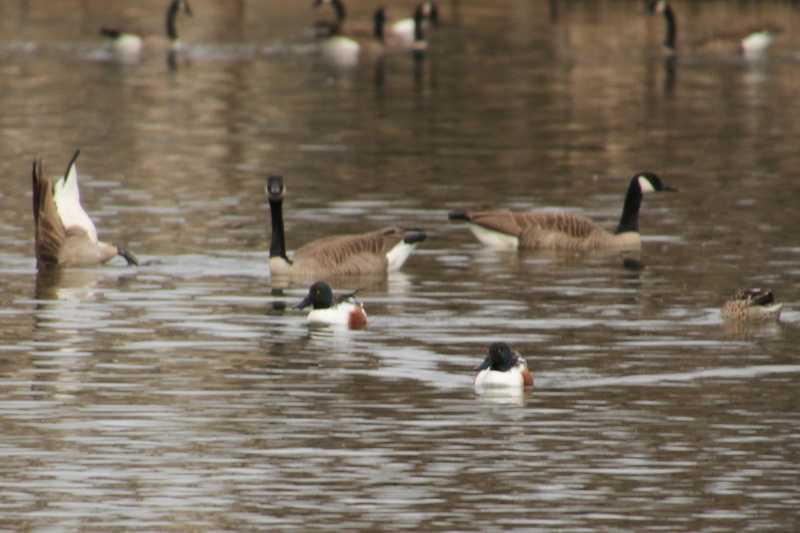
 The best surprise was a fast fly-by of a Peregrine Falcon, and the Northern Shovelers and Ring-necked Ducks on the pond by Constitution Gardens.

Northern Shovelers with Canada Geese
Ring-necked Ducks
 A few other birds which sort-of  posed for a photo ...

Ring-billed Gull
Northern Mockingbird
Double-crested Cormorant
 On the first day, I thought my birding might be limited to the Snow Geese on display in the "Castle" of the Smithsonian.

Snow Goose in Smithsonian display

Monday, March 09, 2015

Florida - First Posting

Just less than a week ago, I returned from a week in Florida - a welcome respite from the harsh winter "enjoyed" by the Northeast. It has taken a while to process the photos.

There were several days with good birding, and good bird photography opportunities. This post will get things started. It seems appropriate to start with Florida's state bird, the Northern Mockingbird. These birds were singing their joyful mocking songs everywhere we went ...

Northern Mockingbird

First - Wakodahatchee & Green Cay, in the Boynton Beach-West Palm Beach area. Both are the final stage of water treatment facilities. Wetlands with extended boardwalks provide pond and marsh habitat for wetland birds and some of the best viewing opportunities to be found anywhere. Much more will follow from these sites. For now, three residents: Great Egret, Glossy Ibis, Pied-billed Grebe.

Great Egret

Glossy Ibis (non-breeding plumage)

Pied-billed Grebe

From Everglades Nat'l Park, two year-round residents (although maybe these particular individuals will be moving northward for breeding), Black-necked Stilt and Eastern Meadowlark ...

Black-necked Stilt

Eastern Meadowlark

From the Keys, and everyplace else along the coast, Brown Pelican ...

Brown Pelican (adult non -breeding)

And from Dry Tortugas Nat'l Park, a year-round resident - Royal Tern - and a winter resident - Ruddy Turnstone.

Royal Tern (non-breeding)

Ruddy Turnstone (non-breeding)
The "up-close and personal" wetland birds (and some non-wetland birds) will follow in subsequent posts.

It was a week of warm weather and Good Birding!

Thursday, February 05, 2015

Still Here - and with a New Blog

I have not dropped off the face of the earth. Still here. But with one thing and another, I have not done much bird photography in the last couple of months, except for turkeys out the back kitchen window in Vermont, and a brief trip to Heinz NWR in Philadelphia in January.

But I have been busy since coming to Philadelphia and I finally began acting on an outlet for my urban photography.

I have created a new blog: EXPLORING PHILADELPHIA


I hope you will check in out - follow me if you are so inclined - let me know what you think in a comment.

And I will be continuing with this blog, so come back soon.

Wild Turkey - South Newfane

Northern Mockingbird - Heinz NWR, Philadelphia

Saturday, April 07, 2012

Blackbird, Mockingbird, Ravensnest

The male Red-winged Blackbird intimidates his rivals and turns on the ladies with the brilliant display of his red epaulets. A photographic goal for this Spring is to capture first rate images of that display by a perched bird and one in flight.

The spring-like weather makes us think that the birds should be feeling as frisky as we do. But, it is still very early. The Red-wings are singing, but their epaulet display is still rather subdues, as though they are just warming up. Here are three early photos. The first is not a "display flight," but is the one I like best. The next two are perched males singing, but with half-hearted display.

"Taking Flight" - Red-winged Blackbird
Red-winged Blackbird - singing male

While stalking the blackbirds yesterday, this Northern Mockingbird distracted me. There was no singing, but I enjoyed the sassy stance ...

Northern Mockingbird
I would like to describe the next photo as a joyous stretch in celebration of Spring's advent ...

"Ah Spring!" - Northern Mockingbird
... but the fact is, he was stretching for a berry.

"Carry-out Lunch" - Northern Mockingbird
Finally, I visited Ravensnest. Three chicks are in the nest. Even with the 400mm lens, it is a long shot across the quarry and significant cropping, so this is what I term a "documentation photo" ...

Ravensnest - Common Raven hatchlings

Good Birding!!

Friday, November 20, 2009

Birding in the Rio Grande Valley

Couch's Kingbird ...

Green Jay - like most of the Corvids, noisy, intelligent, wary - and also strikingly beautiful ...

American White Pelican ...

Red-shouldered Hawk ...

Osprey - this bird was fishing over the pond at Edinburgh World Birding Center. The photo is minimally cropped, and was taken with the zoom at less than 400mm ...

Merlin - This large female was perched on one side of the tree; on the other side and somewhat higher, sat a small male Merlin, looking covetously, or perhaps hopefully (excuse the anthropomorphizing) at the female as she mantled her prey. We were with a group from the Rio Grande Valley Birding Festival in a residential neighborhood of Weslaco looking for parrots when we spotted the two Merlins. The male left, but she stayed put, slightly bothered by our presence but unwilling to fly off with her unconsumed prey. She was dining on an Inca Dove ...

Northern Mockingbird - fairly common in the river valleys near my Vermont home - very common in southern Texas - but that's no reason not to include this joyful mimic in a gallery of bird travel photos ...

Good birding!

Saturday, August 29, 2009

Summer Is Over

From the end of a bare branch, the Carolina Wren lifts his head and sings his bubbly song. Nearby, a second wren perches atop a scrubby bush and sings his song. Both look rather scraggly; neither sport the sleek, neat plumage seen at the beginning of the breeding season three months ago.

I speculate. One is an adult male, his plumage worn after several months defending his territory and rearing his young. Raising young can do that. The other is a young male learning to sing, imitating, repeating, and practicing the song of his species. Assuming he learns how to feed himself, avoid dangers, cope with the elements, and survive his first winter, he must then compete with other males for the opportunity to pass on his genes. During the benign days of late summer, he has time to prepare for both tasks. So he sings.

In the same weathered branches from which the wren sings, a cardinal chips loudly. The beak on this female looking bird is dark. Before long it begins fluttering its wings with the begging posture of a fledgling. Its pleading is acknowledged as the mother arrives to feed it. When the mother flies, the fledgling pursues her.

I hear the triplet mimic song of the mockingbird from some bush top. I cannot find the singer, but ahead of me a gray bird flashes white wing patches and white outer tail feathers as it drops quickly to the grass then returns to the branch. When my binoculars pick up the bird, it has the wide beak with pink of a fledgling. It calls loudly, and is soon visited by a parent with food.

A dark bird with a long tail disappears into the tangle of a berry bush entwined with vines. A second dark bird follows it. Moments later one dark bird, then a second, then a third, fly from the bush across the marshy grasses. They stop briefly on a tree branch, then drop into the tangled undergrowth. Young catbirds are following a parent, still the only source of food for their insatiable appetites which they understand.

High-pitched “sseee” comes from a dozen places in the tree tops along the field edge, and at first appearance the bird movement seems random and chaotic. Through binoculars I see dull, brown- streaked birds mingling with the handsome plumage of the adult Cedar Waxwings. The adults are flycatching, their sorties for food imitated by the younger birds who have not yet gotten the point.


Crows are milling about on the ground. One is fussing over something dark, going through all those motions associated with scavenging on a food source. As I approach, it flies, and with another crow, stops on a nearby fence post, vocalizing loudly. With binoculars I can see its beak; it is a young bird. The adult bird that perched with it soon leads it away. I examine the food that the young crow was scavenging; it is a scrap piece of black landscape fabric, with no food value at all.

In the hot, muggy days of late August, these birds are finishing up their summer task, that of extending their species into the next generation. For some, like the cardinal, catbird, and mockingbird, this is the second brood that they are raising and will soon send on their way.

Our temperate northern latitudes provide abundant protein resources needed for hatchling and fledgling songbirds. In our narrow view, we find many of these resources annoying, but those pesky flies, bugs, caterpillars, and tiny creepy-crawlies are essential to the continuation of bird life.

The birds which I have just described do not migrate, or do not migrate long distances. They can postpone their breeding until late in the summer (waxwings, also goldfinches) or they can raise more than one brood.

For the long distance migrants (the neotropicals) who go to Central and South America, summer is over. They are on their way. In Cape May, a New Jersey Audubon Society research program monitors fall migration with a “Morning Flight” project which counts songbirds for four hours following sunrise. The count began on August 15 and will continue through October.

I visited the observation platform at the count site early this week. At sunrise, the temperature was in the mid-70s, and went up rapidly. The humidity was over ninety percent. It was a hot, sticky summer morning.

But for songbirds, it was fall and time to go home for the winter. I saw more American Redstarts moving through the trees tops and taking flight than I have ever seen at one time. Their movement is underway in full force. In addition, there were Yellow Warblers, Northern Waterthrush, Red-eyed Vireos, Blue-gray Gnatcatchers, several species of Empidonax flycatchers, robins, Blue Jays, Northern Orioles, House Wrens, and many more.

The NJAS website describes the why and how of the project and explains: “the birds are identified in flight using an amalgam of clues - size, shape, overall color or pattern, manner of flight and (hopefully) vocalizations. It’s the toughest challenge in birding.” Many very experienced birders visit the site and stand with the official “Morning Flight” counter. They are typically reduced to observer status.

After observing the morning songbird flight, I went to the wetlands of the Nature Conservancy. For half an hour, I watched an Osprey hunting over one of the freshwater ponds. It seemed like a young bird, not quite sure of how to do this. Several times it hovered, plunged into the water, and came up empty. From time to time a second Osprey joined the first one. I wanted to think that a parent was coming around to watch its progress, maybe do some coaching, and certainly give encouragement. But I don’t really know.

I thought the same thing when I watched pairs of Forster’s Terns hunting the fresh water ponds - that a parent was teaching a youngster how to find its own food. The young birds need to learn the lesson quickly. The time when they can rely on a parent is coming quickly to an end, and they will have to feed themselves if they are going to survive and pass on their genes.

I may be wiping the sweat off of my brow. I may be sitting in the river to cool down from the heat of the day. But I have many clues that summer is over. I have long since lost the battle to eat the squash as they are picked. Now they just pile up. Soon apples will be peeled and holiday pies baked and put in the freezer. Wood is stacked. In so many ways, summertime - when the “livin’ is easy” and the “fish are jumpin’” - is over. The birds know that.

Good birding.


Post of "Tailfeathers," Brattleboro Reformer, Friday, August 28, 2009.

Saturday, April 18, 2009

Feathered Flatlanders

Flatlanders are people living in Vermont who are not native to Vermont, but came from someplace else - the flat lands. The flat lands are presumably a region such as the Connecticut River Valley as it runs south through Massachusetts and Connecticut - or New Jersey, or Long Island. A person not born in the Green Mountain State (emphasis on the “mountain”) is a flatlander. It doesn’t really matter if the place a flatlander comes from is actually flat, just as long as it is not Vermont with its Ethan-Allen-Green-Mountain-boys heritage. There may be exceptions allowed for the New Hampshire native who moves from the White Mountains to the Green Mountains, or the New Yorker who moves from the Adirondacks to the Green Mountains, but that’s about it. All others are flatlanders. You grew up in the Rocky Mountains of Colorado, and moved to Vermont; you are a flatlander. You moved to Vermont from a Swiss chalet in the Alps; you are a flatlander. You came from the Tibetan Himalayas where your entire life was lived about 15,000 feet - more than four times the highest elevation anywhere in Vermont. Then you moved to Vermont. You are a flatlander.

The opposite of a flatlander is a woodchuck, a term that is applied, often with negative connotations, to a native born Vermonter.

In a recent gathering, a friend said that he had been born in Vermont. “So you are a woodchuck,” I replied. “No,” he said, “I am a Vermonter!” Growing up he never heard the term woodchuck. He opined that when the native Vermonters started complaining about all the changes caused by the flatlanders moving into the state, the flatlanders retaliated with the term, “woodchuck.”

With this discussion of flatlanders and woodchucks, I am probably wading into a mucky bottomed beaver pond. It’s time to get out. If you need more information about “woodchuck” and “flatlanders,”, try The Vermont Owner’s Manual by Frank Bryan and Bill Marers. For now let’s just leave it that generally speaking, flatlanders are usually from someplace to the south of the Vermont border.

In addition to the two legged flatlanders that have moved north to Vermont, there are a lot of feathered flatlanders that have also moved north.

Last week I wrote about the Black Vulture, the most recent southern species to begin making regular appearances in the mountainous realms of Vermont. Primarily a bird of the southeast, it has been following its cousin, the Turkey Vulture, northward. Historically, the Turkey Vulture was accidental in Vermont and only occasional in New England. Since the mid-twentieth century, it has increased dramatically. The TV is now commonly seen soaring over lakes, fields, and ridges from early Spring through late Fall. Direct evidence of breeding vultures is difficult to obtain, but there is lots of indirect evidence that Turkey Vultures are resident breeders, and it appears that the Black Vultures will soon join them.

Two weeks ago I wrote about the Red-bellied Woodpecker, a feathered flatlander. Also from the Southeast, the Red-bellied has firmly established its residential status since its first breeding record in 2001.

In March, I wrote two columns on the Mallard. Historically, the common dabbling duck in the Northeast was the American Black Duck. Audubon knew the Mallard from the interior states, but not from New England. As recently as 1933, a Vermont bird list called the Mallard a “rare summer resident” and “not common.” Fifty years later when the first Vermont Breeding Bird Atlas was compiled, the Mallard was described as the “most well-known of all wild waterfowl” and the “commonest duck in western Vermont.”

Canada Geese used to be known in Vermont as a migratory species going to and from breeding grounds in the arctic tundra. Many of the arctic birds still pass through, but many more have become feathered flatlanders. Thirty years ago there were only a few places in Vermont where Canada Geese nested. Today they have an abundant breeding population. Several nesting pairs are already incubating around the Retreat Meadows.

But let’s talk about the songbirds. Around those brushy edges of the Retreat Meadows, one of the first songbirds to burst into full-throated splendor has been singing for at least three weeks. He is a feathered flatlander: the Northern Mockingbird.

One of the earliest songbirds to begin greeting the Spring is yet another feathered flatlander: the Tufted Titmouse. A warm day in January may elicit song from the titmouse, and by the time the days are becoming noticeably longer, he is at it with enthusiasm, celebrating the impending life of springtime. His expectation of Spring is frequently premature, which might prompt a real Vermonter to mutter, “lander” (as in flat), meaning that the titmouse obviously is from someplace else and doesn’t know that winter isn’t over, for certain, until the corn finally comes up, and even then it can be dicey in some places.

Most of the feathered natives are not much for singing: the nuthatch (terse anks), the chickadee (wordy for a Vermonter but native nontheless), the creeper and junco (thin little buzzes & clicks). Feathered flatlanders, by contrast, have brought some real musical abilities to the Vermont landscape. In addition to the mockingbird and titmouse, the Northern Cardinal has moved north from its home in the south, and sings with a whistled enthusiasm that can thaw even the winter-frozen heart of a real Vermonter. And what a splash of brilliant color he adds to the winter landscape. A red cardinal perched on a green, but snow covered branch of a white pine is capable of prompting even the real-est of real Vermonters to admit, grudgingly, that “Some of them landers is okay.”

I know a couple of real Vermonters who are so real that their ancestors came to Vermont on the heels of the great land grabber and speculator, Ethan Allen; their great-great whatever may have been one of the first to buy Ethan’s sales pitch. But oh do they get excited about the Carolina Wren when it comes to the feeder, and especially when he limbers his cords and rivals the cardinal in his song. Then the real Vermonter can barely contain his love for the flatlander.

I said this to a real Vermonter one time. “You love the cardinal and wren, and they’re flatlanders. How come you don’t love me?”

“You can’t sing!” I tried mumbling my other virtues and contributions, but he cut me off. “Nuff said.”

Point is: some of the most common and/or familiar birds in the current Vermont landscape, are relative newcomers. There are various reasons why they have extended their range to the Vermont mountains, and for good cause we should worry about some of those reasons. But these feathered flatlanders brighten the landscape and enrich the airwaves. They contribute to Vermont being a special place ... as do most of us other two-legged flatlanders ... most of the time.

Good birding!

Friday, April 03, 2009

Two Signs of Spring

Yes - Spring. This Common Raven has been incubating her eggs for at least a week ...


... while this Northern Mockingbird was in full throated splendor, running through an amazing repertoire of songs.

LinkWithin

Related Posts with Thumbnails