Showing posts with label Wild Turkey. Show all posts

Thursday, February 05, 2015

Still Here - and with a New Blog

I have not dropped off the face of the earth. Still here. But with one thing and another, I have not done much bird photography in the last couple of months, except for turkeys out the back kitchen window in Vermont, and a brief trip to Heinz NWR in Philadelphia in January.

But I have been busy since coming to Philadelphia and I finally began acting on an outlet for my urban photography.

I have created a new blog: EXPLORING PHILADELPHIA


I hope you will check in out - follow me if you are so inclined - let me know what you think in a comment.

And I will be continuing with this blog, so come back soon.

Wild Turkey - South Newfane

Northern Mockingbird - Heinz NWR, Philadelphia

Saturday, May 26, 2012

Is this turkey wild?

Storm recovery continues ...


... was my first thought when this hen Wild Turkey appeared in the backyard this afternoon, clucking softly and looking as though she would like to scratch for seed beneath the feeders. 


This was the first appearance of a turkey in my yard since Hurricane Irene wrecked her havoc last August. But this girl acted very strangely. My wife was doing transplanting only 20 feet from her, but she (the bird, not my wife) did not flee ...


I circled around her (the bird, not my wife) with my camera, expecting that she would take flight, but she clucked, moved slowly and watched me ... though it hardly seemed that she was very concerned. This was a very young, naive bird, I thought. Or was she a "wild" farm raised bird who wandered off. Perhaps the neighbor across the street who keeps various fowl also kept turkeys. Maybe we should call and ask if she was missing a bird.


After a bit, my companion finished her transplanting and went inside for a shower. I opened a cold local brew and sat on the porch, pleased about how well things were coming together after last year's storm. I also continued to mull the presence of the hen turkey.

And then ... the strange behavior of the hen evaporated and her behavior became clear. She crossed along the far end of the yard, leading a brood of recently hatched poults ...


I count 15 in this next photo ... a handful if she had to feed them ...


.. but she only shows them how to find food, and watches - diligently as I had previously observed - for potential danger.  
 

 Good birding in the backyard!!

Sunday, October 02, 2011

Being Normal and Human

(Note: This column appeared in "The Commons," Wednesday, September 28. It was written on September 19.)

Bridge - Augur Hole Rd nr Alcan Power Equip.
Hurricane Irene ripped apart the tiny village of South Newfane where I live. I was in Philadelphia when she struck. The village was physically isolated, with every road washed out in multiple places and many bridges reduced to rubble. Communication was severed. It was three days before I could make contact with any neighbor.

When I was finally able to return to South Newfane, I found my home safe, but the leach field for my septic system was gone along with 40-50 feet of property. The carefully developed bird and butterfly garden was severed, and many of the protective trees around the bird feeders had disappeared. Those that remain will be removed when a new leach field is squeezed into the remaining space.

the lower lawn
Compared to some neighbors, our damage was not severe. But I quickly recognized that every neighbor was affected. Hurricane Irene ravaged the mental and psychological state of everyone, just as she tore out homes, trees, roads, and bridges. Four weeks after the storm, the daze created by the storm and fatigue is still apparent as one talks with people. Ordinary tasks are difficult and everything seems to take too long.

A week ago I went to the flood sale for my neighbor, artist-photographer Christine Triebert. I paused before a mystical, mysterious scene with a small stream bubbling through a forest canopy. In the distance the water was spanned by a delicate, spider-like, bridge. The title read, “Rock River;” the bridge was the Parish Hill Bridge. Tears welled up in my eyes as I viewed the spiritually rich image - but an image of what was, and a contrast to the Hieronymous Bosch scene left in the wake of Irene. It will be a long time before I can view the image of Chris’ “Rock River” and draw from it the spiritual peace which the artist conveyed.

In the midst of all this, one grasps for the normal activity. One afternoon, I made myself cut the grass. It did not take as long as in the past, so I did the neighbor’s grass and a nearby field.

Black-throated Green Warbler
Two weeks ago after church, friends on Newfane Hill invited me to lunch. We ate our sandwiches and watched the birds coming to the feeders on the deck. I pulled myself out of the daze when an olive-drab and yellow bird landed on the deck. It took a while before the mental computer booted up. When it did, I watched the young Black-throated Green Warbler with a sense that my “normal” expectations for a mid-September day were still around. That sense continued as a young Blackburnian Warbler also gleaned food in one old apple tree while a young Common Yellowthroat gleaned food in another apple tree.

Last Sunday, I wandered along the Dover Road to again try to wrap my mind around the damage. Between the Covered Bridge and the Parish Hill Bridge there were four washouts. Road construction crew had brought these back to grade and had made them passable. Beyond my home on the Dover Road, another washout was nearly back to grade. Each of these required major road reconstruction. The tireless efforts of the construction workers was heroic, but in a way, unexceptional. The number and variety of people who have made heroic and tireless contributions is legion - volunteer firemen, cleaning crews, community dinner organizers, communicators, town officials, emergency workers, and neighbors handing out supplies ... and hugs.

Wild Turkeys

When I drove out the Augur Hole Road last Sunday, a flock of turkeys crossed the road. I tried to creep close to them in my truck, but the wary birds scurried off and gave me only a third rate photo opportunity. Even so, it was a moment of normalcy.

But that moment paled when I reached Tom Fusco’s home. The bridge just past his shop, Alcan Power Equipment, like all the others on the Augur Hole Road, had been washed out by the Marlboro Branch. Four culverts had been placed along side the broken bridge and a one car lane reconnected the isolated residents with roads to Route 30. At one end of the basic river crossing, a hand lettered sign announced “The Thomas Fusco Memorial Bypass.”

Tom Fusco Memorial Bypass
I laughed, as I am sure I was meant to. In the midst of so much somberness, for a moment the burden was lighter. As we slog through the debris and labor through the destruction, those moments when we cry, and those moments when we laugh, are moments that keep us human and connect our humanity.
The Bypass reconnected residents of the Augur Hole
Common Yellowthroat

Wednesday, April 06, 2011

Turkeys

Evidence of the early migrant fallout being reported in the Northeast was evident in the backyard the last couple of days, with large numbers of juncos, Song Sparrows, and robins busy feeding on seeds and old fruit. Evening Grosbeaks have returned as regulars at the feeders as well, and hopefully will be nesting in the area again this year.

The turkey flock continues to scratch up the seeds scattered from the feeders through the winter. 15-20 hens visited this morning. By watching them through an upstairs window, I succeeded in not scaring them off.


The toms were close by, though they were more intent on feeding than strutting. I guess this gentleman figured his stunning good looks did not need any further efforts, at least for the moment.


When I returned to the kitchen, the hens were immediately aware of my presence, and moved down toward the river. The toms were close behind ...


I'm still trying to get a photograph of a displaying tom that will leave me breathless, though I doubt any of the toms care one wit what I might think. For the time being, the hens don't seem to care a great deal.

 Though not the photo I am in search of, I must say this guy is quite impressive ...

Friday, March 25, 2011

Wild Turkey Trot

The turkeys continue to come to my feeders, although I have been trying to discourage them. On my lower lawn near the river, some grass has reappeared, and the turkeys seem to be finding something to eat.

In a sign of Spring, the tom turkeys are beginning to strut, displaying themselves to the hens. I slipped quietly through the kitchen door this morning with my camera, hoping not to alert the skittish birds to my presence on the back porch.

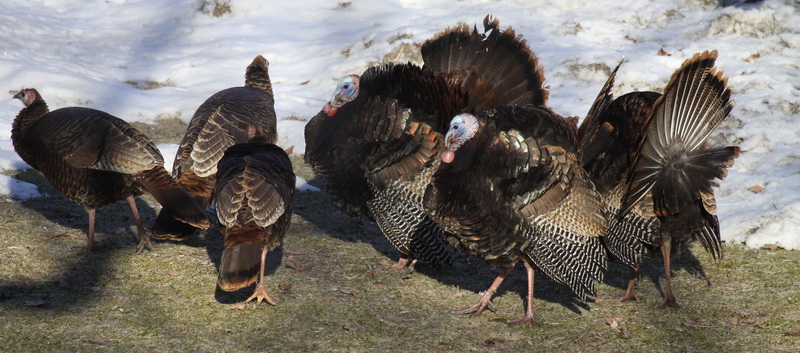
This tom was probably the most impressive with his tail fanned, his wings displayed, his bald head a brilliant blue, and his red wattle aglow.


There are stories with the toms that I wish I could tell. The tom on the right looks a bit bedraggled. Has he had frays which have broken feathers? Or has he not gotten in his new feathers? By contrast, the tom on the left looks like he is still growing in his tail feathers - notice how much shorter the feathers are on the left of his tail (as we look at him).


There were at least four tom turkeys who were displaying for the hens; they numbered around twenty. It is early in the season, and the hens do not appear much impressed.


While the toms were preoccupied with one another and showing off for the hens, the hens began to get skittish. I was slowly trying to maneuver myself so that I did not have branches in my line of sight. The hens became aware of my movement, gathered at the river bank, then flew to the other side. Eventually, the preoccupied toms realized that their audience had left them.


With unarguable hormonal logic, they soon followed the hens across the river.


Good birding.

Wednesday, February 09, 2011

Not the Face That Launched a 1000 Ships

... well maybe that's not fair. She is undoubtedly attractive to a turkey tom.


A couple of turkey flocks - 4 and 12 respectively - (also known as posse or raffle) have been regular at the feeders. As near as I can tell, they are all hens. In the previous picture, note the tan tipped feathers on the breast. The breast feathers of the tom are tipped black.

The turkeys are very skittish, sensing any inside movement. They were a little less so when I crawled to an upstairs window and looked down on them.


In the kitchen, I stood well back from the window. The scene outside was chaotic, especially given the size of these birds, as they competed for the best feeding position at the platform feeder, or on the ground.


When I got close to the window, they spooked and flew.


Good birding!

Wednesday, February 02, 2011

No Respite from Winter

Alas, the whole of the United States seems to be reeling from one storm after another. For all of the anticipation heaped up by the media, when it finally reached us here in Vermont it was not too bad - about 10 inches (25cm), with some mixture late of sleet and freezing rain. The snow pack in the back yard is now 30 inches (75 cm).

The storm may not have been too bad for us, but I am getting tired of winter.

After the big flock moved through a few days ago, four Wild Turkeys are continuing in the near vicinity.


While eating lunch, I saw big black things high in the willow tree. We don't think of turkeys as flying machines, but they are quite adept.


The winter finches have moved elsewhere - no grosbeaks, redpolls, siskins. But the neighborhood residents are still present, including at least five cardinals ... and a Red-breasted Nuthatch returned briefly to the suet.

Northern Cardinal, female

Northern Cardinal, male

Red-breasted Nuthatch

Thursday, January 27, 2011

Turkey Trot

After months with Evening Grosbeaks coming daily - often in a flock of 50+, once 100+, today there have been NONE. What ungrateful birds! There has never been a lack of seed. In fact, most mornings I have filled feeders and cleared snow before sunrise, the task being done second only to the feeding of the cats (who will not tolerate any delay in getting their breakfast). You would think those grosbeaks were a bunch of corporate execs, who get their seed bonuses with nary a thought for the poor smucks who labor to make it possible.

However, early this afternoon I heard strange noises. Suspecting the cats had cornered some tiny intruder to the old farmhouse, I investigated. It was a rare instance in which the cats were innocent. The strange noise was gobbling. A flock of turkeys were transiting the yard on both ends of the house, and along the river. I got my count to 36, probably with half again as many being missed.


The Wild Turkey is a wary and skittish bird. As soon as I snuck onto the back porch for a photo op, they knew I was there and hurried away.


In addition to a maze of turkey tracks, there were other tracks close to the feeders following last night's snow. Our motion activated camera caught a Gray Fox - not much of a picture, but it shows what we miss when we are sleeping.

Monday, August 16, 2010

Game Birds and Flycatchers

Some miscellaneous photos from early to mid June that did not quite fit anywhere else.

In early June, Mr. Tom the Wild Turkey began making our yard a regular stop on his grocery route ...


Ruffed Grouse ...


Two Empidonax Flycatchers best distinguished by vocalization (to call either a songster would be a disservice to the real singers).

Alder Flycatcher (my mnemonic is "freeBEER") ...


Willow Flycatcher (FITZbew) ...


Good Birding!

Saturday, March 20, 2010

The Recovery of the Wild Turkey

A huge dark lump was on a branch of the cottonwood across the river. As I wiped the morning blur from my eyes, it launched itself with stubby wings beating. Barely in defiance of gravity, it coasted to my side of the river. Just over the bank, out of sight, but somewhere beneath the willow, it landed.

“Turkey,” I announced to the somnolent household. I continued watching through the kitchen window, hoping for another glimpse. Instead, from across the river I saw more brown lumps on a downward arc - coming from the pine trees where they had roosted during the night - to the old farm field and orchard. I counted fifteen.

From the spruce behind my neighbor’s several more came down with a flight pattern that seemed to say, “Trust me, I really am in control.” They joined the first bird, over the bank and out of sight. I watched, hoping they might wander up to where I could have a better look - come around and clean up under the feeders. They did not.

I pulled boots on, grabbed my camera, and silently opened the door. With all the stealth that a city-bred person can muster, I stalked toward the edge of the bank. I saw a dozen heads erect, on long necks. They were watching for me ... wary. I took a half step and raised my camera. They flew - with a roar of beating wings, with a quickness and agility which belied the barely controlled plunges I had seen earlier. My camera recorded only dark blurs as they disappeared across the river.

My backyard experience is not unique. I receive regular reports during the winter from people mesmerized by flocks of turkeys visiting their yards. It is a relatively new phenomenon, and one which we came close to losing forever.

Turkeys are native only to the Western Hemisphere. There are two species - our widely distributed North American Wild Turkey (with six recognized sub-species), and the Ocellated Turkey of the subtropical lowlands of the Yucatan Peninsula.

The Wild Turkey is our largest North American game bird, and one of only two domesticated birds originating in the Western Hemisphere. The Muscovy Duck is the other.

The turkey was domesticated by Native Americans in Mexico and southwestern United States. The earliest archaeological evidence for its domestication appears in Mayan sites dating to around 100 BC to 100 AD. Pueblo societies in the American southwest imported turkeys from Mexico about 300 AD. Turkey husbandry grew rapidly in the southwest beginning around 1100 AD.  In the early sixteenth century, Spanish conquistadors took turkeys to Spain. From there, they spread throughout Europe. By 1524, domesticated turkeys were being raised in England. English settlers then brought domesticated turkeys back to America.

The burgeoning population of the English colonists demanded food. The need outstripped what they could provide for themselves, and so they hunted. In New England, turkeys were abundant, and tasty, and they were heavily hunted. Relentless hunting and elimination of much of their forested habitat resulted in the Wild Turkey disappearing from much of its original range, especially in the northern and northeastern parts of the U.S.

Forbush describes their retreat: “Shooting and trapping the birds at all times soon had its inevitable effect, and the Turkey rapidly retired before the advance of settlement, and soon it could be found only in the wildest parts of the country. In Massachusetts Turkeys were most numerous in the oak and chestnut woods, for there they found most food. They were so plentiful in the hills bordering the Connecticut Valley that in 1711 they were sold in Hartford at one shilling four pence each, and in 1717 they were sold in Northampton, Mass., at the same price. In the last part of the eighteenth century most of the Wild Turkeys had been driven west of the Connecticut River.”

The last turkey on Mt. Tom was reported (and shot) in 1851; a few may have remained on Mt. Holyoke at that date. “Since then the Wild Turkey has disappeared from Canada and from most of the Atlantic seaboard, although a few are still to be found in Virginia and other Southern States, and it is still common in some western localities.”

Forbush concludes his account: “its great size and beauty contribute to make it, to my mind, the noblest game bird in the world. It is destined to vanish from the earth unless our people begin at once to protect it.”

The quotes are all from Birds of Massachusetts, 1929. A turnaround for the Wild Turkey began in 1937 when Congress passed the “Federal Aid in Wildlife Restoration Act.” Lobbied for and supported by hunters, this act placed taxes on firearms, ammunition, and other hunting equipment and designated that the funds raised be used for conservation and wildlife habitat enhancement programs. From fewer than 30,000 Wild Turkeys in the late 1930s, the population today is estimated at nearly 7 million. There are huntable populations in all of the lower forty-eight states and in parts of Canada and Mexico.

I am not a hunter. Hunting was not a part of the urban culture in which I grew up. But I am grateful to hunters and sportsmen. Many of the places I go and experiences I enjoy in the out-of-doors are possible because of the fees, licenses, and taxes they have paid, and the attention they have given to conservation, habitat, and environmental health. Turkeys wandering our fields and woods are but one of those benefits we enjoy as a result of their efforts. Conservation organizations, wildlife agencies, sportsmen, hunters, hikers, naturalists and bird watchers probably have more goals in common than they have differences.

School children may think nothing of seeing a dozen turkeys cross the road and disappear into the forest. They may be unmoved by thirty turkeys feeding beneath a feeder. It may be no surprise to them to happen upon a turkey hen racing through the grasses and brush with a dozen poults behind her. But to those of us who are more mature, these are wonders! We never saw flocks of turkeys when we were young. Only in the last couple of decades has it become more possible to happen upon such sights and they are still not in the every day occurrence category.

Good birding!

Saturday, February 06, 2010

The Wild Turkey Is No Turkey

“You turkey!” Those words are not a compliment. You are dumb! Stupid! Like that dumb turkey.

I once asked a farmer, “How dumb is a barnyard turkey?” She told me that a barnyard turkey is so dumb that it will stand in a pouring rain, with its head up and beak open - and drown. If she wasn’t joshing this city-bred transplant, then I have to agree that barnyard turkeys are astonishingly dumb.

Even a popular naturalist and author calls the barnyard turkey “a rather stupid creature,” but hastens to add that “the original wild form is a wary and magnificent bird.”

The domestic turkey and the Wild Turkey are the same species, Meleagris gallopavo. A distinctively American bird, its scientific name is derived from the Latin names for an African guinea fowl and and Asiatic bird. The occasional domestic turkey which might wander off can be distinguished from its wild relative by the white tail tip of the original Mexican subspecies from which it was domesticated. Wild turkeys have chestnut-brown tail tips. They are also thinner than domestic turkeys.

Turkeys are large, mostly ground dwelling birds. They forage in the morning after leaving their roost and again during the few hours before sunset. With their long, powerful legs, they scratch the ground and leaf litter for seeds, nuts, and acorns. They also eat the fruit of junipers, dogwoods, and grapes, corn and other grains. In summer they may eat grasshoppers, frogs, salamanders, toads, lizards, fiddler crabs. In winter when snows are deep, they may fast for up to a week. Seed and corn around bird feeders may attract wandering flocks.

The male Wild Turkey (called a tom, or a gobbler) is about four feet long, the female (hen) about three. The breast feathers of the male have black tips; those of the female are brown. The tom’s head and neck are blue-gray with pink wattles. During spring display, his forehead is white, face bright blue, and neck scarlet.

Turkeys usually travel on the ground by walking or running. In spite of what sometimes appears to be a reluctance to fly, and an awkwardness when airborne, they are remarkably strong flyers. Flight speed has been timed at 32-42 miles per hour on one occasion, and 55 miles per hour on another. They typically roost overnight in tall trees.

Several people have commented to me this winter about seeing turkeys in same-sex flocks - all females or all males. This is typical of turkeys during most of the year, although the young will stay with their mothers. Within the flock, there is a pecking order. The oldest and biggest birds rule over the younger and smaller birds.

Courtship and breeding begins in late February in the southern states, in early April in the North. Toms may gobble in any season, but in early spring, any loud noise may stimulate gobbling - an airplane roaring overhead, the hooting of an owl, or the slamming of car door. Gobbling may be heard a mile away. Spring gobbling season is triggered by the increasing day length and warming temperature.

In the Spring, the gobbler gobbles to attract a female. Once he has attracted one - or preferably, several - hens to his vicinity, the gobbler does his courtship display. He struts around the hen. His tail is fanned and held vertically. His wings are lowered and drag on the ground. He raises the feathers of his back, throws his head back onto his back, and inflates his crop. He makes deep “chump” sounds, then hums while rapidly vibrating his tail feathers. During the strut his facial skin engorges and the colors intensify. In the presence of the big, wily old tom who knows the strut, the hen swoons and her resistance vanishes.

Having done the deed, he gobbles and struts for the next hen. Toward the end of mating season the harem breaks up, the hens wander off by themselves to complete the task of raising a brood, with no further assistance, care, attention, or concern from the self-important gobbler. The nest consists of a shallow excavation scratched into the earth then hastily lined with leaves and other forest-floor debris. But even if they're slovenly builders, wild turkey hens always conceal their nests carefully, and cover their eggs with debris each time they leave the area to feed. A single hen often lays over a dozen eggs, and several hens may share one nest. (Audubon reported finding 42 eggs in a single nest, with three hens in attendance.) The incubation period is 28 days, with a hatch success rate of 35%.

The poults can walk and feed themselves when they hatch, but cannot fly for about two weeks. Clearly this whole period is fraught with great danger and vulnerability for the mother, her eggs and her young. The list of predators is long: raccoons, red foxes, striped skunks, crows, snakes, opossums, chipmunks, squirrels, owls, hawks. We are most likely to see turkeys fleeing, but a nesting or brooding hen will not hesitate to attack a predator threatening her eggs or her young.

The turkey was once so common in North America and so highly regarded, that it was considered a choice for our national emblem. At least, Benjamin Franklin so proposed. In a letter to his daughter, Franklin objected to the choice of the Bald Eagle. He thought it “a bird of bad moral character ... too lazy to fish for himself,” often robbing the “fishing-hawk” (osprey) of its prey. “Besides he is a rank Coward: The little King Bird not bigger than a Sparrow attacks him boldly and drives him out of the District. He is therefore by no means a proper Emblem for the brave and honest Cincinnati of America who have driven all the King birds from our Country ... The Turkey is in Comparison a much more respectable Bird, and withal a true original Native of America ... He is besides, though a little vain & silly, a Bird of Courage, and would not hesitate to attack a Grenadier of the British Guards who should presume to invade his Farm Yard with a red Coat on.”

Franklin correctly described the character of the Wild Turkey. The sum of it is - a Wild Turkey is no turkey, except in the mind of some turkeys!

Good birding!

LinkWithin

Related Posts with Thumbnails