Monday, January 28, 2013

Birds by the Numbers

My wife’s elderly aunt clips newspaper articles about birds and sends them to me, sooner or later. One arrived with a little note attached: “This fell out of my dictionary.” So I don’t know when or where it is from. But it opened an interesting subject - how do we refer to numbers of birds?

 “A Gaggle of Geese” describes the goose tendency
 to “talk” constantly with one another when in flight.
The newspaper clipping began with: “many of us know that it’s truly bad form when among birders to blurt out, ‘Oh, look at that big bunch of crows!’ ‘It’s a murder of crows!’ a prism of bonafide birders will promptly advise you with blood in their eyes. And so, with an unkindness of ravens or a parliament of owls or a pitying of turtle-doves. There’s a way to speak of groups of things and you’d better get them right.”

I read this and I thought - Well, okay, maybe I’m not the bonafide birder I thought I was, because most of these terms were only vaguely familiar to me.

However, there are other phrases for numbers of birds with which I have long been familiar: a kettle of hawks, a gaggle of geese, a raft of ducks.

Where these familiar phrases (familiar to me) came from was not difficult to figure out. “A kettle of hawks” describes hawks rising on warm thermals, much as bubbles might rise to the surface in a boiling kettle of water. “Gaggle” is what a bunch of geese sound like. A large number of ducks riding the ocean waves look like a rudderless raft rising and falling. A “raft” can also refer to a large collection of something, such as a large collection of ducks.

"A Murder of Crows"
But where does the term “a murder of crows” come from? Apparently the term derives from the persistent folk tale that crows form tribunals to judge and punish the bad behavior of a member of the flock. If the verdict goes against the defendant, that bird is killed (murdered) by the flock. The basis in fact may be that occasionally crows will kill a dying crow who doesn’t belong in their territory - or much more commonly, that they will feed on carcasses of dead crows. Also, both crows and ravens are associated with battlefields, medieval hospitals, execution sites and cemeteries, all places where crows scavenged on human remains. These associations with places of death may also account for “the unkindness of ravens.” The latter phrase may also relate to the image of the raven used by Danish Vikings on their flags - “unkindness” being a characteristic of these marauding bands.

Parliament is a gathering for talk and discussion. I remember one summer evening on Sunset Lake listening to a “parliament” of Barred Owls conversing back and forth. And the voice of the dove is often mournful (Mourning Dove) and plaintive - hence “a pitying of turtle-doves.”

My curiosity peaked, I did some further research. There are a few terms that can be applied to many different groups of birds: colony, company, flock, parliament, party. There are other group terms that  are standard and likely recognizable to many people, even non-birders: a bevy of quail, a bouquet of pheasants, a covey of partridges (or grouse or quail), a skein of geese.

There are terms which use to be used, but are hardly ever heard anymore: a congregation of plovers, a dole of doves, a paddling of ducks. My source suggested that “a host of sparrows” falls into this category, but I find myself using “host” for sparrows and many other species. That same source also cites “a fall of woodcock” as an obsolete term. Come Spring, I will begin a revival of “a fall of woodcock,” for that is an apt description of how the woodcock’s display flight concludes - after circling and twittering overhead, he suddenly drops, or falls, out of the night sky as he returns to his dance floor.

Many of these terms are listed in James Lipton's An Exaltation of Larks (1991), which is based on old sources. The terms evolved during the Middle Ages when the sophisticated art of hunting demanded an equally sophisticated vocabulary. In addition to a passion for sport, the nobles also delighted in the play of words.  There were manuscript lists of group names in the 15th century, and these lists appeared in some of the first books printed in England.

 “A Kettle of Hawks” - Broad-winged Hawks
 circle on rising thermals over Putney Mountain.
The best source for investigating the histories of English words is the Oxford English Dictionary. Unfortunately, even the OED is not always reliable. The word "kettle" (as both a noun and a verb) has been used by hawk watchers for many generations, and it has often appeared in print; the OED editors obviously are not birders, since they do not make any reference to “a kettle of hawks.”

“A Stew of Oystercatchers” may have been coined
 by birders peering too long through their binoculars
In my search for terms to express bird numbers, I came across many which appear to be modern coinages. The nature of some of these coinages leads me to conclude that some birders have been spending too much time peering through their binoculars. Consider: a herd of cowbirds, a stew of oystercatchers, a pint of bitterns, an avalanche of Snow Geese, a jar of nuthatches, a suite of nutcrackers, an earful of waxwings, a grain of sanderlings, a gallup of redpolls, and a college of cardinals. Those are just a few.

So, what do we make of all of this? Not much. If you want to refer to those geese you saw as a bunch, rather than a gaggle, that’s okay. If you like pointing toward those hawks that are “flying in a big circle” rather than kettling, who am I to complain? But as far as I’m concerned those hundred big black birds rising out of their rousting pines are going to be “a murder of crows,” because at the very least, they can make a murderous noise when they want.

"A Raft of Ducks"
And let me know when you see the first Red-winged Blackbird - even if it’s just one. Because that will mean Spring is coming and I can finally get out of these four walls. I’m going a little crazy. I need a harold of robins!

Good birding!

Wednesday, January 23, 2013

A Photo Review of 2012

Sometimes it is good to look back, and a New Year provides a good opportunity/excuse to do so. Here are a few of the Birding/Photography images which stand out for me during 2012.

"Morning Flight" - Sandhill Cranes, Bosque del Apache, NM, 02/02/12
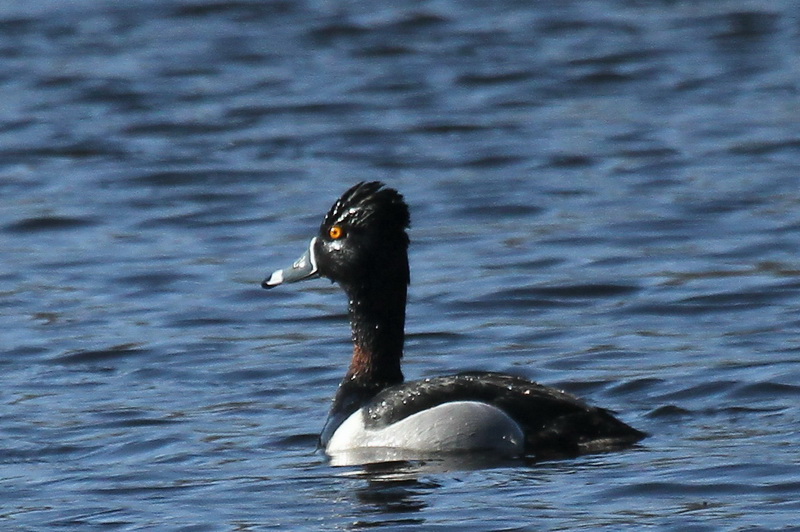
"Why Is It Called Ring-necked?" - Ring-necked Duck, Forsyth NWR, NJ, 03/07/12
"Alone" - Solitary Sandpiper, Herricks Cove, VT, 05/05/12
"Untitled" - Blue-gray Gnatcatcher, Herricks Cover, VT, 05/06/12
"What's Up" - Chestnut-sided Warbler, Brookline, VT, 05/27/12
"Kids!" - Hooded Merganser, Putney Wetlands, VT, 05/27/12
"Leap" - Spotted Sandpiper, South Newfane, VT 08/02/12
"Yellow Blossom" - Ruby-throated Hummingbird, South Newfane, VT, 08/17/12
"Untitled" - American Oystercatcher, Cape May, NJ, 08/29/12
"On Your Way" - Red-tailed Hawk, Cape May, NJ, 08/29/12
"The Stoop" - Merlin, Putney Mountain, VT, 09/14/12
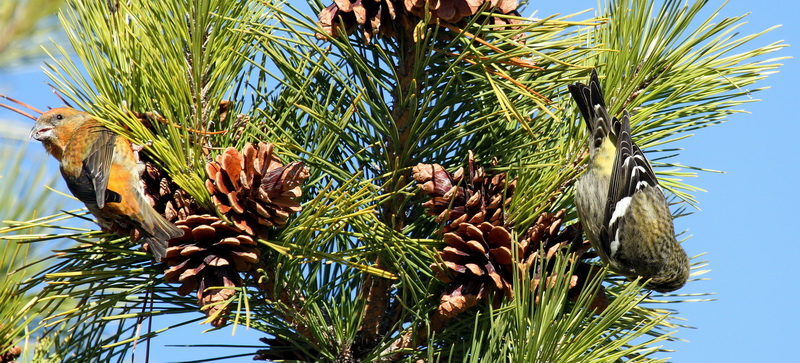
"Ignore Him!" - Red Crossbills, Salisbury Beach, NH, 12/06/12
"Friends" - Sanderling & Dunlin, Parker River NWR, MA, 12/06/12
May your birding be good in 2013!

Friday, January 18, 2013

Brigantine at Forsythe - alas

I recently saw a report about the condition of Brigantine at Forsythe NWR near Atlantic City, NJ. Hurricane Sandy caused significant damage to the refuge road. The report made it sound as though it will be a long time before the road is repaired. Alas - this eight mile loop around the impoundment ponds, and along canals, the ocean and salt marsh is a prime spot for viewing waterfowl, shorebirds, raptors waders, gulls, terns, and marsh birds.

This post is a fond recollection of last June's visit to Brigantine, plus an opportunity to use a few photos which haven't fit anywhere else.

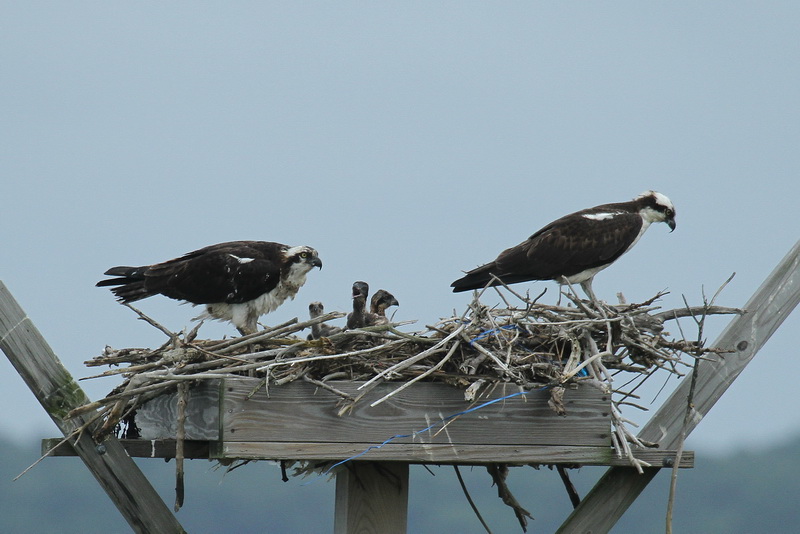
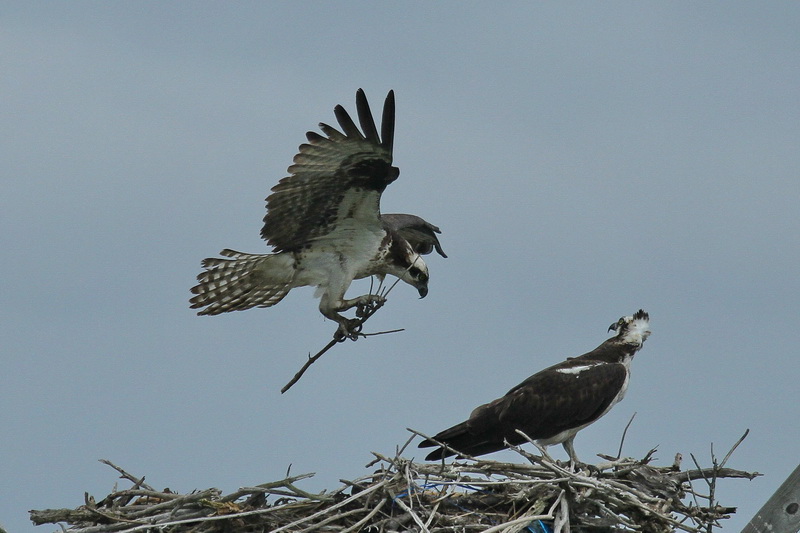
I have been following one Osprey nest, in particular, for several years; I am sure I am not unique in this, since the nesting platform is quite close to the eastern section of the loop road. A couple of images ...

Osprey parents tend the kids
Mom feeds the youngsters ...
... then does some interior decorating.

While Brigantine is a favored spot for wetland and coastal birds, one never knows what else will come to view ...

Fiddler Crabs at low tide
Young Red Fox along the refuge road
Great Crested Flycatchers in its nest hole

Sunday, January 13, 2013

Lapland Longspur, buntings & larks

The farms in Addison County, Vermont, are hosting many flocks of Snow Buntings and Horned Larks. We drove many of the roads; flocks were constantly flying from the roadside and swirling about the barns and feed areas. Here are a few images ...

Snow Buntings
Horned Larks - a portion of a flock which numbered in the 100s
Horned Lark
Snow Buntings atop a silo - 3 Lapland Longspurs are also present
Detail with Lapland Longspur
Good Birding!!

Thursday, January 10, 2013

Common Pochard

Yesterday I made the trip to Lake Champlain with neighbor Richard Foye. Just offshore from the Dock Street Campground in Port Henry, NY, the Common Pochard was with a tight group of Ring-necked Ducks, Mallards, American Black Ducks, and three Redheads.

The Common Pochard has been photographed (not by me) with a leg band, and there has been list serve discussion as to whether it is wild, or an escapee. Whatever the outcome of the discussion (debate?), yesterday was a day of good birding, with thousands of waterfowl in the open waters of Champlain, beautiful views of Ring-necks and Redheads, and an usual bird that we ought to feel sorry for. Whatever the origin of the Pochard, it is unlikely to fulfill its function in life: keeping its presence in the pochard gene pool alive.

Light and distance made photography difficult, but I did manage a few documentary images ...

Common Pochard
Common Pochard and Redhead
Common Pochard, Redheads, American Black Duck, Mallard
Common Pochard, Ring-necked Ducks, Redhead
Common Pochard with Redheads
Addison County in Vermont, and the southern Champlain Valley, is a great place for winter raptor viewing. We saw 4 Bald Eagles on the edge of the lake ice, a Peregrine Falcon, 2 American Kestrels, and 6 Rough-legged Hawks. The latter provided (sort of) photo ops ...

Rough-legged Hawk
Rough-legged Hawk
The farms in Addison County also hosted many flocks of Horned Lark, Snow Bunting, and a few Lapland Longspurs. I post photos in a few days. Come back soon for soon.

Good birding!!

Saturday, December 22, 2012

CHRISTMAS BIRD COUNT - A SNAPSHOT OF WINTER BIRDS

Eastern Bluebirds favor orchards during winter.
During the winter months, it is not uncommon to hear the question, “Where are all the birds?”

A flip answer would be - “They’ve gone south” - which they have. Most of the birds which fill our landscapes during the summer are tropical birds which return to the tropics in Central and South America during our winter months. Most of the warblers, vireos, thrushes, and flycatchers fall into this category. Many other birds move to the milder climate of the southern states: This includes many species of waterfowl, wading birds, and raptors, plus some of the hardy songbirds.

On the other hand, boreal species from the north also move south, driven by changes in the weather, but also, and probably more importantly, by the availability of food in their northern homes. Food availability means that some winters they more or less stay home, while other winters they irrupt southward. When there is an irruption, we may notice their numbers. When they stay home, we may ask that question about where they are.

Common Redpoll has irrupted into New England this winter.
As we watch our feeders, or wander about on our skis or snow shoes during winter months, it often seems as though we are seeing very few birds compared to what we remember seeing in other years. For example, two years ago during the holidays, my feeders were inundated with northern birds. Flocks of Common Redpolls, and mixed flocks of Evening Grosbeaks and redpolls descended in swarms. I was filling my bulk feeders twice a day. This year as of the time of writing, my feeders have been visited by a small flocks of 15 redpolls, while the grosbeaks have been completely absent.

In October, flocks of 200+ Pine Siskins swarmed about my feeders. During December they have been absent. Where are they? Undoubtedly, they have gone further south, in spite of the dependable food source at my feeders ... because ... birds do not simply rely on bird feeders, but in fact, derive most of their food most of the time from naturally occurring food sources. If those sources do not seem adequate, they move on.

White-breasted Nuthatch is a year-round feeder bird.
There are two citizen science projects which provide a snapshot of where the birds are during the winter. One is the Great Backyard Bird Count. This is primarily a feeder count which is conducted on the President’s Day weekend in February. To learn how you can participate (in the comfort of your home) visit this website: www.birdsource.org/gbbc.

The second citizen science project is the Christmas Bird Count. In its 113th year, the CBC engages over 60,000 people in about 2500 locations.

There are several Christmas Bird Counts done in southeastern Vermont and southwestern New Hampshire. I participate in the Brattleboro Area CBC on the third Saturday in December, so that is the one I can write about.  Here is a snapshot of where the birds are around Brattleboro.

Many participants returned from their day of counting speaking of how hard it was to find birds and how low the numbers were. But when the counts were tallied, the number of birds counted (4100) was slightly above the ten year average (3900).

With open water in the Connecticut and West Rivers, waterfowl were well represented by Canada Goose, Mallard, and American Black Duck. Most significant was the number of Hooded Mergansers. Consistently present on the count, this year the 138 “hoodies” was five times greater than in any previous year.

The winter finches and boreal species showed no consistency as a group. The American Goldfinch was hard to find and the count was the lowest in the last 15 years. Pine Siskin, so abundant in October, was absent. Evening Grosbeak, consistently present the last 11 years was absent. There are usually a few Purple Finches in December; not this year.

Pine Grosbeaks appear in SE Vermont every 5 or 6 years.
On the other hand, Pine Grosbeaks appear every 5 to 6 years. This was their year. Common Redpolls show a consistent pattern of being present every other year. This was the year they were expected, and they did not disappoint; counters tabulated the largest number of redpolls (almost 300) in recent years.

Sparrows were hard to find, but the winter sparrows, American Tree Sparrow and Dark-eyed Junco were within their expected numbers, along with small numbers of Song and White-throated Sparrows.

Red-bellied Woodpecker has continued its expansion in Vermont.
The Red-bellied Woodpecker which first nested in Vermont in Brattleboro in 2001 continued its steady population increase.

Blue Jay and American Crow had their smallest numbers in years. Putney Mountain Hawk Watch counts migrating Blue Jays (when not counting hawks); they counted hundreds of jays. Apparently, the Blue Jays kept on moving because they were difficult to find in the Brattleboro area.

Other common feeders birds were present in average or above average numbers: Black-capped Chickadee (up), White-breasted Nuthatch (up), Downy Woodpecker (down slightly), Tufted Titmouse and Northern Cardinal (steady).

American Robin often winter in Vermont, feeding on fruit.
Some species are seen in flocks, and may be very localized. Horned Larks were in Vernon (180). Eastern Bluebirds were mostly in Dummerston (total 59 verses 10 year average 25). American Robins were scattered, but with a large flock in an old Dummerston orchard (total 244 verses 10 year average 44). Only one small flock of Cedar Waxwings (31) was found around Sunset Lake.

There are always a few birds which should have migrated, but have not. Brattleboro recorded this year a Red-shouldered Hawk and a Common Yellowthroat (a first CBC record for Brattleboro).

If you are a reader who is worried about a lack of birds at the bird feeders, I say, “Don’t be.” The CBC suggests that the birds are still around. Except when humans really screw up the environment, the birds are resilient and adaptable. Their population numbers go through regular and natural fluctuations. Once the counters on a CBC thaw out and examine the count numbers, this is confirmed (for most species) year after year.

Stay warm, and if the birds don’t come to your feeders, go out and look for them. Good birding!!

Thursday, December 13, 2012

Red Crossbill

As promised ... Red Crossbill images from last week at Salisbury Beach State Park campground.

There are 7-9 "types" of Red Crossbill, which some consider to be separate species. Type 1-4 occur continent wide. Type 8 is found (rare) in Newfoundland. The remaining types are western. (Sibley) If anyone has any thoughts as to which type these photos represent, please offer your comment.

Red Crossbill (male)

Red Crossbill (female)


Family Quarrel??

Well, she seems to be ignoring him, whatever his complaint.

Red Crossbill (male) (l) & White-winged Crossbill (female) (r)
Good Birding!!

Monday, December 10, 2012

White-winged Crossbill

Last week's trip to the Massachusetts coast yielded a great day of birding with abundant photo opportunities, highlighted by both crossbills. I promised additional photos, but was delayed by the Pine Grosbeaks close to home.

The cone laden pines in the campground at Salisbury Beach State Park are likely to host these birds for some time.

White-winged Crossbills were the more abundant of the two. Images are below. I'll post Red Crossbill photos in a couple of days.

White-winged Crossbill (female)

White-winged Crossbill (male)


White-winged Crossbill (young male)

White-winged Crossbill (l) & Red Crossbill (r)
Good Birding!


LinkWithin

Related Posts with Thumbnails