Showing posts with label Northern Pintail. Show all posts

Monday, February 29, 2016

Bombay Hook NWR

Yesterday was only the fifth sunny day in the Philadelphia area during February. We took full advantage and went early morning to Bombay Hook NWR near Smyrna, Delaware. The refuge during winter in a prime location for observing wintering waterfowl, and there were abundant numbers in attendance.

But the highlight of this preview-of-Spring day was two songbirds.

In fresh Spring plumage, Tufted Titmice were enthusiastically singing. Actually, their singing was vocal dueling. The ladies were nearby watching, listening, and assessing.

Tufted Titmouse

The second songbird highlight was the Yellow-rumped Warbler. They were not yet singing, but they showed clear signs that song fests are not far off - they were well along in their molt to breeding plumage, as this individual will testify. His yellow cap and sides are much more brilliant than in winter plumage, but the black and white of his body is not quite as crisp as it will be when he makes his way north.

Yellow-rumped Warbler

Among the waterfowl, I was especially pleased at the number of Tundra Swans. I counted upwards of 80 in the various pools. I usually see them along the mid-Atlantic coast during winter, but rarely in the numbers I saw yesterday.

Tundra Swans (Shovelers in foreground)

All of the usual puddle ducks, and a few diving ducks, were present, and the drakes were brilliant in fresh breeding plumage.

Northern Shovelers
Northern Shovelers
Northern Pintails
Ring-necked Duck
Can you identify these dabblers?


 And finally ... this first year Great Blue Heron has yet to achieve the resplendent plumage of a breeding adult, but he/she survived its first winter.

Great Blue Heron
Great Blue Heron

The day ended with 40+ species. Not too bad for late winter birding.

Friday, February 10, 2012

Dabblers on the Wing 2

Please see previous post for a few comments about dabblers in flight and photography.

Gadwall (l, male - r, female)
Mallard -females
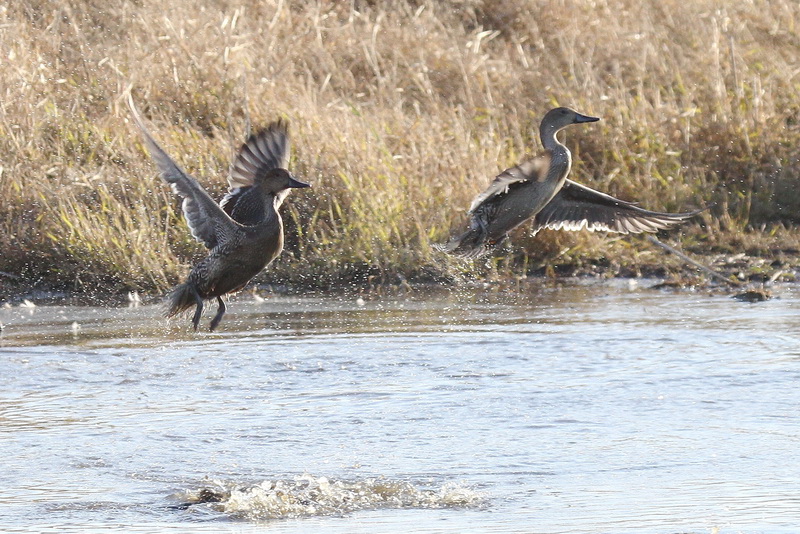
Northern Pintail - l, 2 females - r, male
Northern Shoveler - (Fall or Young) Male
Good Birding !!

Sunday, January 29, 2012

Dabblers Take Flight - Case Study 2

The dabbling ducks (Genus Anas) are inhabitants of marshes, ponds, and small lakes. These habitats often are thick and tangled. When danger comes, they have to get up and out quickly. They leap into the air - virtually straight up - and then get going.

When any of these birds take flight, it happens so fast that we can easily miss the details.

This case study is from a burst of five photographs taken in less than one second. The Northern Pintails (hens) are the two in the center and cropped from the five photos.

Photo 1 - Mallard and 3 Northern Pintails take flight
Photo 1 - Northern Pintails
Photo 2 - Northern Pintails
Photo 3 - Northern Pintails
Photo 4 - Northern Pintails
Photo 5 - Northern Pintails
 ... and then they were gone in a blur ...

Good Birding!!

Monday, January 23, 2012

Dabblers Take Flight

The dabbling ducks (Genus Anas) are inhabitants of marshes, ponds, and small lakes. These habitats often are thick and tangled. When danger comes, they have to get up and out quickly. They leap into the air - virtually straight up - and then get going.

Taking flight in this manner is very different from almost all other other waterfowl, which need a running start - often a very long running start.

When any of these birds take flight, it happens so fast that we can easily miss the details. My photography is a relatively new addition to my birding (about 6 years - less than 3 with good equipment). Freezing the moment with the camera has allowed me to see the detail and to learn - plus, it's fun!

This first photograph captures dabbling ducks as they "leap" into flight. In subsequent posts, I will have details from a burst of photos. This is the first in that burst.

Mallard (drake) and 3 Northern Pintails (females) "leap" from the water's surface
 In the next photo, a Gadwall is in the air, while American Coots are just beginning to "run" on the water's surface in order to gather enough speed to get airborne.

A Gadwall "leaps" into flight while American Coots "run" to take flight
The mixed flock of Green-winged Teal and Northern Pintail are on the wing. The American Coot (lower left) is still running, not quite airborne. Note the splashes from the coot's feet.

Green-winged Teal and Northern Pintail - American Coot lower left
To illustrate the contrast with the dabblers, next are two photographs of mergansers. Mergansers are adept divers with legs located toward the rear of the body to assist as they swim underwater; this also makes them very awkward on land. When taking off, they need room to run ...

Common Mergansers (hens)

Hood Merganser (hen)
Where dabblers leap into the air, American Coots patter across the water, flapping furiously in the effort to get airborne. They are tough, adaptable, and common - and thoroughly entertaining. Watching them take flight, or watching them doing whatever they may be doing, will explain the origin of such phrases as - "He is crazy as a coot." - or - "He's a crazy old coot." (This last saying is one I am beginning to find offensive.)

American Coot
More on dabblers leaping into the air in a few days.

Good Birding!

Saturday, January 21, 2012

Bottoms-up - ID Post 3

No. 13 - Mallard
No. 14 - Blue-winged Teal
No. 15 - Northern Pintail
No. 16 - Canada Goose
No. 17 - Gadwall - background, American Coot
No. 18 - Green-winged Teal
No. 19 - Northern Shoveler - background, Northern Pintail

Tuesday, January 17, 2012

Bottoms-up - ID Post 2

No. 7 - Northern Pintail - not as much pintail as when he ready for courtship and breeding
No. 8 - Northern Shoveler
No. 9 - Blue-winged Teal
No. 10 - Canada Goose
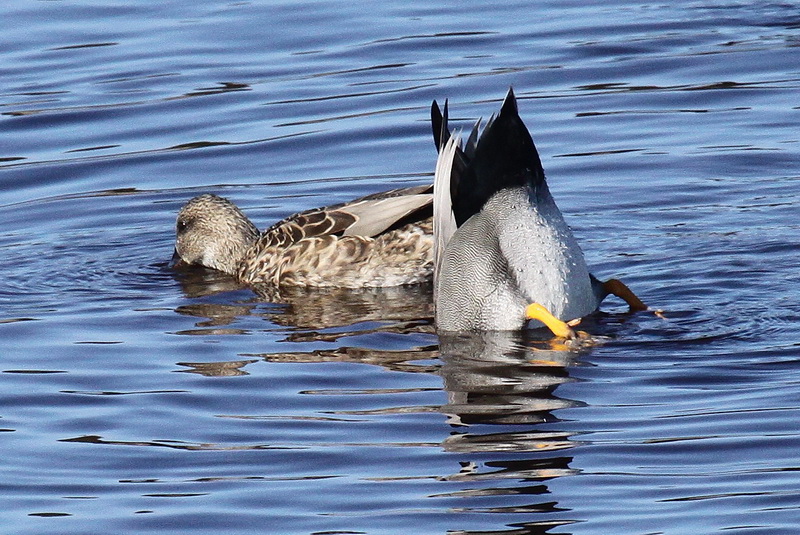
No. 11 - Gadwall

No. 12 - Mallard - (default duck)

Friday, January 13, 2012

Bottoms-up - ID Post 1

 No. 1 - Gadwall
 No. 2 - Green-winged Teal
 No. 3 - Mallard (I love the curls on his tail!)
 No. 4 - Mute Swan
 No. 5 - Northern Pintail - note on these breeding plumage males the long "pintail"
No. 6 - Northern Shoveler

Sunday, January 01, 2012

Dabbler ID for #4

Happy New Year!!

Keeping things simple today, in case your mind is still fogged from partying. Just straightforward IDs.

 #16 - Gadwall, female
 #17 - Green-winged Teal, females
Green-winged Teal - male and female

#18 - Blue-winged Teal, non-breeding adult male
#19 - Northern Shoveler, non-breeding male
Northern Shoveler - non-breeding male, and male
#20 - Northern Pintail, female
Northern Pintail, male and female
Good Birding!!

LinkWithin

Related Posts with Thumbnails