I have had Brown Thrashers make rare and brief appearances in the yard, usually early in the breeding season when they are still moving.
However, for the last several days, Brown Thrashers have been regular, with signs that they are nesting very close by. The one photographed here is a fledgling - rather quiet, but still hopeful of being fed, with occasional attempts at begging from any likely bird in the vicinity.
Sunday, July 10, 2016
Saturday, July 09, 2016
New Camera Body
Thursday my new camera body arrived - Canon 7D Mark II (upgrading from the 7D).
Miserable gray weather, so trying it out has been limited to the back porch. But so far I am pleased.
20.2MegaPixel (versus 18MP) and a better processor means I can crop without loosing resolution. Better sensor means I can shoot at higher ISO without noise. Most pictures here were taken at 1600 ISO - previously I rarely went above 800 and preferred 400.
Lighting and weather today have been dreary, but the camera has responded well.
Many features still to work with, but the spot focus option and spot metering is great for birds which often hide in the leaves. Several of the pictures here would not have been possible with my previous camera. Second 2 photos below cropped about 25% of original.
Spot focusing makes possible a sharp image even though it is partially obscured by foliage.
In the dreary light, the camera is still able to capture detail of this fledgling as it begs to be fed ...
Fledgling Rose-breasted have one of the sweetest begging calls of any bird - not at all harsh, or noisy - the opposite extreme of the very loud and noisy Blue Jays.
Daughter Downy wanted dad to keep feeding her, but he refused, and eventually she figured out that she could get the food for herself ...
Another spot focusing example ...
And finally ... just because there are so many of these creatures which do not understand "bird feeder."
BTW, lens used is Canon 100-400 L. Most photos are 400mm focal length.
Miserable gray weather, so trying it out has been limited to the back porch. But so far I am pleased.
20.2MegaPixel (versus 18MP) and a better processor means I can crop without loosing resolution. Better sensor means I can shoot at higher ISO without noise. Most pictures here were taken at 1600 ISO - previously I rarely went above 800 and preferred 400.
Lighting and weather today have been dreary, but the camera has responded well.
Many features still to work with, but the spot focus option and spot metering is great for birds which often hide in the leaves. Several of the pictures here would not have been possible with my previous camera. Second 2 photos below cropped about 25% of original.
| Gray Catbird |
| Red-bellied Woodpecker |
| Northern Cardinal (fledgling) |
| Rose-breasted Grosbeak |
| Rose-breasted Grosbeak |
| Rose-breasted Grosbeak (fledgling) |
| Rose-breasted Grosbeak fledgling fed by its father. |
| Downy Woodpecker (adult male) with fledgling female |
| Northern Cardinal (fledgling female) |
| Eastern Chipmunk |
Monday, July 04, 2016
... and things with Wings
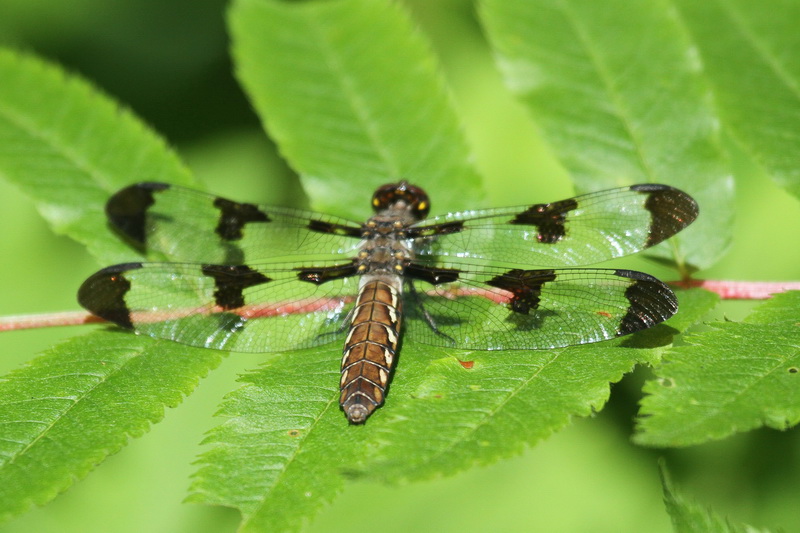
.. other things with wings often don't become obvious until morning birding has finished. I have had even less time to shorten focus onto the insects than I have had for morning birding. But there have been some.
(Caveat - please jump in if you think butterflies or dragonflies have been mis-ID'd.
From Putney Wetlands on May 30 - Eastern Least Clubtail and Common Baskettail ...
From Somerset June 30 - White Admiral and Red-spotted Purple look distinctly different, but are actually the same species - Limenitis Arthemis. White Admirals were common. The second photo below is an intergrade between the two forms of the species ...
Additional photos from Somerset, June 30 ...
Enjoy the Outdoors!
(Caveat - please jump in if you think butterflies or dragonflies have been mis-ID'd.
From Putney Wetlands on May 30 - Eastern Least Clubtail and Common Baskettail ...
| Eastern Least Clubtail |
| Common Baskettail |
From Somerset June 30 - White Admiral and Red-spotted Purple look distinctly different, but are actually the same species - Limenitis Arthemis. White Admirals were common. The second photo below is an intergrade between the two forms of the species ...
| White Admiral |
| Intergrade between White Admiral and Red-spotted Purple |
| Red-spotted Purple - Philadelphia, 8/29/12 |
Additional photos from Somerset, June 30 ...
| Chalf-fronted Corporal - male |
| Chalk-fronted Corporal - female |
| Elegant Spreadwing (?) |
| Common Whitetail - female |
| Beaver Pond along Forest Route 71, Somerset, VT |
Friday, July 01, 2016
Grout Pond
I finally got out yesterday morning for some birding. Headed into the Green Mountains in Somerset and the Grout Pond area.
Magnolia Warblers were vocal, busy, and common in the upper elevations. Require patient (as always), but one hyped up male finally came in camera range ...
Speaking of hyped up, wandering slowly down a remote lane, I ambled through the territory of this pair of Common Yellowthroats. They were agitated just by my presence. When I pished, they went bonkers. I love these masked rogues ...
Along the road, this Ruffed Grouse hen was clearly agitated when I stopped to take her picture. I suspected she had young about, and sure enough, a very young chick finally, and suddenly, scurried across the road. Mom and chick quickly disappeared.
Good Birding!
Magnolia Warblers were vocal, busy, and common in the upper elevations. Require patient (as always), but one hyped up male finally came in camera range ...
| Magnolia Warbler |
Speaking of hyped up, wandering slowly down a remote lane, I ambled through the territory of this pair of Common Yellowthroats. They were agitated just by my presence. When I pished, they went bonkers. I love these masked rogues ...
| Common Yellowthroat - female |
| Common Yellowthroat - male |
Along the road, this Ruffed Grouse hen was clearly agitated when I stopped to take her picture. I suspected she had young about, and sure enough, a very young chick finally, and suddenly, scurried across the road. Mom and chick quickly disappeared.
| Ruffed Grouse - hen |
Good Birding!
Monday, June 13, 2016
On May 30, I posted a photo of a redstart female building her nest. I returned to the location at the Hinsdale setbacks last Thursday. Although I knew "almost exactly" where that nest was being built, I could not find it, which I am sure is what the birds would want.
So I had to settle for a male redstart further down the bike trail, still protecting his territory with song. American Redstarts have been especially common this year (as opposed to Chestnut-sided and Black-throated Green Warblers which have been hard to find, even by voice, let along see them)
An amusing observation was a passing Great Blue Heron being angrily and aggressively escorted out of the territory of a Red-winged Blackbird.
At Wilson Wetlands in Putney, a Wood Duck hen led her two (surviving?) ducklings across open water and quickly disappeared in the willow thicket ...
Good Birding!!
So I had to settle for a male redstart further down the bike trail, still protecting his territory with song. American Redstarts have been especially common this year (as opposed to Chestnut-sided and Black-throated Green Warblers which have been hard to find, even by voice, let along see them)
| American Redstart |
| Red-winged Blackbird and Great Blue Heron |
At Wilson Wetlands in Putney, a Wood Duck hen led her two (surviving?) ducklings across open water and quickly disappeared in the willow thicket ...
| Wood Duck hen with ducklings |
Saturday, June 11, 2016
Black-capped Chickadee
In early May, I watched a chickadee excavating this hole in a birch snag along the bike path at Hinsdale setbacks. I did not get a photo of the excavation because I had violated the number one rule for a good photograph - I did not have my camera with me. When I returned the next day, the chickadee was nowhere near the hole, although there was a lot of "action" in nearby trees.
I continued to check the hole on several return trips, but there was no activity, although I could not imagine these small birds going to so much trouble for naught.
On Thursday, the "quiet abandonment" was at an end, as a pair of chickadees made visit after visit to the nest hole, clearly feeding hungry mouths inside. I think the photo series captures the frenetic activity of parent birds as they race to feed their voracious young.
Good Birding!!
| Chickadee excavated holle |
On Thursday, the "quiet abandonment" was at an end, as a pair of chickadees made visit after visit to the nest hole, clearly feeding hungry mouths inside. I think the photo series captures the frenetic activity of parent birds as they race to feed their voracious young.
| Black-capped Chickadee carrying food |
Good Birding!!
Wednesday, June 01, 2016
Neighborhood Mergansers
On the Rock River behind my home, two pair of Common Mergansers were foraging and coyly courting until I wandered a little too close along the bank. Then they headed up-river, either to escape my prying eyes or to find an appropriate nest site.
So great to have Good Birding right in the back yard!!
| Common Merganser, male |
| Common Merganser, male |
| Common Merganser, female |
Monday, May 30, 2016
Early Nesting Activity
In the last week and a half I have seen lots of breeding evidence, with a few opportunities to photograph this activity.
When Vermont did the breeding bird atlas (2003-2007), June 1 was the safe date for many species, particularily for neo-tropical migrants. "Possible" and "Probable" designation were not acceptable. Breeding had to be confirmed. Of course, there were earlier safe dates, depending on the species.Those "safe dates" were pushed earlier for nearly all species during the course of the atlas survey.
Ten years later, I don't remember how that applied to different species, but my sense it that breeding is generally becoming earlier as Spring becomes earlier.
On May 15, I posted a photo of a Baltimore Oriole nest whose construction was nearly complete. The female was working on the nest (but not when I had my camera aimed, alas).
Here are a few more "Confirmed" breeding photos ...
American Redstart, female, May 21, Hinsdale setbacks, checking size, shape, and fit of the nest she was building ...
Eastern Phoebe, May 21, Hinsdale setbacks, carrying food to nest ...
Brown Thrasher, May 21, Hinsdale setbacks, carrying food to nest ...
Black-throated Blue Warbler, female, May 23, West Dover, gathering nesting material (birch bark) while her mate kept an eye on me ...
Yellow-rumped Warbler, female, May 21, West Dover, gathering nesting material ...
And finally ... no birds. Just one of the many beaver ponds scattered throughout the Green Mountains and creating open space, edge, wetlands, and assorted nesting places for many species, and a tranquil scene for an early morning wanderer ...
Good birding!!
When Vermont did the breeding bird atlas (2003-2007), June 1 was the safe date for many species, particularily for neo-tropical migrants. "Possible" and "Probable" designation were not acceptable. Breeding had to be confirmed. Of course, there were earlier safe dates, depending on the species.Those "safe dates" were pushed earlier for nearly all species during the course of the atlas survey.
Ten years later, I don't remember how that applied to different species, but my sense it that breeding is generally becoming earlier as Spring becomes earlier.
On May 15, I posted a photo of a Baltimore Oriole nest whose construction was nearly complete. The female was working on the nest (but not when I had my camera aimed, alas).
Here are a few more "Confirmed" breeding photos ...
American Redstart, female, May 21, Hinsdale setbacks, checking size, shape, and fit of the nest she was building ...
| American Redstart |
| Eastern Phoebe |
| Brown Thrasher |
| Black-throated Blue Warbler, female |
| Black-throated Blue Warbler |
| Yellow-rumped Warbler, female |
Good birding!!
Subscribe to:
Posts (Atom)