Showing posts with label red-winged blackbird. Show all posts

Wednesday, August 10, 2016

Egret Convention at Heinz NWR

I was stunned on my recent visit to Heinz NWR in Philadelphia by the number of egrets (mostly Great, also Snowy) in the empoundment (along with many Great Blue Heron). Impressive and picturesque.

Egret Convention - I count 35+, a small portion of the gathering.

25+ egrets in this photo, plus at least 3 Great Blue Herons
 Still early August, but the signs that summer is nearly over were seen everywhere: recently fledged Barn Swallows, young Marsh Wren foraging for itself, Red-winged Blackbird feeding a fledgling, and a vangard flock of Semi-palmated Sandpipers.

Barn Swallows
Marsh Wren
Red-winged Blackbird with fledgling
Semi-palmated Sandpipers
 Although I could not find them, cicadas were singing loudly in the trees. Along the pathway, Cicada Killer Wasps were also active. 

Cicada Killer Wasp
Boardwalk at Heinz NWR
Good Birding!

Monday, June 13, 2016

On May 30, I posted a photo of a redstart female building her nest. I returned to the location at the Hinsdale setbacks last Thursday. Although I knew "almost exactly" where that nest was being built, I could not find it, which I am sure is what the birds would want.

So I had to settle for a male redstart further down the bike trail, still protecting his territory with song. American Redstarts have been especially common this year (as opposed to Chestnut-sided and Black-throated Green Warblers which have been hard to find, even by voice, let along see them)

American Redstart
An amusing observation was a passing Great Blue Heron being angrily and aggressively escorted out of the territory of a Red-winged Blackbird.

Red-winged Blackbird and Great Blue Heron


At Wilson Wetlands in Putney, a Wood Duck hen led her two (surviving?) ducklings across open water and quickly disappeared in the willow thicket ...

Wood Duck hen with ducklings
Good Birding!!

Friday, May 20, 2016

Red-winged Blackbird

There is always a temptation to overlook the common birds, especially when there are so many new arrivals filling the airwaves with song and wing.

But ... when I am birding with my camera I am also looking for the esthetic, the arresting, trying to grab a composition which fleets in and out of view.

Such happened with this Red-winged Blackbird a few days ago ...


Good Birding!!

Thursday, March 17, 2016

Spring Signs - 1

There have been lots of Spring Signs around the Philadelphia area during the last week.

At Heinz NWR the Rusty Blackbirds were back and the boys were singing there thin little blackbird song, while in the air the Tree Swallows were twittering their love songs and looking for territory to claim as their own.

Rusty Blackbird
American Tree Swallow

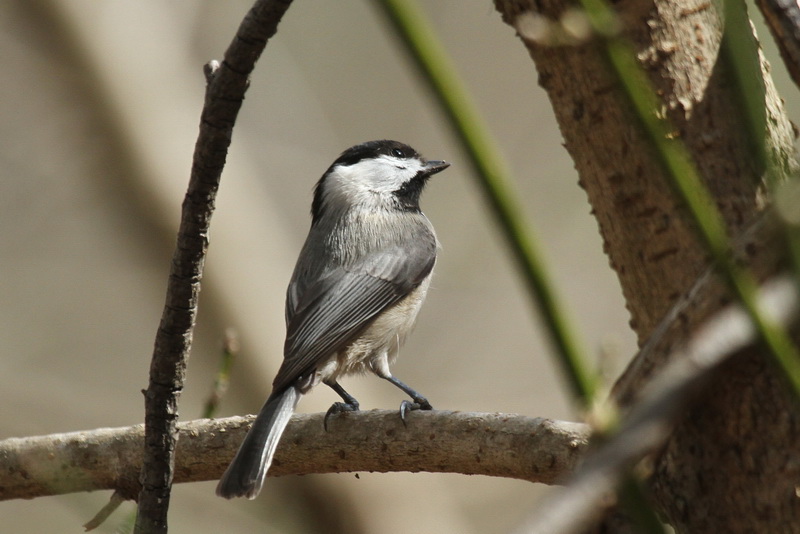
Not quite so quiet were the Red-winged Blackbirds, the Song Sparrows, and the chickadees (who provided photo ops), along with robins, cardinals, and wrens.

Red-winged Blackbird

Song Sparrow

Carolina Chickadee

Turtles were soaking up the sun, and the first butterfly of the season flittered through the woods, and toads were croaking their love song.


Eastern Comma

Waterfowl are decked in their finest (I never tire of the handsome shovelers or pintails).

Northern Shovelers

Along the Wissachickon Creek Wood Ducks (I counted at least 30) were resplendent.

Wood Duck (drake)
Wood Ducks
Wood Duck (hen)
 Good Birding!! and Happy Spring!

Sunday, July 12, 2015

Youngsters

It is that delightful time of the year when birds are nesting, fledging, feeding, and finding their way. Here's a sample, first from the backyard, and beginning with a handsome portrait of a young male Rose-breasted Grosbeak ...

Rose-breasted Grosbeak (juvenile male)
Lots of feeding is going on - Evening Grosbeak and Tufted Titmouse are just two of many. And many more still hoping for a free handout, such as the fledgling Red-winged Blackbird, who was ignored despite its persistent complaints ...

Evening Grosbeak

Tufted Titmouse

Red-winged Blackbird
This young Northern Cardinal has just about gotten the problem of food figured out ...

Northern Cardinal

 Elsewhere around the area, young Hooded Mergansers were in the Wilson Wetlands in Putney ...

Hooded Mergansers

... and in the upper elevations of Somerset, many songbirds were busy feeding fledglings, but unfortunately did not come within camera range.

Barely within camera range, and probably caring less about the birds and the bees (at least for the next few months) was this Black Bear in the wet grasses of a large beaver pond ...

Black Bear
Good Birding!!

Saturday, April 11, 2015

More This & That - 2

A few more "un-themed" birds from Wakodahatchee and Green Cay - all friends who have returned, or will return soon, to my Vermont neighborhood.

Red-winged Blackbird

(Western/Brown) Palm Warbler

Ruby-crowned Kinglet

Blue-headed Vireo

Pine Warbler

Northern Harrier - female
Good Birding ! !

Friday, March 28, 2014

Red-winged Blackbird

Red-winged Blackbird males begin to return
before winter has loosened its grip

“Conk-a-reeeee!”

I sit in my study, waiting yet another late winter snow storm. But I know that Spring is here. The visual signs are missing, but the auditory signals are certain.

“Conk-a-reeeee!”

By the still-frozen riverbanks, ponds and marshes, one of the earliest announcer of Spring has been passing through since early March. Nine inches of black feathers, he stretches his neck skyward, opens his pointed bill and belts out nasal, gurgling phrases which can only be called a “song” by another of this species. And as he sings, his wings open in flightless display, and red epaulets flash with sun-drenched brilliance even on the grayest of days. The Red-wing Blackbird has returned.

Some Red-wing Blackbirds may winter as near as the Connecticut coast, but most gather much further south in flocks which may number in the thousands. They wander through farmland, marshes, forest edge and open fields, gleaning whatever food might be available. But even before winter begins to loosen its grip, the males begin moving northward.

Male Red-winged Blackbirds claim their territory
when the marsh is still barren
By the time the Red-wing Blackbirds begin reaching our neighborhoods, the flocks are starting to break up. Individual males begin looking for breeding territory. When the ice finally goes out of our ponds and marshes, and plant life begins to reassert itself, the males will be there. Perched on a reed, cattail, or shrubby willow, they will stake their claim as proprietors, intimidating their rivals with red-wings and vocal prowess. “Conk-a-reeeee!”

When the drab females come along in another few weeks, the males will have settled their real estate disputes. They’ll be ready to urge one or more females to make a home.

The Red-wing Blackbird does not draw much attention from bird watchers except in March when it is one of the earliest of the summer residents to return. It is a successful and adaptable species. Except during our Vermont winters, there is no shortage. The Red-winged Blackbird is so common that it is easy to overlook its beauty ... and its toughness - it is a scrappy bundle of feathers.

Male Red-winged Blackbird displays his prowess
What the Red-wing’s song lacks in musical quality to our ears, it makes up for in volume. Inevitably, it draws my attention. If it draws your attention as well, you will be treated to the accompanying nuptial display. He holds the fore part of his wings well out from the shoulders. He spreads his shiny black tail. He bows his head low and displays his bright red wing patches. It is an impressive display; one might even say thrilling. And if I have that kind of reaction, imagine what it can do for a female blackbird! Some males are so impressive that they attract two or three mates, all nesting in polygamous harmony near one another in the same marsh or bog.

Female Red-winged Blackbird
Once the nuptials are concluded, the nondescript females seem to disappear into the confused tangle of the marsh while the male stands guard. He is vigilant, and fearless. A passing crow will draw his attack, as will a Northern Harrier, a bittern, or an Osprey. Neighbors will join the fray, and the passing intruder will be soon mobbed by angry blackbirds. On a misty, early morning, I once watched a Turkey Vulture laboriously take flight. It was all it could do to get airborne in the heavy atmosphere. The struggling vulture with his five and a half foot wingspan was soon hurried along by nine inches of black fury. The attacking Red-wing Blackbird pecked and prodded and harassed the backside of the hapless and probably harmless scavenger.

Nest of Red-winged Blackbird
Last summer I wanted to find the nest of a Red-wing Blackbird. So I cautiously ventured through the marshy fringes of the beaver pond and into the soggy grasses. I was just able to see a couple of nests - bulky open cups which were lashed to the reeds. But I quickly retreated. My slight intrusion into the marsh had sent the Red-wings flying into hysteria. They fluttered over head, heaping maledictions on my head. They raced from reed to reed to shrub wailing at my intrusion into their domestic realm. Seldom have I felt less welcome anywhere.

“Conk-a-reeee!” I heard the Red-wing’s gargle as I made a few quick birding stops in between my other errands. The sky grew grayer and heavier. The first few flakes of snow began falling. I hurried home to wait out the winter storm. Even so, I know it is Spring!

Male Red-winged Blackbird aggressively defend their territory
against rival males and any other intruders
Female Red-winged Blackbird on her nest

"Conk-a-reeee!” Good birding!

Monday, May 13, 2013

Samples from Cape May

Clapper Rail is easy to hear in the New Jersey salt marshes, but a sighting is often a matter of luck, or long patience waiting for one to walk into the open. But it is Spring, they have just arrived, the hormones are surging, and they are hyper. At Jake's landing I kept seeing the birds pop out of the marsh grasses, fly a short distance, then disappear into the grasses again. But I was patient and tried to be alert. The payoff:

Clapper Rail
Clapper Rail

Wrens are compact bundles of energy and irrepressible song. Higbee's Beach WMA teemed with Carolina Wrens; Jake's Landing hosted vocal duels from Marsh Wrens, and in various places House Wrens let their song tumble forth. It was a particular treat to see the House Wrens in a "natural" setting, rather than a backyard setting ...

Carolina Wren
House Wren
Marsh Wren
 The Red-winged Blackbird is rightly appreciated for the bright red epaulets which he flashes to intimidate rivals and attract females. The female is usually passed over as a rather dull, medium-sized, brown bird, but the one below demonstrated an often overlooked and under appreciated variety and beauty ...

Red-winged Blackbirds - female
Red-winged Blackbird - female
Red-winged Blackbird - male displaying
 Courtship season is going full tilt. Forster's Terns used the same land posting at Jake's Landing that I have seen them use in previous years. The gentleman on the right did not bring the lady a fish, and after a few moments she flew off in an apparent huff ...

Forster's Terns

... and across the marsh, the Willet winged back and forth with their "pee-will-willet pee-will-will-it" ...

Willet
 And finally, the Seaside Sparrow is not much to look at, and nor is his song much to listen to, unless you happen to be another Seaside Sparrow in the throes of the breeding season ...

Seaside Sparrow
Good birding!

LinkWithin

Related Posts with Thumbnails