Showing posts with label Purple Finch. Show all posts

Wednesday, July 01, 2015

A Busy Day in the Yard


This afternoon alternated between heavy showers and golden sunshine, and the yard was as busy as ever. At least two dozen species (maybe three dozen) nest in our immediate neighborhood, and most of those make regular visits to our bird feeders. I sat on the back porch and watched the show! Hardly a pause in the activity ... a captivating way to spend an afternoon.

Here is just a sample ...

Rose-breasted Grosbeak
Rose-breasted Grosbeak - immature male

Mourning Dove
Red-bellied Woodpecker

Evening Grosbeak
Northern Cardinal

Purple Finch
 
American Goldfinch
Gray Catbird
White-breasted Nuthatch waits its turn - Evening Grosbeak (female)
It is a BIRD Feeder!! What do you not understand about BIRD FEEDER?


Good Birding !!

Saturday, May 02, 2015

Spring Migration - Arrivals

Southeastern Vermont Audubon has done 2 walks along the old railroad bed at the Hinsdale Setbacks, listing species, and hoping to establish a baseline for future years.

Yellow-rumped Warblers have been the most numerous warbler to date, followed by Palm Warbler, and those are the only 2 which have provided photo ops.

Yellow-rumped Warbler

Palm Warbler
On some occasions at the setbacks, Tree Swallows are been rife ...

Tree Swallows

After today's walk, I did my favorite type of birding - sitting on the back porch and watching the action around the yard. The new arrival today was the Rose-breasted Grosbeak ... at least 3 males. Girls haven't arrived yet.

Rose-breasted Grosbeak

Rose-breasted Grosbeak
The Evening Grosbeaks are back in numbers (yet to figure out how many pairs). They are using the maple just off the porch to do their courtship (when they aren't emptying the feeders of sunflower seeds). The boys are displaying their fine grosbeak genes ...

Evening Grosbeak displaying

Evening Grosbeak displaying
 Finches have also been abundant, including Pine Siskins ...

Purple Finch

Finch Feeder - Purple Finch (female), Pine Siskins, American Goldfinch
I don't want to neglect the year-round residents who endured the tough winter, and are now singing the hearts out. Black-capped Chickadee is just one ...

Black-capped Chickadee
And to add the downside to all of this, there have been plenty of Brown-headed Cowbirds ...

Brown-headed Cowbird
Good Birding !! ... and more to come

Friday, April 12, 2013

Early Sprimg (Late Winter) Feeder Activity

Take your pick - snow, sleet, freezing rain, rain - we have it all today as winter just refuses to let go of Vermont and New England.

But the birds are moving anyway, and there has been more activity in the yard and around the feeders than I have seen for months.

Highlight has to be the Fox Sparrow - two have been scratching the ground - very welcome visitors who usually stop on the way north (or south). On their recent travels, I have missed them ...

Fox Sparrow

A mixed flock of blackbirds (red-wings, grackles, cowbirds) occasionally do a bit of displaying between frantic eating. Spring is the one time of the year when birders are half glad to see the Brown-headed Cowbird, though on a semi-winter spring day, this birder is mainly glad to be inside ...

Brown-headed Cowbird

Dark-eyed Juncos are moving in a very serious way - the flock around the feeders and yard must be in the 200-300+ range ...

Dark-eyed Junco

... and finally, FOY Purple Finches. The blackbirds are chasing the boys from the ground and platform, leaving only the high hanging sunflower feeder. Photo is through door window and storm section, but that helps capture is misery of the day ...

Purple Finch

Good birding, all things considered ... but better birding is on the way!

Friday, September 28, 2012

Brown - But Not Boring

White-throated Sparrow
 In a post on my blog some time ago, I made a passing comment that European birds are dull. My comment prompted an e-mail from a British birder: You have obviously never felt the numinous awe when in the presence of a Garden Warbler in full nuptial splendour! Some would say that they even surpass Warbling Vireos in their sheer, beautiousness.”

It was a busy time, and it took a while for my mental processor to register the comparison to our Warbling Vireo. Our Warbling Vireo is a dull gray bird with no distinguishing characteristics except its musical warble. Then I checked my European bird guide, which describes the Garden Warbler as “Anonymous appearance ... with no obvious features.”

Song Sparrow - the "default sparrow"

The Brits take their birds seriously. Even so (their testiness not withstanding) common European birds are a rather dull lot. I had a pair of Brits (not British birders) stay with me. They were charmed by the chickadees at the bird table, stunned by the sartorial splendor of the Blue Jays, and departed speechless when a male Northern Cardinal visited on their last morning, all experiences nearly unknown on the other side of the pond.

Even so, I can imagine some readers might be saying that in today’s world we Americans have few friends, so we ought not insult the ones we do have. “Dear British friends,” they might say, “we have our share of dull, brown, nondescript sparrows and finches.”

And yes, we do have lots of little little brown birds which are often difficult to tell apart. I watched them at my feeders as I ate breakfast, a milling mass scratching the ground and covering the feeders. There were juveniles in the mix, and many of them lack the handsomeness that characterizes the adults. The plumage of adults is worn from a summer of child-rearing and has lost its crispness, but this is also a defensive tactic designed to camouflage them from predators during the winter ahead.

Most of the sparrows and finches have been around all summer, but the migrants are also beginning to make their appearance. Generally, they move in fits and starts, and no further than is necessary to get plenty of food, either for further flight or against the cold. They are opportunistic foragers drawn to the bounty of bird feeders. They hang around, and so give us a good opportunity to study them, distinguish them, and enjoy their variety. With a good bird guide nearby, late September through mid-November is a perfect time to dispel the notion that all sparrows and finches are dull brown birds that look alike.

Here is a quick run-through of the most common “little brown birds” which frequent my feeders during the Fall.

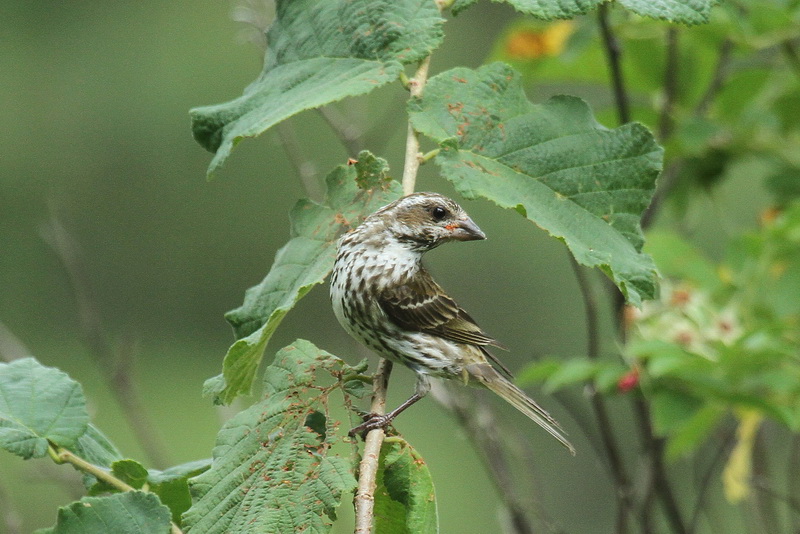
Purple Finch - female
Lining the perches of the sunflower feeder are Purple Finches. The females are plain, dull streaky brown and white birds, but the males still sport their wine red plumage, though it is faded. Occasionally an even duller brown, more finely streaked female House Finch will appear, perhaps with a faded red male, but these are more common in the towns.

Littering the ground and blending in with the fading green grass are American Goldfinches. An occasional male still shows some remains of his sunburst-yellow breeding plumage, but most - males, females and juveniles - are in their drab olive green plumage. They are so well camouflaged on the ground that I am often unaware of how many there are until they burst into flight. The finches - gold, purple, and house - may be “dull” this time of year, but in breeding plumage the males are stunning.

Chipping Sparrow
Chipping Sparrows use the bird feeders. Adults have the deep brownish red cap outlined by a white eye stripe and with a dark line through the eye. Necks and chest are white, fading to gray along the sides. Juveniles are plainer, with only hints of the red cap and white stripe, but they are usually present with adults and size and shape all say, “Chippy.”

On the ground, seven species of sparrows are often scratching for food. The common Song Sparrow,  often referred to as the “default sparrow,” has bold brown streaking on a white breast, often with a prominent brown “stick pin” in the middle of its breast. Uncommon at the feeders is the slimmer Savannah Sparrow. Compared to the Song Sparrow, the Savannah Sparrow is usually paler, more finely streaked, lacks the “stick pin,” sometimes has some yellow in front of the eye, and has a notched tail.

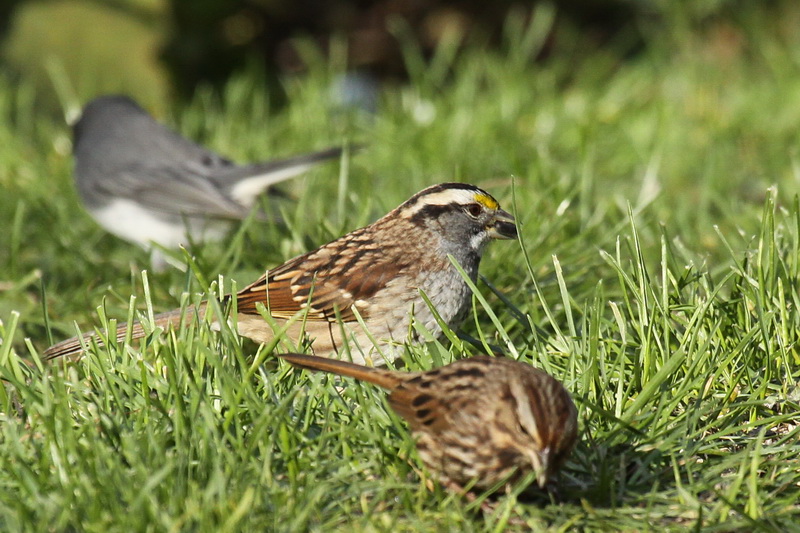
The White-throated Sparrow is a bit larger, often has yellow spots in front of the eyes (very faded in the Fall and Winter) and a white throat. It has moved down from the higher elevations where it nests, and some will stay all winter if there is food available.

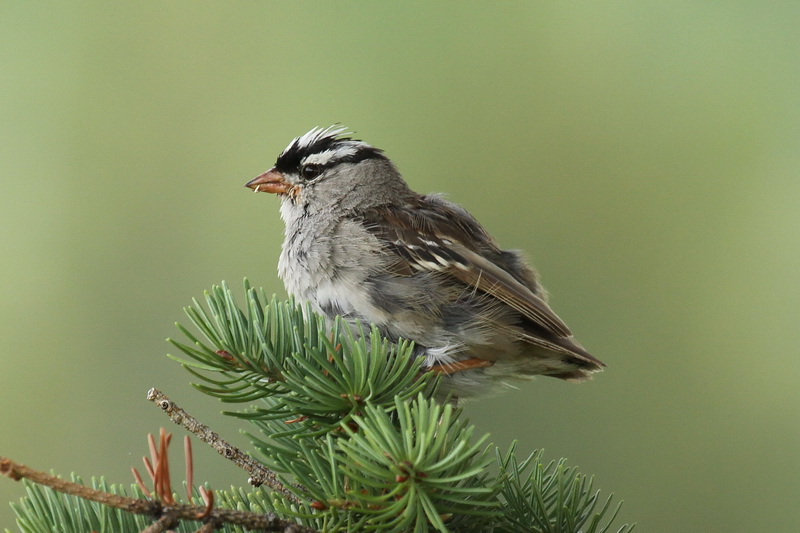
White-crowned Sparrow - juvenile. Insert - adult

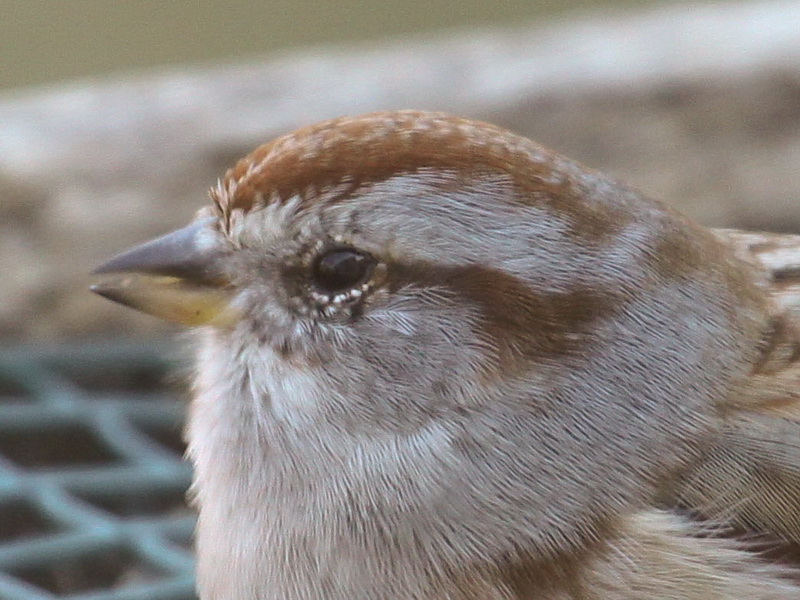
Juvenile White-crowned Sparrows usually appear in mid-October, migrating from the north of Canada. These juveniles can be confused with the American Tree Sparrow (which doesn’t show up until November); the tree sparrow also has an unstreaked breast and buffy sides, but it sports a “stick pin” in the middle of its breast. The young White-crowned Sparrow has brownish and buffy head stripes which hint at the bold black and white stripes of the slim and handsome adults.

Dark-eyed Juncos, gray and white “snow birds” come down from the mountains and are gathering in their nomadic flocks for the Winter. There is great variation in the shades of gray on the juncos, ranging from near black to very pale gray. Occasionally the western race with rusty sides, known as “Oregon Juncos,” will appear in our neighborhoods as well.

Fox Sparrow (in background, White-throated Sparrow)

In late October, the large, deeply rufous-colored Fox Sparrow can be expected. It looks like an especially robust and handsome Song Sparrow.

Becoming familiar with these common sparrows will also enable you to pick up the rare vagrant that will make you the envy of the local birding community. Some years ago an observer in Putney noticed a “mutant” sparrow among the half dozen species feeding outside of his living room window. It was a juvenile Harris’ Sparrow and was only the second confirmed sighting of this species in Vermont.

The little brown birds that frequent our feeders are dull and drab only when we are bored and inattentive. They great variety and give us lots of opportunities to hone our observational skills.

Monday, July 16, 2012

More Youngsters

The next generation of birds keep passing through the yard. Two families of Black-capped Chickadees made a rapid transit. The family of Tufted Titmice paused briefly in a bush, giving the young one a brief opportunity to beg.Chipping Sparrow young are feeding themselves.

Yesterday was a gray - and finally rainy - day, but many young were about. Probably the best juvenile for the yard this year was a Black-and-White Warbler. (The young age is more apparent in another photo, but it is not sharp enough for posting, and even this photo is marginal) ...

Black-and-White Warbler - juvenile
 The Purple Finch juveniles were everywhere. This one may look slightly perplexed - or hopeful that someone might still provide food - but it figured things out on its own ...


Purple Finch - juvenile

American Robins were not at the feeders, but were working the lawns and the river bed, although this young bird seemed a bit perplexed about it all ...

American Robin - fledgling
 The Northern Cardinal juvenile was very skittish and especially shy about having his picture taken, but it eventually managed to grab a seeds ...

Northern Cardinal - juvenile

Red-winged Blackbirds are regular and common visitors to the yard, but yesterday I had a first ever observation when fledglings begged for food and were fed by a male. The nesting habitat is probably marginal for the blackbirds, so the males are unable to acquire the usual harem. Obviously, this drives them to desperate measures ... like helping with the child rearing ...

Red-winged Blackbird - fledgling begging

Red-winged Blackbird - fledgling being fed

And finally ... I paid attention yesterday and saw what I have been missing in the past - a juvenile Brown-headed Cowbird. As many cowbirds as there are around, I knew they must be parasitizing nests, but have not had confirmation ...

Brown-headed Cowbird - juvenile
Good Birding (well, maybe with the exception of the cowbird) !!


Friday, January 21, 2011

LBJs - IDs for Exercises 11 & 12

Song Sparrow (default sparrow) - see! We don't need to use the breast spot to ID this songster.
Pine Siskin
American Tree Sparrow
Swamp Sparrow
Lincoln's Sparrow
White-throated Sparrow (l), Blue Grosbeak, female (r)
Fox Sparrow (foreground), White-throated Sparrow (2)
White-throated Sparrow (l), White-crowned Sparrow (r)
Purple Finch, female (foreground), White-throated Sparrow, Dark-eyed Junco (background)
Song Sparrow (foreground), White-throated Sparrow, Dark-eyed Junco

Tuesday, January 04, 2011

LBJs - IDs for #7 & 8

#31 - American Tree Sparrow
 #32 - Field Sparrow
 #33 - Fox Sparrow
 #34 - Purple Finch, female
#35 - Seaside Sparrow -a large and awkwardly shaped sparrow found in the coastal salt marshes. Habitat is one of the best "field marks." Drab, with just a hint of yellowish lores. Big bill and a tail that looks like it has been clipped off with scissors, if you manage to get any kind of a look at it.
#36 - White-crowned Sparrow - an adult in molt. Note the absence of a tail.
#37 -White-throated Sparrow (oops - I did not catch the typo until after this was posted, but this is truly a White-throated, not a White-Crowned)
#38 - Seaside Sparrow - singing male, if you can call his buzzy hissing a song.
#39 -White-crowned Sparrow, juvenile
#40 - Lincoln's Sparrow

LinkWithin

Related Posts with Thumbnails