Saturday, February 01, 2014

A Winter for Owls

Snowy Owl
If you have never seen a Snowy Owl, this is the winter to do so in the Northeast. Snowy Owls have irrupted into New England, and been commonly reported in the mid-Atlantic states. At least one even wandered as far south as Jacksonville, Florida. I have seen reports of seven Snowy Owls sighted in the Champlain Valley in one day, and eight on Plum Island near Newburyport, Massachusetts. To find out where the owls are being seen check the “Vermont & New England” links.

That’s the months-old news alert. Even the general media has picked up on the unusually large number of Snowy Owls in New England this winter. What really got their attention was the Snowy Owl that was seen looking out of a building window (!) in Portland, Maine. Yes, somehow she got inside the building, possibly in the course of seeking out the building’s roosting pigeons. She was rescued from the building, found to be in good health and with no injuries, and released.

The Snowy Owl is a circumpolar arctic bird. It breeds in open terrain north of the tree line and to the very edge of the polar seas. It is a big owl, with a length of 23" and a wingspan of 52." Only the Great Gray Owl exceeds the Snowy Owl in length (27").

With a 52" wingspan and weighing 4 pounds,
the Snowy Owl is a large & powerful predator

The Snowy Owl is by far the heaviest owl. It weighs on average 4 pounds, as compared to the Great Horned Owl which averages 3.1 pounds, and the Great Gray Owl which averages 2.7 pounds. For comparison, the most common owl in our New England woods is the Barred Owl: length = 21", wingspan = 42", weight = 1.6 pounds.

Snowy Owls are well adapted to the arctic environment. They are nocturnal in the endless night of winter, and diurnal in the endless light of summer. They literally hunt day and night; they do so regardless of weather.

Like most birds, their food habits are governed by opportunity. They take mammals (small rodents to large hares), birds (song birds to small geese), and occasionally fish or other aquatic animals.

In the arctic, their preferred prey is lemmings. They may consume over 1600 lemmings in one year. Lemmings are small rodents, 3-6" long and weighing 1 to 4 ounces. They are active all year, which means that they are a food source for the Snowy Owl all year. Like many other rodents, they can reproduce rapidly, so rapidly that their population in a particular area outstrips the resources causing them to disperse and their numbers to crash. When lemming populations crash, the Snowy Owl has to look elsewhere for food.


Snowy Owls move throughout the arctic depending upon the availability of food. In our temperate forests, birds of prey return to the same locality, often the same nest, to breed every year. Snowy Owls have also been documented using the same nest year after year. On the other hand,  territorial fidelity is quickly abandoned if food resources are not available.

Food availability also determines clutch size. Typically she lays 3-5 eggs. If food is abundant, she may lay 7-11 eggs. If food is scarce, nesting may be aborted.

Snowy Owls are not unexpected in New England during the winter. Almost every year there are a few reported along the New England coast. In December, 2011, one spent several days in the Brattleboro Area, delighting the local birders and thrilling many others fortunate enough to be in the right spot at the right time.

This year the number of Snowy Owls has been way more than usual. As you may gather from what was written above, food in the arctic was scarce, and the birds went in search of places where the pickings are better. The frozen tidal flats and farm lands of New England beckoned. We may be shivering in the sub-zero temperatures, but our harsh winter is no big deal to the Snowy Owl. It can handle it; this winter is just like home for this white owl.

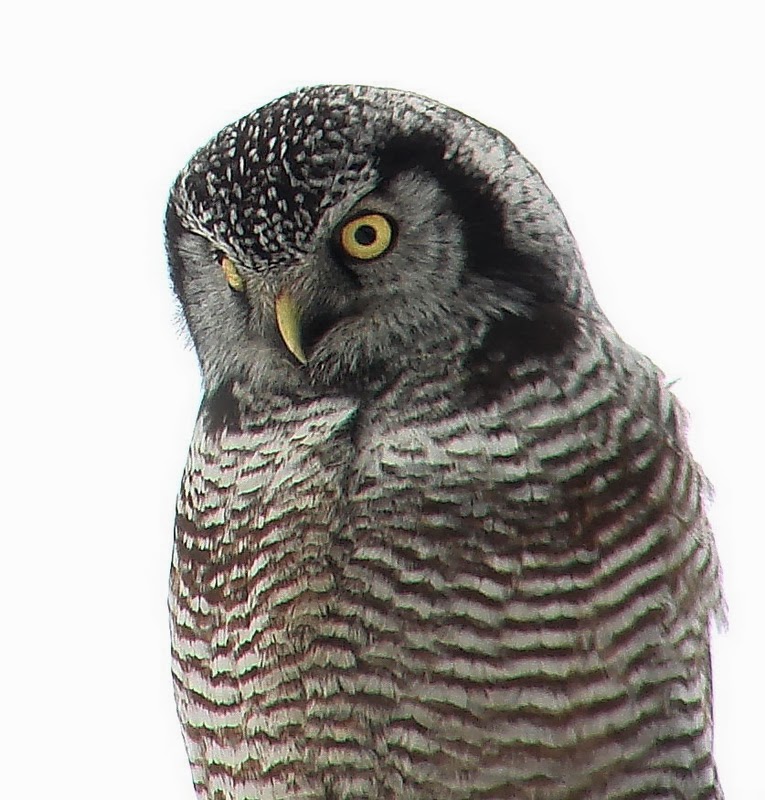
Northern Hawk-Owl

A second owl has also made a Vermont appearance this winter. A Northern Hawk Owl has been wintering just north of Waterbury Center. A circumpolar species of the boreal forest, it makes rare and irregular visits to the northern states. What makes the Northern Hawk Owl a good bird to “chase” is that it is diurnal, actively hunting during the day. When not hunting it perches prominently on the top of tall trees. It stays in the same area, and it attracts birders from many miles away.

When I chased the Waterbury owl a few weeks ago, I spoke with another birder. He was local, and was out nearly every day looking for, and photographing, the bird. He told me where it liked to perch, and which fields it liked to hunt. There were a dozen other people looking for the bird as well. Lots of eyes and lots of help. When the bird perched at a distance, good spotting scopes were readily shared with those who had only binoculars, a common occurrence when a rare bird is found.

The Northern Hawk Owl is a medium-sized owl: Length = 16", wingspan = 28", weight = 11 oz. With a long tail and short wings, this owl resembles an accipiter (Sharp-shinned or Cooper’s Hawk), hence its name, “hawk owl.” It glides low over the ground at high speed or flaps with powerful, falcon-like strokes. Hawk-like, it often hunts with the “perch and pounce” technique, swooping from its high perch when it spots prey.

Rarities always attract lots of birders, with eyes & optics for spotting.

Last winter we had many daytime sightings of the Barred Owl. The summer before the rodent population was abundant and these owls had nesting success. With winter came a decline in the rodent numbers and these normally nocturnal owls needed to continue hunting during the day. Many of our neighbors had the opportunity to see the Barred Owl.

This year the rodent population crash occurred in the arctic, and Snowy Owls (along the occasional boreal Northern Hawk-Owl) have hurried to New England. Undetected by our poor senses, the frozen fields harbor food resources waiting to be exploited by these powerful predators from the north.

Good birding!

Thursday, January 30, 2014

Retrospective 2

The weather in the Northeast has been gruesome, and I have been pretty much confined indoors. But I feel like I need to get back into the regular groove of posting.

So I am doing in a series of photos from last year - random, and obviously not just birds and things with wings.

I will be back to my main theme soon.

Retrospective 2 --

Wood Duck - hen

Song Sparrow

Winter Rye

Village Barn

Tracks

Tuesday, January 28, 2014

Retrospective 1

The weather in the Northeast has been gruesome, and I have been pretty much confined indoors. But I feel like I need to get back into the regular groove of posting.

So I am doing in a series of photos from last year - random, and obviously not just birds and things with wings.

I will be back to my main theme soon.

Retrospective 1 --

Atlantic Puffin

Fly-Away

Hummingbird Moth

Summer Azure

Carolina Wren

Sunday, January 26, 2014

Snowy Owl & Northern Hawk-Owl

There has been lots of excitement in my neighborhoods about the presence of northern owls in the Northeast, mid-Atlantic, and elsewhere. Here are a few images of the birds that are creating all of the interest.

Snowy Owl ...


 Northern Hawk-Owl ...


Good birding!

Monday, January 06, 2014

The Red Bird

Northern Cardinal
Bird calls are very difficult to distinguish. Most are some form of “chip,” which sounds like every other “chip” to anyone who does not have an auditory acuity, a great memory, and lots of experience.

However, there is one “chip” that I recognize almost all the time and wherever I am. It is a “chip” - or as some render it, “tchip” - that I hear from my feeders when the sky is just beginning to lighten in the morning. I hear the “tchip” in the evening as the last light is fading. I hear it on sultry summer evenings, on promising spring mornings, and wintry days when snow quickly deepens or frigid winds howl. I poured my first cup of coffee this morning, cupping the mug to warm my hands. Through the thermal paned kitchen window I heard the familiar “tchip” and could just make out the crested figure hopping over the frosted grass.


First in the morning, last in the evening, frequent through the day when weather is foul or young fledglings need easy foraging, the Northern Cardinal is a bright splash of cheerful red during every season of the year. He is a welcomed presence at every backyard feeder. The cardinal would probably lead a poll which asked people to name their favorite bird. When people report cardinals at the feeders, they do so with underlying satisfaction. When the cardinals are absent there is a sense that a small, but important, pleasure in life is being withheld - as though one’s favorite glass of wine could no longer be sipped.

The male cardinal sports the bright red. The female is a rich golden brown with splashes of red and the characteristic cardinal crest, a beautiful bird in her own right. But it is the male that draws the attention. He stands out against the white snow, when singing on a budding spring branch, when dashing about in summer to feed his young. When you see a cardinal, you know, almost immediately, that it is a cardinal.

Northern Cardinal - female

The only other bright red bird that we might expect to see in our New England states is the Scarlet Tanager; he is bright red with black wings. But the Scarlet Tanager is a tropical species that is only present during the late spring and summer, and stays pretty much in the mature forest. He is not a backyard feeder bird.

The presence of the Northern Cardinal in Vermont is a rather recent occurrence. John James Audubon reported the “cardinal grosbeak” as “very abundant in all our Southern States ....They are found in the maritime districts of Pennsylvania and New Jersey, where they breed, and where a few remain the whole year; some are also seen in the State of New York, and now and then a straggler proceeds into Massachusetts.”

The Massachusetts ornithologist, Edward Forbush, knew the cardinal as a year-round resident in the vicinity of New York City, but he basically regarded it as an abundant southern species, and his account is rather limited.


The “Life History” of the cardinal by Alfred Cleveland Bent, published in 1968, begins: “As we travel southward from New England’s ice and snow to meet spring halfway, we are greeted by the loud “peto, peto” of the tufted titmouse, the lively, striking song of the Carolina wren, and the rich, whistling notes of the cardinal redbird, three birds we rarely see in New England. They seem to be welcoming us to the land of sunshine and flowers, and their music brings a heart-warming change from the bleak and silent woods we have left behind.”

Forty years later, these three southern species to which Bent referred are all present in most of our Vermont neighborhoods throughout the year. We no longer have to travel south during the ice and snow to enjoy the Tufted Titmouse, Carolina Wren (the least common of the three) or the Northern Cardinal. The cardinal is undoubtedly the favorite of the three.

The cardinal has been extending its range into the snowbelt. Toward the west, it can now be found in western Nebraska and Kansas, and sometimes into Montana and southern Alberta. It lives year-round in central Minnesota and Wisconsin, southern Ontario and on into Maine. In 2006 and 2007, the Christmas Bird Count north of Minnesota in Ontario recorded cardinals for the first time.


Audubon found “a great number” of cardinals “as far up on the Ohio as the city of Cincinnati.” For the last several years, the middle of Ohio (well north of Cincinnati) has been, in the words of “Birder’s World,” the “cardinal capital of the world.” One Christmas Bird Count last year counted a record 3,045 Northern Cardinals in the fifteen mile diameter count circle.

The authors of the Northern Cardinal monograph in “Birds of North America” cite three reasons for why the cardinal has extended its range and is thriving in northern winters. First, warming climate means less snow depth and easier foraging. It also means that less food is needed to stay warm.

 Second, residential encroachment into forests and farmland with its hedgerows have created more cardinal friendly edge habitats. These habitats produce winter food and nest locations.

Finally, well-stocked bird feeders in winter: in the truly foul weather, when the snow pack is deep and the temperatures are low, backyard bird feeders provide easily attained food for generating the body energy needed to stay warm and survive. Many experts credit bird feeders for enabling cardinals to expand their range into the hostile winter climes.

The Northern Cardinal is most abundant in our southern states, but in accord with its common name, it is moving northward. Indeed, it has become an icon of the December holidays and the northern winters: the bright red cardinal on a white, snow covered branch - or resting among the needles of an evergreen tree - or on perched among pine boughs amid holly berries. Forbush put it this way: “when in winter a thick carpet of snow lies on the ground, its plumage seems to shine with unusual brilliancy in the reflected light from the snow and it stands out in marked contrast to the wintry background.”

 The cardinal in winter is an assurance of good birding.

Friday, January 03, 2014

Snowed In

Mourning Doves during the snow storm
I have been unable to get free to pursue any of the Snowy Owls which have irrupted into the Northeast this winter. In fact, yesterday's winter nor'easter with its foot of snow precluded almost all venturing beyond the warm walls of the house.

That's okay, because there has been plenty to do just watching the birds in the back yard. There has been no winter finch presence this winter, but the variety of sparrows has been notable. Juncos are always present in numbers, but this year several American Tree Sparrows have been regular, as have White-throated Sparrows. The White-crowned Sparrow first seen in early December continues.

Best of all has been the Fox Sparrow. Probably my favorite sparrow, it generally makes brief stops during Spring and Fall migration. For the first few days, it kept to the brushy edge of the yard, but as the snow has continue to accumulate it has moved into the open ...

Fox Sparrow - Red (Taiga)

... and yesterday, it became a true "feeder" bird, scratching seeds on the platform feeder, and as the photo shows, un-intimitated by the much larger Mourning Doves which crowd the platform, and often chasing off juncos, goldfinches, white-throats, and even Blue Jays ...

Fox Sparrow on the platform feeder with Mourning Dove and junco

A few additional images ...

White-throated Sparrow

Dark-eyed Junco

American Tree Sparrow
Chickadees are unfazed by all the visiting "snow birds," always finding a free feeder somewhere to grab a seed, then head to a branch to pound it open ...

Black-capped Chicadee
Good birding in the year ahead!

Tuesday, December 31, 2013

Fox & White-crowned Sparrows

The Christmas Count Fox Sparrow and White-crowned Sparrow continue to be daily visitors at our feeders.
 
Fox Sparrow
White-crowned Sparrow

Thursday, December 26, 2013

Fox Sparrow & CBC Documentation

The Brattleboro Area CBC "count week" ended on Tuesday, 12/24. At 4:00pm on Tuesday, a Fox Sparrow was scratching beneath one of our feeders, just making it into the "cw" list.

This crummy photo is for documentation purposes ...

Fox Sparrow - 12/24, 4:10pm
 The Fox Sparrow was present off and on throughout Christmas Day ...

Fox Sparrow, 12/25, South Newfane
Also for documentation purposes is this equally crummy photo of the White-crowned Sparrow on 12/22, the day after the Brattleboro CBC. The bird has been present since early December. It was missed on count day, probably because we were both in the field all day counting bird ...

White-crowned Sparrow, South Newfane, VT 12/22
During the summer, 5 pair of Evening Grosbeaks consumed copious quantities of black oil seed raising their young. When the job was complete, they left, and my bird-seed cost plummeted. A small flock made a brief stop yesterday ...

Evening Grosbeak
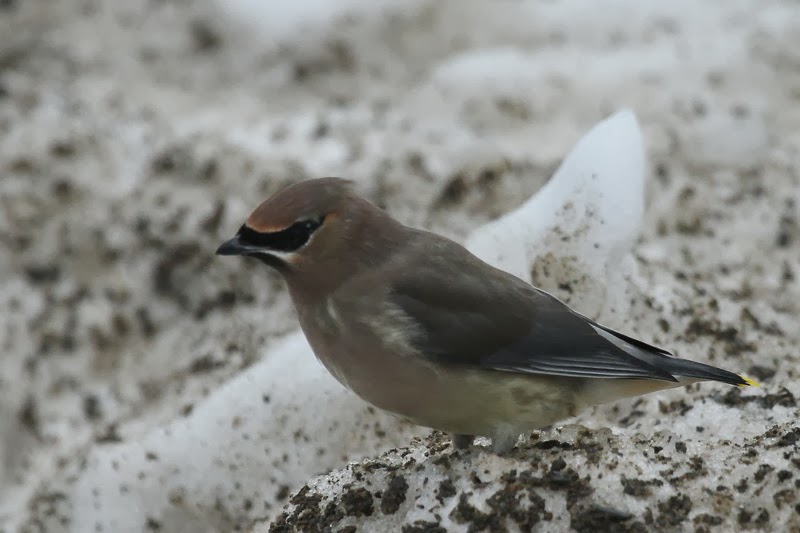
I took few photos during the CBC last Saturday, except for a flock of Cedar Waxwings. This youngster was "knee deep" in snow ...

Cedar Waxwing
I hope 2013 has been a good birding year for you!!

Sunday, December 22, 2013

Still Here! Brattleboro CBC

I'm still here, although for various reasons I have not posted for several weeks.

Yesterday we did the Brattleboro Area Christmas Bird Count in southeastern Vermont. Rain held off and we had a good count, with 56 species recorded.

Highlights included
 -- Barrow's Goldeneye among several hundred waterfowl coming in to roost above the Vernon Dam in the late afternoon (previous cw in '04 & '10)
-- Rough-legged Hawk seen near the fish hatchery along Connecticut River (last record '04)
-- count week Common Grackle  (last record cw '06)
-- count week White-crowned Sparrow (last records '90, '92)

The White-crowned Sparrow was at my feeders. I photographed it on December 14. It was seen everyday through December 20.

White-crowned Sparrow - South Newfane
Northern Cardinals have been common at my feeders this month. A resident pair plus a "flock" of 5 males and 4 females; I suspect these are yearling birds yet to pair and establish territory. Cardinals in Vermont are colonizers from the south. Old-time Vermonters often look askance at "flatlanders," but cardinals seem to be the exception ... and for good reason ...


The backyard feeders also host the "snowbirds" who come south to enjoy to temperate winters of Vermont (temperate? really) and the several residents like the chickadees ...

American Tree Sparrow
Black-capped Chickadee
Good birding!

LinkWithin

Related Posts with Thumbnails