This crummy photo is for documentation purposes ...
 |
| Fox Sparrow - 12/24, 4:10pm |
 |
| Fox Sparrow, 12/25, South Newfane |
 |
| White-crowned Sparrow, South Newfane, VT 12/22 |
 |
| Evening Grosbeak |
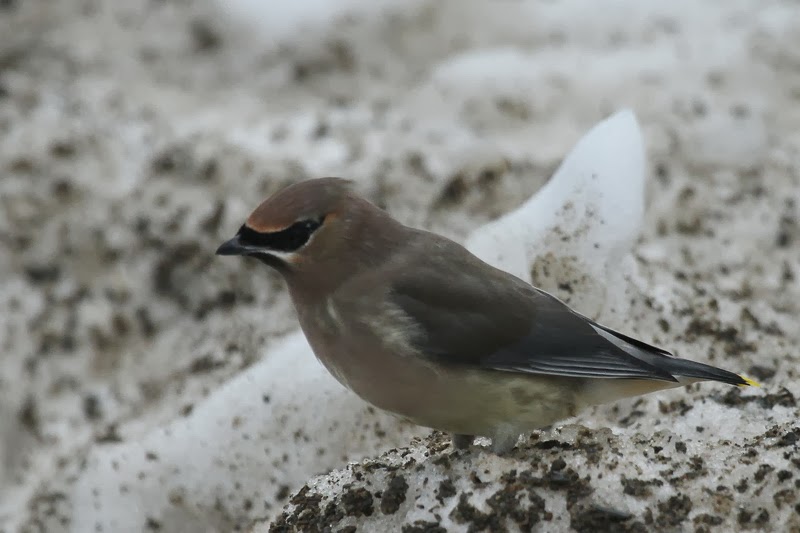 |
| Cedar Waxwing |

|
| Fox Sparrow - 12/24, 4:10pm |
|
| Fox Sparrow, 12/25, South Newfane |
|
| White-crowned Sparrow, South Newfane, VT 12/22 |
|
| Evening Grosbeak |
|
| Cedar Waxwing |
 |
| Fledgling Blue Jay begs for food |
 |
| Evening Grosbeak - juvenile |
 | ||
| "Hey Dad, is this where I get the food?" |
 |
| Mrs. Downy (the frazzled one in the back) feeds her daughter |
 |
| Mr. Downy feeds his son |
 |
| Hairy Woodpecker - juvenile male |
 |
| A "shy" Red-bellied Woodpecker - he/she would not look at the camera |
 |
| Fledgling Common Grackle - one of many! |
 |
| Cedar Waxwings |
 |
| Part of the mixed flock of Bohemian Waxwings and Cedar Waxings in my neighborhood |
 |
| Horned Lark |


 |
| Bald Eagle over Putney Mountain |
 |
| Cedar Waxwing |
 |
| Cedar Waxwing |
 The 110th Christmas Bird Count (CBC) got under way on December 14 and will continue through January 5. This is a massive citizen science project. Last year’s CBC involved almost 60,000 participants: 11,700 in Canada, 46,600 in the United States, 1700 in Latin America, the Caribbean, and the Pacific Islands. 9200 were stationary feeder watchers; the rest were in the field. The field counts are done in prescribed areas with a fifteen miles radius. In 2008 there were 2124 count circles which reported; a good number of counts were canceled due to the weather.
In the past, I have had some beef with some of the reporting on the Christmas counts in some birding circles, and in some birding publications, including the official publication of the CBC. There has been a tendency to place emphasize on the counts that get the highest number species or the biggest total of birds, as though the CBC was a contest that someone could win. For example, in a report from a couple of years ago, a count circle in Texas “regained its crown at the top of the species list at 235; last year’s champ [also in Texas] found some wonderful birds, but lost the top spot.” I have deliberately edited out the names, because there are no champs and no crowns in the CBC. It is not a sport and a contest, and there should be no implications in that direction. If the Texas birders want to have a strutting testosterone contest with one another and with areas in California, then they should do that at another time.
 The real champions of the CBC are the thousands of counters who go out in the field searching for birds when most sensible people are hunkered down by a warm fire sipping hot toddies. The champions of the CBC are the like counters in Vermont and New England. They are like the people who did the Springfield and Bellows Falls count circles. They are like the thirty people who did the Brattleboro area who set out on the coldest Saturday morning any of the veterans could remember for a count day ... when the temperature was two degrees above zero. Through the day it crept up to the low twenties, but the damp cold penetrated clothing in a way that the early morning cold did not.
Sorry Texans, but listing 200+ species on a Christmas Bird Count does not make you a champion. Doing a Christmas Bird Count in the grip of a Canadian, Northern Great Plains, or New England winter does make you a champion. Doing a count in the face of a Gulf Coast storm might also qualify a Texan, but not a mere long list of birds. I would suggest that finding a 150 or more species in California or Texas - the states where most of the highest counts occur - is no more of an accomplishment than finding 20+ species in the Yukon, 40+ species in North Dakota, or 50+ species in Vermont. In fact, in Texas or California it is probably easier to find 150 species than it is to find 20 in many northern count areas. In the Brattleboro area, we barely managed 50. In Randolph they began the day at minus12 degrees, ended it at 17 degrees, and tallied 34 birds. The Brattleboro team which did the Marlboro area found 14 species. A counter in Winhall listed 12 species on her route.
Simply put, the champs and heroes of the CBC are the volunteers who do the counts whatever the foul conditions may be as one year turns to the next, and regardless of how many wintering species there may be.
Collectively, the Christmas bird counts provide data on such subjects as numbers, migration, irruption patterns, range expansion (or contraction), accidentals, endangered or threatened species, long-term population trends, and much more. It is fodder for the analysts, statisticians, and macro-biologists.
The information garnered by any one count area needs to be examined in the context of other counts. But the individual counts, with caution, can give us a glimpse of local situations as well.
 For example, many people have asked me where all the birds are this winter, because they are not seeing them at their feeders. The Brattleboro area CBC gives a mixed report on common feeder birds. The number of Black-capped Chickadees was the lowest in the last ten years. The White-breasted Nuthatch also had a low count. On the other hand, Tufted Titmouse was about average, as was Mourning Dove. Downy and Hairy Woodpecker counts were up from the last two years, but within the expected range. Blue Jay had the highest count on record, as did Northern Cardinal. Dark-eyed Juncos were very common around feeders and in the woods and had the highest number in the last seven years.
The finch count was another matter. American Goldfinch numbers were low, and the winter finches are simply not here this year. Pine Siskins which irrupted last year were absent. Common Redpolls have been following a pattern of being here every other winter; this should have been their “on” year, but they were entirely absent. We counted only one Purple Finch. House Finches, which rely on feeders during the winter, were half of their recent numbers.
Pigeon and starling numbers were lower than usual; House Sparrow numbers were about average. These are the birds that everyone loves to hate, but they are an important food source for wintering hawks, and an indication of conditions (though don’t press me on what they are indicating).
Among the hawks, the Red-tailed was the most common; we counted sixteen, a record. Sharp-shinned, Cooper’s, and Northern Goshawk were also recorded. The first two often hunt around bird feeders. One of the highlights of the day for me was the sharpie which stooped on a bird feeder, having used a barn as cover for its attack.
 Nearly every winter I hear people express surprise when they see robins or bluebirds. These two thrushes are seen every month of the year, even in the midst of the most wintry of winter months. The robin has only been missed twice in the last twelve years; 25 were counted this year. The Eastern Bluebird has been counted every year for the last twelve years on the Brattleboro count; this year there were 33 in several small flocks. The flock of eight male bluebirds which we found along Black Mountain Road was one of the day’s highlights.
In the Brattleboro area, we recorded 50 species, including our first ever Green-winged Teal. That is a relatively low number for recent years. However, we were solidly into winter’s grip with very little open water on ponds or rivers. Understandably, waterfowl and gulls which favor open water were fewer in numbers and species. The CBC often records a bird that normally should have migrated but for some reason lingered; usually weather conditions are milder when we record such species. This year the “winter accidentals” were absent: no catbird, sapsucker, heron, towhee, grackle, or summer-nesting sparrow.
Like most count groups across the country, the Brattleboro area counters gathered for a potluck party in the evening. After plate fulls of good food, vinous libations, and warm companionship, most still had not chased the cold from the bitter day out-of-doors. Will they do it again next year? You bet! People like that - people who are just a little bit nuts - are the champions of the Christmas bird count.
Good birding!

A single flock of Cedar Waxwings was found on the Brattleboro CBC, but that flock numbered over 250 birds. They were feeding on fruit trees just off Route 5 near the C&S warehouse.
The Fall Equinox was this week. The “Farmer’s Almanac” tells me that today’s length is twelve hours and one minute. Starting tomorrow there is more night than day, and it only gets worse for the next three months as we head toward winter.
Long lines of geese cross the distant horizon. We hear their honking from somewhere overhead. Confusing fall warblers are heading to the tropics; the striking and colorful plumage differences that make these birds the envy of the world is now muted. The warblers all “look alike.”
The birds came north a few months ago because our temperate northern forests provide a protein cornucopia for raising young - insects, creepy crawlies, amphibians, reptiles, rodents and other small mammals compress their reproduction into a few intense months, producing so many offspring that birds come from thousands of miles to enjoy the bounty.
That protein bounty is about to go into hiding, or dormancy, and the birds are leaving.
 Most species are through with raising young for this year, but a few are still busy with the task. Late nesting American Goldfinches were in my backyard early this week feeding fledglings. On Putney Mountain one early morning last week, I watched a Cedar Waxwing feeding fledglings. For at least an hour, the young birds did not move from their perches in the scrubby oak tree; they waited for their parent to return with food, then fluttered wings and offered a gaping mouth. This was a late brood. Elsewhere around the opening on the ridge, young waxwings were practicing their flycatching skills. Except for the proximity of their parents, they were on their own.
 About a week ago I was surprised to see a very young cardinal on the ground around my feeders with his mother. He was a plain, dull tan-colored bird. He had only a trace of red wash in his feathers. His beak was black, not the orange red of the adults. Mother cardinal had led this young bird to a source of food where it could learn to forage. This may have been one of the first times he was expected to feed himself. He tried his begging posture, but without success. She ignored her fledgling’s pleas, and fed herself. She was beginning to replenish her fat reserves which she had expended in the arduous task of laying eggs and feeding young.
This very young cardinal was around the feeders for several days with one or both parents. Gradually he learned to feed himself, a picky picky eater. He still half hoped a parent would do the job for him. But the parents had shifted out of parental mode. Their hovering young might make it or might not. The adult cardinals knew that they would soon face the challenge of personal survival and that trumps all else.
Other young cardinals have been around the feeders for months. The ones that first appeared in late June or early July are molting into adult plumage. The males are beginning to acquire the red feathers that will make them such bright spots in the dull winter landscape.
 The Northern Cardinal is an abundant bird of our southern states. It has been expanding its range northward. In the 1920s, Forbush knew of a few year-round cardinals “as far north as the region about New York City.” In Vermont, a sighting was recorded at Wells River in 1933. It wasn’t until the 1960 Christmas Bird Count that the next sightings were recorded - three that winter. By the time of the first breeding bird atlas in Vermont (c.1980), the cardinal had expanded its breeding range along the river valleys.
The cardinal is not abundant in Vermont, although it is common. It is non-migratory. A pair tends to stay on or near its territory throughout the year, while younger birds may flock together. The pair bond relaxes during the early months of winter, then renews in late winter and early spring as the male and female sing together and feed together. The female is as accomplished a vocalist as the male, something that is rare in the bird world and which doubles the pleasure of their human audience.
 With her warm brown plumage splashed with red, the female cardinal is a beautiful bird. But her mate, sporting his brilliant red feathers and cocky red crest trumps any attention she may attract.
The male cardinal is a fierce defender of his territorial prerogatives. He will drive off any real or imagined rival with persistence, even when the intruding rival is his own image in a window. When we lived in Pennsylvania, for several summers we had a male cardinal who banged against the bedroom windows in an effort to drive off his reflection. This week someone told me about a male cardinal who attacked the side view mirror of their car; he saw another male cardinal in the car’s mirror, and was determined to drive it away.
The male cardinal also has a strong instinct to feed. He feeds his mate when she incubates and tirelessly feeds his own young. Male cardinals have been observed stuffing food down the throats of nestlings of other species. One male even fed goldfish in a backyard pool. I would suspect the sobriety of the reporter, except for the accompanying photograph (in “Song and Garden Birds,” by Wetmore, 1964.)
Cardinals raise two or three broods during a summer; four broods have been recorded. Multiple broods and warming climate are contributing factors to the range expansion of the cardinal. Bird feeders help as well, providing a food supply during the difficult winter months. I have yet to meet anyone who is not delighted to have cardinals at their feeders and often hear disappointment at their absence.
 Most songbirds are heading south. The ones who stay around may be noisy with calls and chattering, but their melodious songs are over for the year. Except for the cardinal. This redbird may sing any month of the year, as though practicing for the springtime serenades. If the young cardinal at my feeders learns to feed himself, then he will soon be able to start learning the songs of his parents - his melodious cardinal songs adding to the fall colors and brightening the crisp days of winter.
“In richness of plumage, elegance of motion, and strength of song, this species surpasses all its kindred in the United States.” So wrote John James Audubon, and who am I to argue with Audubon.
I saw the young cardinal again today - still in plain plumage, still with a black beak. He was busy feeding himself on my seed. He’s learning, and that Good Birding!
 But his "do" is still nothing to brag about, although I probably should not anthropomorphize, because yesterday I caught a flash of a Sharp-shinned going low through the back yard. So it is probably more appropriate to say that he is being on the look out.
 But this poor gentleman (or gentlelady) looks like it had a run in with a boot camp barber who only knows how to give a short buzz cut ...
 No other way to put it but ugly. However, this does show the relationship, physically, to the dinosaurs ...
 More families have been coming by. Mother Rose-breasted Grosbeak (left) was feeding the youngster all afternoon from the bounty and generosity of my feeders.
 Sitting on the back porch, I heard Cedar Waxwings in the trees overhead. Then one flew into a nearby maple, showing the red tip of its tail. But not an adult - note the brown streaking. And of course, that open beak and begging posture! Tough being a parent.
 And finally, a Black-capped Chickadee ... just because I love these little guys, and they stay around all winter ...
 In the evening we kayaked Sunset Lake and I have more pictures of the loon. I am still going through them, but you'll want to come back tomorrow for the loon pics (or at least, I hope you'll want to come back).
 Cedar Waxwings flocks seem everywhere. Most are still a few weeks from nesting.
 Red-eyed Vireos are lactive into their breeding season. Males sing in between their nesting responsibilities and occasionally one even has allowed me a brief glimpse.
 Some American Robin pairs are close to fledging their first brood. I have no idea if this one was building a first or second nest for the season, but was certainly busy in construction. The bird made regular trips to the muddy edge of Herrick's Cove, returning with big loads of building materials. Nest was somewhere in a dense tangle of brush roses.
 After a couple of days of rain, I returned to where I had seen the Blue-headed Vireos in the early stages of nest building. There was no sign of the pair, but the nest appears ready for occupancy, and perhaps deep in the nest, incubation is proceeding. The bottom of the nest is comprised of wood chips and wood shavings. A couple hundred yards away I saw an old tree which had been heavily worked by Pileated Woodpecker, perhaps excavating a nest hole. A Blue-headed Vireo was carrying wood chips. They were singing in many places along the old road, so I can't claim it was "my" pair. Clearly the nest building activity of one species was assisting the nest building activity of another species.
 American Crows are nesting down river from my home. Evidence suggests a pair and a helper, since 3 are often around the feeders. This one is "carrying" food - note the bulge in its crop. I have seen the crop much larger. They are very wary birds able to sense when someone is inside watching them. It is difficult to get close to the window for a photo without having them fly off.
 The Eastern Phoebes at Herrick's Cove fledged their first brood at least a week ago. The youngster is here waiting for another meal, but occasionally tried some things on his own.
 I have been astounded at how much suet is being consumed by the birds. At least two pair of Downy Woodpeckers, one pair of Hairy, and two pair of starlings seem to be relying on the suet for feeding their nestlings. Plus a wide assortment of other birds are also using the suet. The suet gets taken in at night. In the morning the woodpeckers are lined up on the tree waiting for us to bring it out.
 Fledgling Downy Woodpeckers were at the suet this morning. At one time, there were five Downies, from two families - all female. The youngster is clinging to the post; its understanding of life is that someone will feed. Well, for a while someone will.
 Good Birding!

