|
Rock Pigeon nesting in Elliott St retaining wall -
a non-native bird that adapts to urban habitat |
I enjoy standing on the top deck of the parking garage in Brattleboro and watching the pigeons swirl over the downtown buildings. They are masters of urban adaptation and they thrive in the barren habitats of cities and towns. As I walk down the stairs to Flat Street, I pause to watch their activity in the rock retaining wall beneath Elliott Street. Like the ancient cliffs that gave them their name, Rock Pigeon, they build their simple nests in the wall and raise brood after brood.
On Main Street, nondescript brown birds pick crumbs dropped by diners from beneath sidewalk tables. House Sparrows are the second species that has adapted and manages to make its living in the barren habitat of downtown streets.
 |
Northern Flicker - a species favored by milliners
for adorning feathered hats |
By contrast, if I want to see a native species such as the Cedar Waxwing, I will not look for it at Main and Elliott. I’ll go up to the neighborhoods and look for fruit trees, or further out to the orchards, or wherever berries hang heavy on bushes. If I want to see Northern Flickers, I go south of downtown along the Connecticut River in the Spring or Fall when they are migrating along the river and feeding in the mature forest near the banks. A downtown street in any town anywhere is not the place to look for waxwings or flickers or any other perching bird.
But there was a time when a skilled observer could identify many such birds in the barren urban habitats of our cities. Frank M. Chapman was such an observer. He was an ornithologist and curator of the bird collections at the American Museum of Natural History in New York City. He developed the innovative exhibits which displayed birds in their natural habitats.
 |
Feather adorned hat on display at
John James Audubon Center at Millgrove, Pennsylvania |
In the late 1880s, Chapman left his museum office and took two bird walks along the streets of Manhattan. He identified 40 species of native birds. (Note that the House Sparrow and pigeon are not native species.) His list included sparrows, warblers, and woodpeckers. The flicker and waxwing were among the most abundant. But none of the birds identified by Chapman were flitting through trees, picking crumbs off of sidewalks, or swirling through the air. They had been “plucked, disassembled, or stuffed, and painstakingly positioned on three-quarters of the 700 women’s hats Chapman saw.” (“A Birder’s Handbook”)
The feather trade was thriving, and birds were dying to provide high fashion ladies with elaborate evidence of their taste and prosperity. Women’s hats became larger and ornamentation more lavish. The feather trade exploded. 64 species of native birds were hunted, and exploited, for their feathers.
 |
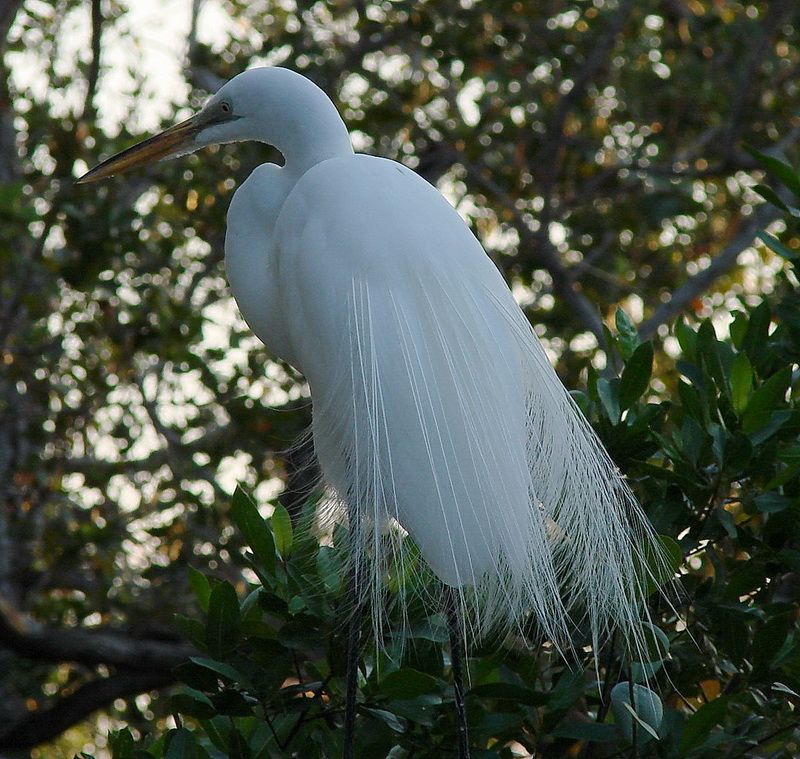
Great Egret - demand for the breeding plumes
nearly led its extinction |
The Great Egret and Snowy Egret were favored. At the beginning of the breeding season, both species sport extravagant plumage as sexual advertisements. But they were not given the opportunity to attract mates. They were shot so that their plumage could adorn the hats of Victorian women, a few of whom may even have defied the prudish conventions of the time and used those plumes as part of their own elaborate sexual attractions. Egret populations plummeted.
Herbert Job, an ornithologist and pioneer wildlife photographer, wrote about the feather trade: “Here are some official figures of the trade from one source alone, of auctions at the London Commercial Sales Rooms during 1902. There were sold 1,608 packages of ... herons’ plumes. A package is said to average in weight 30 ounces. This makes a total of 48,240 ounces. As it requires about four birds to make an ounce of plumes, these sales meant 192,960 herons killed at their nests, and from two to three times that number of young or eggs destroyed. Is it, then, any wonder that these species are on the verge of extinction?”
In 1903, feathers sold for $32 per ounce, twice the price for an ounce of gold. The millinery trade employed 83,000 people (1 of every 1000 Americans) in 1900.
 |
Herons, such at the Great Blue, were sought after
by the millinery industry |
The Audubon Societies were born in response to the carnage of the feather trade. Its symbol was, and still is, the Great Egret. In 1901 the Brattleboro Bird Club reorganized as the Vermont Audubon Society. Audubon Societies and preservationists began a decades-long push for the enactment of laws. Public awareness was raised through lectures on topics such as “Woman as a bird enemy.”
Gradually the “Age of Extermination” came to an end. Dwindling supplies caused prices to soar. Fashion evolved new directions. Women’s life styles changed. And governments acted. In 1916 the United States and Great Britain (on behalf of Canada) signed the Migratory Bird Treaty and in 1918 Congress enacted the treaty into law. The Act established Federal responsibilities for the protection of nearly all species of birds, their eggs and nests.
The Migratory Bird Treaty Act (MBTA) made it illegal for people to "take" migratory birds, their eggs, feathers or nests. “Take is defined in the MBTA to include by any means or in any manner, any attempt at hunting, pursuing, wounding, killing, possessing or transporting any migratory bird, nest, egg, or part thereof ... In total, 836 bird species are protected by the MBTA, 58 of which are currently legally hunted as game birds. A migratory bird is any species or family of birds that live, reproduce or migrate within or across international borders at some point during their annual life cycle.” (www.fws.gov)
 |
| Blue Jay feathers are silent evidence of a hawk kill |
Recently I received an email from a reader of my blog remarking about how lucky I was to find some blue jay feathers. The emailer wrote: “I live in Holland, and am not so lucky to find these beauty's around. Is there any way you could send some to me?”
He had seen photographs I had posted of the feather remains of a Blue Jay which had been taken by a hawk in my backyard. I replied that I photograph the feathers, sometimes study or examine them, but do not keep them. I could not send feathers to Holland because I do not have any and because it is illegal under the MBTA to possess or transport feathers.
Feather collecting, and the companion hobby, egg collecting (known as oology) are illegal in the United States, Canada, United Kingdom and many other jurisdictions. Underground and illegal collecting continues.
The MBTA allows special permits for protected nongame species that become local pests (e.g., giant flocks of winter roosting blackbirds). No other birds, except those for which there are designated hunting seasons, can be legally killed, trapped, harassed, or possessed (including birds found dead). Even “adoption” of young birds that appear to have been deserted by their parents is illegal without a permit.
 |
Feather adorned hat on display at
John James Audubon Center at Millgrove, Pennsylvania |
Fortunately, we can no longer see flickers and waxwings on the fashionable hats of fashionable women walking the sidewalks of downtown Brattleboro or any other downtown. The only birds commonly seen in the most barren urban habitats are pigeons and House Sparrows.
Even more fortunately, we can see the flickers, waxwings, and dozens of other species in our backyards, fields, orchards, ponds, and forests. They are protected. Watch them and enjoy them.
Good Birding!