Sunday, January 09, 2011

LBJs - Who Am I? - Exercise #10

I hope these Little Brown Job exercises are not getting old, or repetitive. With all of the modern techniques for learning, my technique is still old fashioned rote learning - do it over and over.

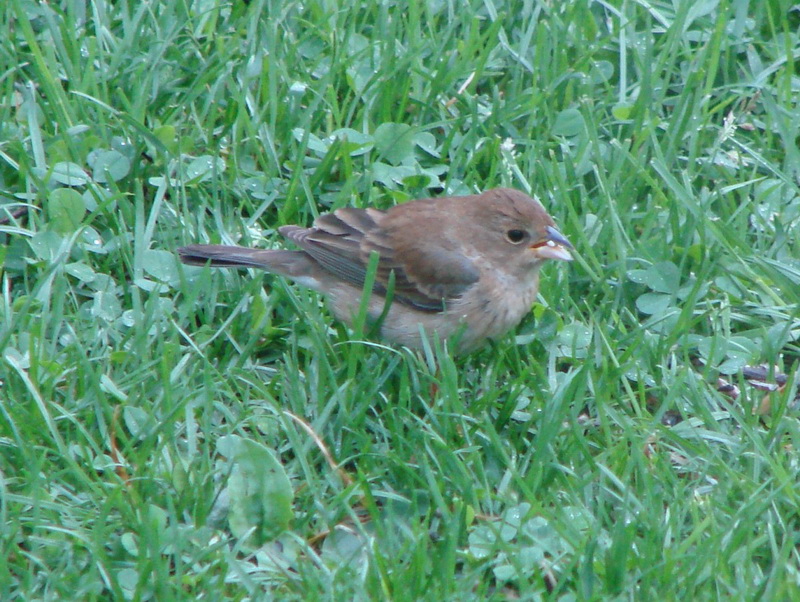
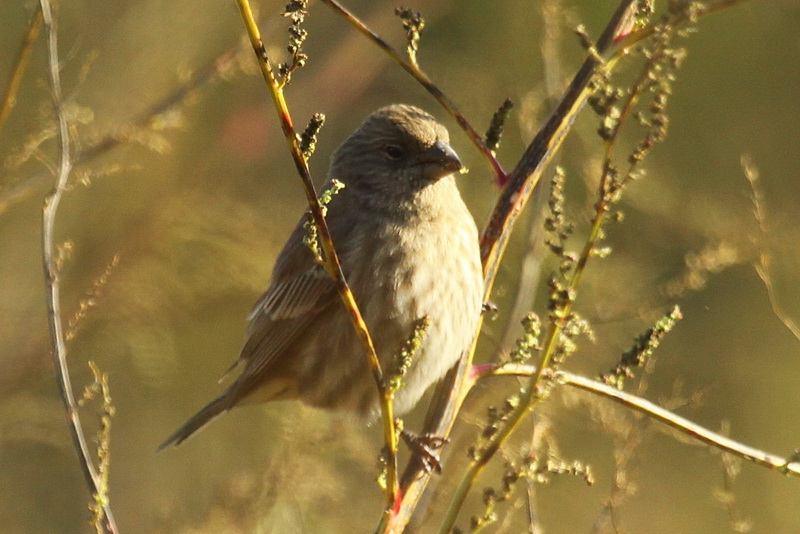
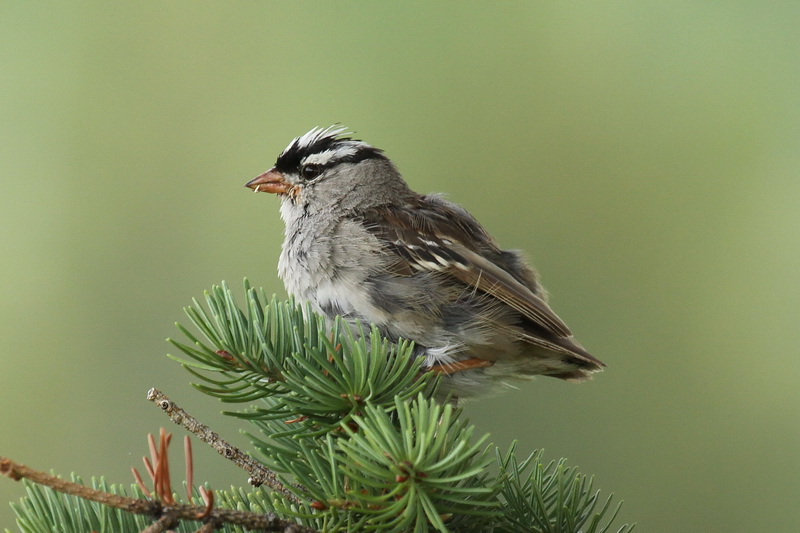
LBJ #46
LBJ #47
LBJ #48
LBJ #49
LBJ #50

IDs for 9 & 10 will be posted Tuesday.

Good Birding!

Saturday, January 08, 2011

Winter Finches - Common Redpoll


“What a rich contrast! tropical colors, crimson breasts, on cold white snow! Such etherealness, such delicacy in the forms, such ripeness in the colors, in this stern and barren season!”
-- Henry David Thoreau, Concord, Massachusetts, December, 1855


On the morning of the blizzard, I was doing some work in my study while the rest of the family was slowly stirring into activity. My grandson came up the steps and said, “Grandad, you should see all the birds at the bird feeders.”

“Ohhh, you’ve got to show me,” and I followed him down the steps.

In the kitchen, he stepped slowly. “Don’t scare them,” he warned.

The platform feeder was covered with small, brown streaked birds, and my first thought as I looked from mid-kitchen through the window was that the Pine Siskins had returned. As I crept closer to the window with my young guide, the connection between eyes and brain started to wake up. Some of the fifteen small birds crowded on the platform were facing me, and they had reddish wash on the breast, a tiny black chin, and a red crown.

“The redpolls are here!” I announced quietly.


I had been expecting them - or to be a little less arrogant - I was expectantly hopeful that redpolls would visit the feeders this year. I did not see a single redpoll all of last winter, and the last time I had significant numbers was during the winter of 07-08. But this year redpolls had been reported for a couple of weeks, the reports gradually moving from northern Vermont toward southern Vermont. My expectations were high.

The “Winter Finch Forecast” stoked the expectations: “Redpolls should irrupt into southern Canada and the northern United States this winter. The Common Redpoll's breeding range in Ontario is mainly in the Hudson Bay Lowlands from the Manitoba border southeast to southern James Bay. Redpolls in winter are a bird seed specialist and movements are linked in part to the size of the birch crop. The white birch crop is poor across much of northern Canada. Another indicator of an upcoming irruption was a good redpoll breeding season in 2010 with double and possibly triple broods reported in Quebec. Samuel Denault of McGill University has shown that redpoll movements at Tadoussac, Quebec, are more related to reproductive success than to tree seed crops in the boreal forest. Redpolls will be attracted to the good birch seed crops on native white birch and European white birch in southern Ontario and to weedy fields. They should be frequent this winter at feeders offering nyger and black oil sunflower seeds.” (Ron Pittaway)

The Common Redpolls crowded the platform outside the kitchen window. They filled the perches on the sunflower feeder hanging from the eave. They scratched the snow beneath the hanging feeder and around the bulk feeder, and they milled on the porch where I had scattered seed. Counting a restless, ever moving flock is difficult, but over the next couple of hours I became confident that the redpoll flock was a conservative fifty-plus.

The redpolls shared the feeding grounds with Evening Grosbeaks. In the week prior to the blizzard, my physical count of the grosbeaks rose to 64. On the day of the blizzard, the grosbeak flock was significantly larger, conservatively in excess of 100.

Common Redpolls are closely related to siskins and goldfinches Their Genus is “Carduelis,” deriving from the Latin for thistle, a favorite food of these birds. The “poll” of the redpoll comes from Middle English “pol” meaning head, as in taking a poll or “counting heads.” Hence redpoll means “red head.” As you may guess, redpolls are circumpolar and were known by the British long before the British found their way across the pond. John James Audubon called this bird the Mealy Redpoll Linnet, but could discern to difference between it and the Common Redpoll which he met in northern Europe.

Forbush wrote of the redpoll, “This little wanderer drifts into the most northerly of the United States every winter in considerable numbers, but rather irregularly as far south as the latitude of New York City ... They come with the snowflakes out of the dun sky of November and leave as spring approaches. They are such hardy, boreal birds that probably they leave the northern wilderness in great numbers only when driven south by lack of food.”

There was no lack of food in my feeders during the late December blizzard.

As the blizzard swirled snow outside my window, I was warm and cosy on the inside. One of the delights of living in rural Vermont is being able to take winter in stride, accepting it as a normal part of living with changing seasons. Before the storm arrived, many neighbors canceled plans and headed toward the frozen ponds for a last bit of ice skating while the ice was still snow free. And as the storm ebbed, they canceled work; fresh deep powder is a time for snow shoes, cross country skis, sleds and saucers. I feel sorry for the people crowded in the cities who view a winter storm as a massive inconvenience that interferes with their plans. They yell at politicians for not making it go away immediately. Where I live snow is an opportunity, not a problem. I took the opportunity to watch the redpolls that came with the snow.

Arthur Cleveland Bent began his “Life History” of the Common Redpoll with the context in which they are often seen: “When the cold air masses of winter extend their fronts into our northern tier of states, a period of welcome surcease from the storminess of the seasonal transitions descend upon regions within their influence. During this month or more of calm the days scintillate and begin to lengthen, and the dwellers of the northland, human as well as wild, come out of hiding to enjoy the sun and the cold, dry air. These are among the most beautiful days in the northland; the temperature hovers between -10 and -20 F; there is no wind, and a great silence lies upon the winter barrens. From the distant spruces that dot the valley slopes like stubble come ... the occasional rattle of redpolls, sounds so faint that you must hear them repeated to feel sure that the sound is not coming from your own lungs.

“... To those who have not visited the northland, the redpolls remain erratic winter visitors; they rarely go south of the 40th parallel. They are rare in many years, but are sometimes abundant, often occurring then in large flocks, the members of which may be alternately wild and delightfully tame.”

Of all the winter finches, the redpoll is my favorite. Good birding!

Friday, January 07, 2011

Redpoll Invasion

As today's snow storm slowly got underway, the redpolls invaded my yard in numbers that left me breathless. The moments of repose for the birds were few as they fed with a frenzy.


At one point, my spouse offered her estimate: 200-300 redpolls. I did not disagree, but needed some more tangible means for reporting such a number. It came with this following picture. The photo will win no awards, but the physical count yielded 105 birds. This does not include the many birds hidden beneath the edge of the porch and around the edge of the barn. Nor does it include at least as many birds feeding beneath the bulk feeder, nor those picking seeds from beneath the kitchen window, or crowding the perches on the thistle feeders, or perching in the trees, or continuing to fly in. To say 100s of redpolls is not unreasonable, although to keep it conservative I will confine the count to the 200-300 which she proposed.


The birds were continually moving, frequently bursting with so many wings that "roar" is appropriate.


Though there was no shortage of food, they vied for perches and contended with one another.


With each "spook," they just as quickly returned. Even my presence on the back porch did not keep them from returning and feeding at my feet. From time to time there were even moments that I could call "pensive."


With such a rich display, one should be satisfied, and I was - but I was also hopeful that a Hoary Redpoll might be somewhere in the flock. It would be a lifer. But today was not the day. Someday.

Good birding.

Thursday, January 06, 2011

LBJs - Who Am I? - Exercise #9

Little Brown Jobs (LBJs) are mostly sparrows. But by no means are they always sparrows, as this exercise will remind us.

LBJ #41
LBJ #42
LBJ #43
LBJ #$$
LBJ #45

Exercise #10 will be posted on Sunday. IDs will come on Tuesday.

Good birding!

Tuesday, January 04, 2011

LBJs - IDs for #7 & 8

#31 - American Tree Sparrow
 #32 - Field Sparrow
 #33 - Fox Sparrow
 #34 - Purple Finch, female
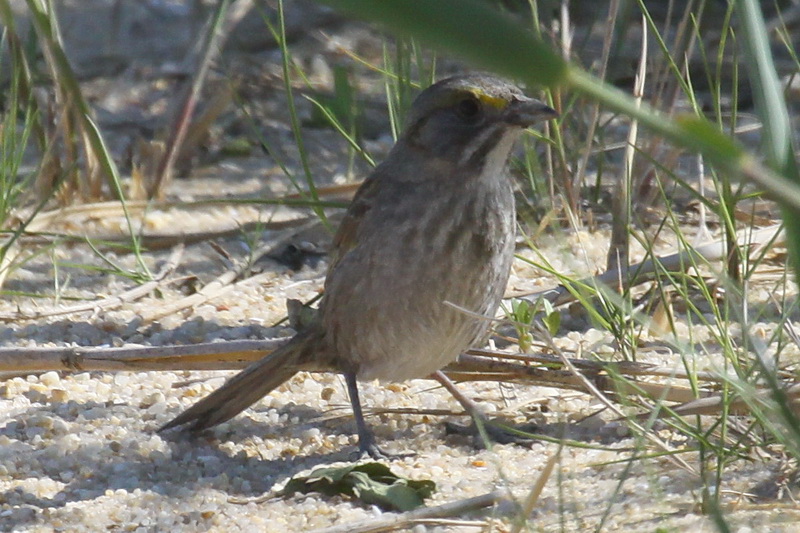
#35 - Seaside Sparrow -a large and awkwardly shaped sparrow found in the coastal salt marshes. Habitat is one of the best "field marks." Drab, with just a hint of yellowish lores. Big bill and a tail that looks like it has been clipped off with scissors, if you manage to get any kind of a look at it.
#36 - White-crowned Sparrow - an adult in molt. Note the absence of a tail.
#37 -White-throated Sparrow (oops - I did not catch the typo until after this was posted, but this is truly a White-throated, not a White-Crowned)
#38 - Seaside Sparrow - singing male, if you can call his buzzy hissing a song.
#39 -White-crowned Sparrow, juvenile
#40 - Lincoln's Sparrow

Sunday, January 02, 2011

LBJs - Who Am I? - Exercise #8

Little Brown Jobs - continuing the exercises in identifying these often confusing birds.

LBJ #36
LBJ #37
LBJ #38
LBJ #39
LBJ #40
Good birding!

Saturday, January 01, 2011

Weather or Not

Last week I finished my column with a brief weather report on the day we counted. Then I began to wonder how I had recapped the weather for previous Christmas counts. I went back through the last ten years of participating in, and writing about the Christmas Bird Count which we do in the Brattleboro area on the third Saturday in December. Here are the weather recaps which I wrote for the last ten years beginning with this year.

2010 - Unlike so many years, it was a delightful winter day, with brilliant blue skies,  pleasant winter temperatures, only a dusting of snow, and only a few icy spots when walking. It made for a day of good birding.

2009 - The thirty people who did the Brattleboro area set out on the coldest Saturday morning any of the veterans could remember for a count day. The temperature was two degrees above zero. Through the day it crept up to the low twenties, but the damp cold penetrated clothing in a way that the early morning cold did not.

2008 - I stayed put during last week’s ice storm. Except for bringing in wood, I did not go out of the house. The lights flickered several times. I had to reset my clocks, but that is hardly unusual. I was insulated from the nasty weather in more ways than one.

me the Christmas count, and I began to realize the storm’s impact on our region. In the Brattleboro area, the 15 mile diameter count circle is divided into seven regions, each with a count team. Two of those teams begin the day at my home. On the count morning, nine people gathered from seven homes. Only two had electricity.

In the evening when we gathered in a Brattleboro home for the compilation pot luck, I learned even more about the impact. A week before the count, about forty people were planning to participate. Twenty-seven went out. The majority had storm impact with which they were dealing.

By now we know how severe last week’s ice storm was. At the evening pot luck, we were still relying on civilization’s oldest medium of mass communication - word of mouth. But the personal stories were not the main topic of conversation. The main topic of conversation was birds.


2007 - There was more snow on the ground than I can remember in the years I have done the Brattleboro Area Christmas Bird Count (CBC). And it was colder than previous years. And when the wind blew, it was colder yet. By mid-afternoon, the clouds began moving in; the air became dank and damp and felt even colder. My heavy insulated boots kept my feet warm, but everything became chilled.

Tiny birds moving through tree tops are located by ear, not eye, and that means exposing tender, delicate flesh to the frigid air. We could sort of warm up in the car as we crept slowly from place to place, except that the windows had to be down so we could listen as we crept along, and the fan motor on the heater had to be low or off because it made too much noise. The rivers and ponds were frozen. The fields were barren and cold. There were icy patches on many roads, and no place to pull off the road when we had to stop, walk, listen, count, freeze and shiver.

I had a blast!


2006 - Weather conditions were unseasonably mild and pleasant. Mostly sunny skies, light winds, and moderate temperatures made it seem like New Jersey in December, not Vermont. Rivers and ponds were completely open.


2005 - Weather conditions were wintery; the foot of snow cover was the most we’ve had in many years. Temperatures occasionally flirted with “December balmy,” then quickly returned to wind-chill cold.  Rivers and ponds were almost entirely frozen.

To most veterans of the field count, it was a difficult day - one in which they had to search for species and where counting was not difficult because there seemed to be few birds to count.

2004 - Weather condition were marvelous with clear blue skies and cold but not bitter temperatures. With almost no snow cover and with rivers not yet frozen over, conditions were ideal. Conditions were so ideal that the day produced record numbers for the Brattleboro area. Some of the regular participants in the field count have often slogged through horrible weather to find few birds; this year at the end of the day they were satisfied  with a day of very good winter birding - 58 species had been observed with a total bird count of 4,307 birds.


2003 - While the weather was cold and the wind brisk, the conditions generally were the best in several years. Skies were clear, the sun was bright, and the roads were clear. Thin ice in a few places prevented some exploration, and snow cover kept the number of miles walked on the low side. Veteran participants were enthusiastic about the good conditions.

On the other hand, the number of species reported, 42, was the lowest in over a decade, and in recent years, only 1999 counted fewer birds. The low number of species is probably due to winter getting an early grip. In previous years the Count has had such fair weather species as Great Blue Heron, Wood Duck, Ruby-crowned Kinglet, Chipping Sparrow, robin, cowbird, and towhee. No such fair weather species were reported this year. Either they have all gone south, or the individuals which lingered were done in by the weather.

2002 - These CBC results were obtained on a day with unfavorable weather conditions for the birds and the counters. In fact, veteran counters can remember few less favorable days. Roads were often slush covered and icy. Fog and mixed precipitation (mostly cold drizzle) reduced visibility, misted binoculars, and confined many birds to their roosting places. Nearly every team had to “work hard” to find birds, with usual hot spots being often disappointing their expectations.

2001 - The day was not without its frustrations for the field counters. The lack of snow cover, and winds which increased throughout the day, probably contributed to the birds being more widely scattered than usual, and hence harder to find. Nearly every team reported long stretches in which no birds were seen or heard. There were “hot spots,” but it required patient searching to find them.


In summary - the Brattleboro area, hundreds of places throughout North America, and many places around the world, do the Christmas Bird Count between December 14 and January 5. Some places have favorable weather. In southeastern Vermont, some years the weather is favorable. But the count is done, weather or not.

Good birding!

Thursday, December 30, 2010

LBJs - Who Am I? - Exercise #7

Little Brown Jobs gradually become less mysterious and confusing as one becomes more familiar. Then a new one appears. The possibilities are narrowed with the familiar ones eliminated. Habitat may give clues, as may range. Size and shape are examined. Finally a new bird is identified
.
LBJ #31
LBJ #32
LBJ #33
LBJ #34
LBJ #35
Good birding!

Tuesday, December 28, 2010

Portraits during a Blizzard

Individual portraits of a few feeder birds which visited during Monday's blizzard.

Common Redpoll
Evening Grosbeak
Blue Jay
Northern Cardinal
Red-breasted Nuthatch
Good Birding!

LinkWithin

Related Posts with Thumbnails